
📚 Quick index
Everything you need to know about camper van and RV electrical systems, explained from my own installation: how to size the battery, set up the solar system, pick the right inverter, and diagnose the most common faults. No manual-style theory — just what’s actually worked for me on my Ford Transit and my ’82 motorhome.
A guide organized by topic. Use the index below to jump straight to what you need.
“Want to see the real story behind these numbers? Go to the homepage — that’s where I explain who’s actually measuring all of this, and on which vehicles.”
— Gustavo, read the full story on the homepage →
If you want to see how all of this comes together in a real installation, here’s the full wiring diagram (ES) of my motorhome, with the battery and every fuse sized out.
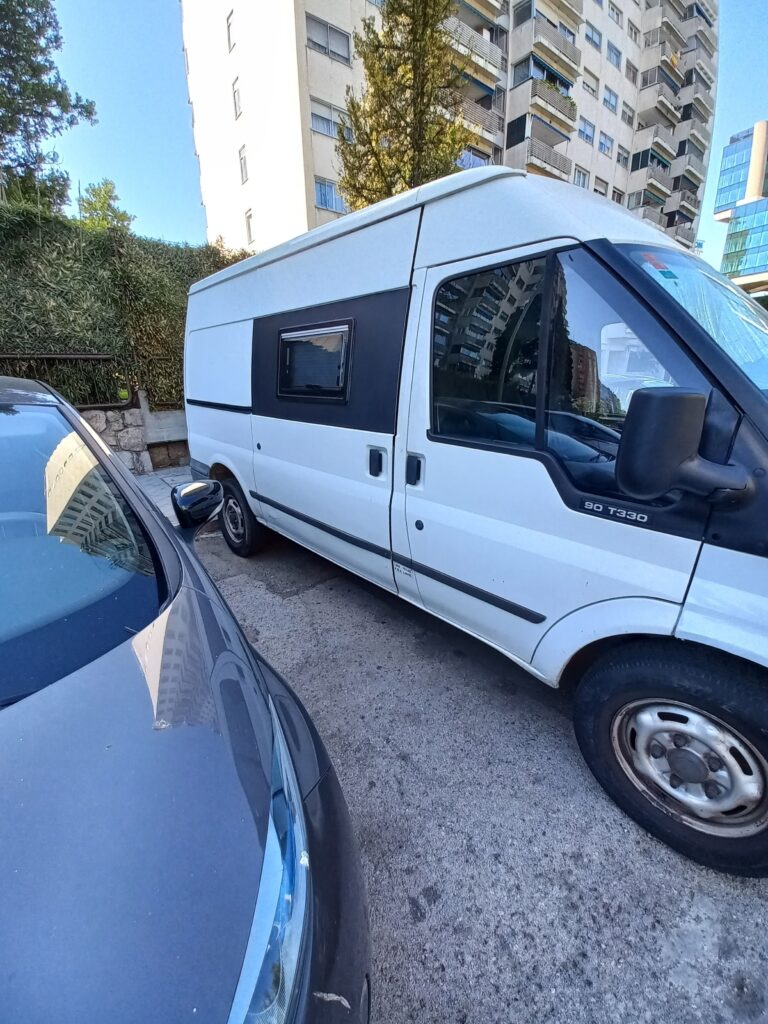
This was my first conversion — a 2005 Ford Transit I built out myself back in 2018. It’s where I learned camper electrics the hard way, through trial and error.
Later I traded that van for this 1982 Ford Transit motorhome — the vehicle behind most of the real-world numbers and tests you’ll find across this guide today

Real experience behind this guide
I’m a trained electrician, and I converted my own van back in 2018. Years later, a workplace accident changed my life, and that van ended up becoming my home. Since then I’ve been sharing faults, installs, and solutions I’ve actually tested in real conditions.
Over the years I’ve modified and upgraded several electrical installations, solar systems, auxiliary batteries, inverters, and real-world consumption setups — both in camper vans and in a classic 1982 Ford Transit.
In this guide you’ll find everything organized by category, so you can jump straight to whatever you’re dealing with: electrics, batteries, solar panels, energy consumption, wiring, inverters, and fault diagnosis.
All of it is based on hands-on experience, real testing, and solutions I’ve personally used on my own vehicles.
What you’ll find in this camper van electrics guide
If there’s one part of a camper van or motorhome that matters most, it’s the electrical system.
That’s why I’ve split this whole section into more specific parts, so it’s easier to find what you need depending on where you’re at: batteries, solar panels, power consumption, inverters, wiring, or common faults.
Electrics have been part of my life since I was young — I trained in electrical installation. That background helped a lot when it came time to modify and adapt both my first camper van and, later, my motorhome.
In camper vehicles, most of the installation revolves around 12V systems, which behave very differently from a standard 230V/120V household setup. That’s exactly why it matters to understand things like voltage drop, wire sizing, auxiliary batteries, fuses, and solar power.
Throughout these guides I share both the technical knowledge and the experience gained from building, modifying, and actually using different real installations — explaining not just what works, but the mistakes I made and the fixes that gave me the best results over time.
If you’re setting up a camper van or motorhome electrical system, you’ll find every guide here organized by topic: batteries, solar panels, consumption, wiring, inverters, and fault diagnosis.
Whether you’re starting from scratch or expanding an existing setup, use the index to jump straight to what you need.
Batteries
- AGM vs lithium: what the difference looks like in use
- How many amp-hours do I need
- How to Wire an Auxiliary Battery in a Camper Van
- Why the camper battery drains itself overnight
- Why the battery isn’t charging from the alternator
The battery is the heart of any camper van electrical system. In this section you’ll find everything from choosing between AGM and lithium, to sizing the capacity you need, wiring an auxiliary battery, and diagnosing the most common faults.
Solar power
- MPPT vs PWM: which charge controller to choose
- Solar charge controller not showing charge: how to diagnose it
- How long it takes to charge a camper battery with solar
Solar panels are your main charging source while you’re parked. In this section you’ll find everything from planning a solar install from scratch, to picking between an MPPT or PWM controller, and diagnosing why the panels aren’t charging correctly.
Consumption and autonomy
- How much power a 12V camper fridge actually uses
- Diesel Heater Power Consumption: The Startup Is Not One Spike
- Can you run air conditioning off a battery? The real numbers
- Your Power Calculations Are Wrong. Here’s by How Much
Knowing how much power you actually use is the foundation of any correctly sized installation. Without that number, you can’t properly choose the battery, the panels, or the wiring. Here you’ll find how to calculate real consumption step by step, how much a 12V fridge draws, and how to stretch your autonomy so you don’t run out of power.
Inverters
- Inverter sizing calculator — including startup surge
- Why your inverter keeps shutting off — seven causes
The inverter is what turns the battery’s 12V into 230V so you can run standard appliances. Picking one that’s the wrong size is one of the most common camper mistakes. Here you’ll find how to calculate the power you actually need and how to wire it into the system correctly.
Wiring and fuses
- Wire gauge calculator for 12V systems (AWG)
- Where to place fuses in a 12V camper system
- What fuse size between battery and inverter
- What wire gauge to use for a camper inverter (1000W, 1500W, 2000W)
- Reverse polarity: risks and how to fix it
- Why does the fuse keep blowing
- Undersized wire: the symptoms and a ten-minute test
Wiring is the most overlooked part of a camper installation, and the one that causes the most problems when it’s done wrong. Wire that’s too thin causes voltage drop, overheating, and faults. In this section you’ll find how to calculate the correct gauge for your consumption and cable run, where to place fuses, and how to avoid the most common mistakes.
Want to see what all of this actually costs on a real project? In converting an old Ford Transit (ES) I break down the €7,000 I spent, how much went into the electrical side, and what I bought that I wouldn’t buy again.
Electrical faults
- Common camper electrical faults
- How to tell if there’s a parasitic draw
- How to tell if the battery is damaged
- Solar panel not charging? Find the fault in five measurements
- RV water pump not working? Nine times out of ten it’s air, not the pump.
- Has your camper been sitting for months? 12 checks before you travel again
Camper electrical faults usually have specific causes and a direct fix, if you know where to look. In this section you’ll find how to spot a parasitic draw, why the battery drains itself, what to do when the solar panel isn’t charging, and how to diagnose the most common electrical problems in a 12V system.