
I noticed something was wrong with my AGM battery when it seemed to charge normally during the day but lost voltage fast once the sun went down. The voltage dropped much faster than before during nighttime use or under load — a sign of reduced capacity, not outright failure.
“I killed a perfectly good AGM running a 230 V fan overnight through an inverter. That’s the kind of mistake this site is built to save you from.”
Quick test to check your battery’s condition
- Charge the battery fully
- Let it rest without heavy consumption
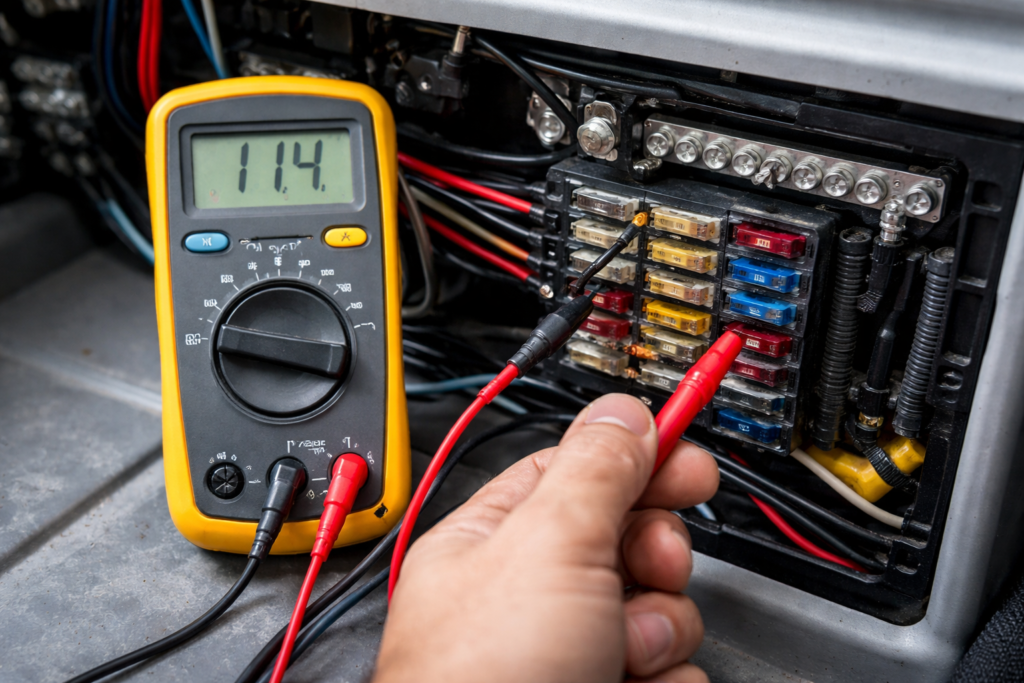
- Measure the voltage with a multimeter
- Connect a known load for a few minutes
- Watch how fast the voltage drops
- A fast drop toward 12.2V points to lost capacity
Voltage reference table (at rest)
| Resting voltage | Approx. state | Practical reading |
|---|---|---|
| 12.8–12.9V | 100% | Fully charged |
| 12.6–12.7V | 80–90% | Good condition |
| 12.4–12.5V | 60–70% | Half charged |
| 12.2–12.3V | 40–50% | Low charge |
| 12.0–12.1V | 20–30% | Very low |
| Below 12.0V | Deep discharge | A problem if it keeps happening |
Healthy vs. deteriorated battery
| Condition | Healthy battery | Deteriorated battery |
|---|---|---|
| After a full charge | Voltage stable | Voltage drops quickly |
| Overnight | Slow, gradual decline | Noticeable drop within hours |
| Under load | Minimal voltage drop | Voltage drops easily |
| Autonomy | Matches original spec | Much worse than before |
| Inverter behavior | Normal operation | Shuts off prematurely |
⚠️ Physical warning signs — check these before you touch a multimeter
Not every failing battery announces itself through voltage readings first. Some signs mean stop and replace, not diagnose further:
- Cracks, splits, or a swollen/bulging case — the battery is physically failing and could leak or, in rare cases, catch fire. Don’t attempt to repair a battery in this state.
- Corrosion on the terminals (white, blue, or green crusty deposits) — points to leaking or a slow chemical failure, not just a dirty connection.
- A rotten-egg smell or an audible hissing/bubbling sound — this means gas is building up inside. Ventilate the area, disconnect the charger, and don’t keep charging it while you investigate.
None of this is diagnosed with a multimeter — it’s a visual and physical check, and it takes priority over everything below. If you see any of this, replace the battery; don’t try to nurse it along.
Symptom 1: Dramatically reduced runtime
Loss of autonomy is the clearest sign of degradation. If you used to get a full night out of lights and the water pump and now the battery runs down much sooner, capacity has dropped even if charging still looks normal.
Example: it used to last two days; now it barely lasts a few hours.
Symptom 2: Voltage drops fast under load
The key measurement is how quickly voltage falls once you put a load on it. A deteriorated AGM drops suddenly as soon as consumption starts; a healthy one stays relatively stable.
Charges fine, discharges fast
A common pattern: the battery appears to reach full charge during the day, especially with solar and good weather, but problems show up at night. As soon as any moderate load connects, voltage falls quickly — a clear sign of lost capacity.
Symptom 3: Inverter shuts off prematurely
When the inverter trips its protection and shuts down even though the battery looks charged, the cause is often voltage collapse under load, not a faulty inverter. A deteriorated battery reading 12.5V at rest can drop hard the moment a 230V device switches on.
Personal note: an inverter left idle is still converting 12V to 230V continuously, and that draws power and affects your voltage readings — worth remembering when deciding whether to leave it switched on.
Symptom 4: Solar shows charging, but the battery isn’t storing it
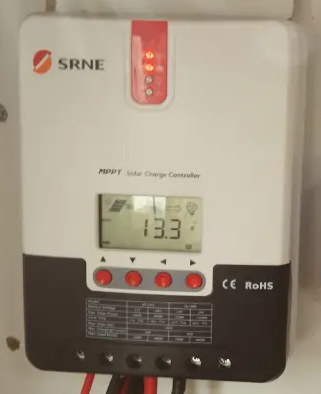
Sometimes the charge controller shows solar production, but the battery keeps losing charge or fails to properly accumulate that energy.
Symptom 5: The battery charges suspiciously fast
Fast charging can look like good news, but it often means lost capacity — the battery reaches “full” faster simply because it holds less energy. Combined with quick discharge afterward and unstable voltage, this points to an aging battery.
Symptom 6: Erratic or inconsistent readings on your battery monitor
General reference, not something I’ve personally run into: if your monitor jumps unpredictably between full and empty, or gets stuck showing a value that doesn’t match reality, that can point to a failing cell or a faulty sensor rather than a wiring problem.
Problem while driving?
If the battery won’t charge from the alternator while driving, the fault is more likely the alternator, relay, or booster — not the battery itself. See why the leisure battery isn’t charging from the alternator.
Testing an AGM battery with a multimeter
If your battery is a flooded lead-acid type with removable caps (not sealed AGM), you can also check its specific gravity with a hydrometer. A fully charged cell should read between 1.265 and 1.285; if any cell differs from the others by more than 0.020, the battery is at the end of its useful life. This only applies to flooded batteries — AGM and lithium are sealed and this method doesn’t work on them.
Measure at rest: after at least two hours with no solar charging and no loads connected. A healthy AGM reads 12.7–12.8V. Below 12.4V means it’s undercharged; repeatedly below 12.0V means you’re actively degrading it.
Resting voltage alone isn’t enough — a sulfated battery can still show a normal resting reading.
Measure under load: connect a modest load (5–10A) and watch how the voltage behaves.
- Healthy: voltage dips slightly and stabilizes
- Compromised: voltage drops suddenly and keeps falling
If you start at 12.7V and a modest load puts you at 12.2V in under a minute, there isn’t real capacity behind that voltage.
Measure while charging: watch two things — whether it reaches absorption voltage (14.4–14.7V for AGM), and how fast it gets there. Reaching absorption quickly when starting from a heavy discharge suggests the battery can’t accept much more energy — a chemical limitation, not a sign of a fast charger.
Testing a lithium battery
Lithium batteries hold a relatively flat voltage through most of the discharge curve, then drop fast near the end. Relying on voltage alone will give you a misleading picture of how much charge is actually left.
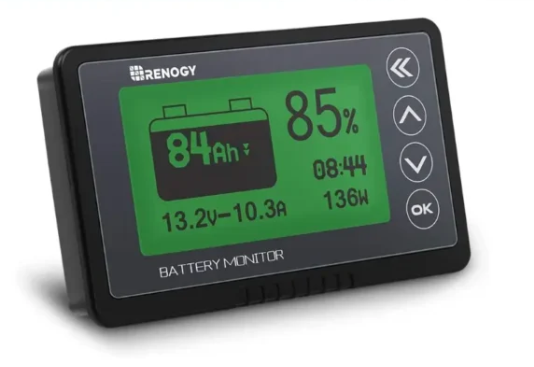
A battery monitor with a shunt is far more useful here — it shows the actual percentage of charge available, energy already used, and remaining autonomy, instead of a voltage number that doesn’t move much until it’s nearly empty.
Roughly how fast should a healthy battery lose charge on its own?
As a general industry reference (not something I’ve personally measured): a healthy lead-acid battery should self-discharge at under about 5% per month at rest, and a healthy LiFePO4 under about 3% per month. Losing charge noticeably faster than that, with nothing connected, points toward an aging battery rather than a wiring or system issue — though it’s worth ruling out a hidden parasitic draw first, which is a different and more common cause. See why a camper battery drains overnight for how to test for that specifically.
When to replace the battery
- Significant loss of autonomy compared to when the battery was new
- Resting voltage stays below 10V even after a full 24-hour charge
- Case is bulging, cracked, or leaking
- Persistent sulfur smell during charging
- Unstable voltage or recurring problems that keep coming back
🔋 Confirmed your battery needs replacing?
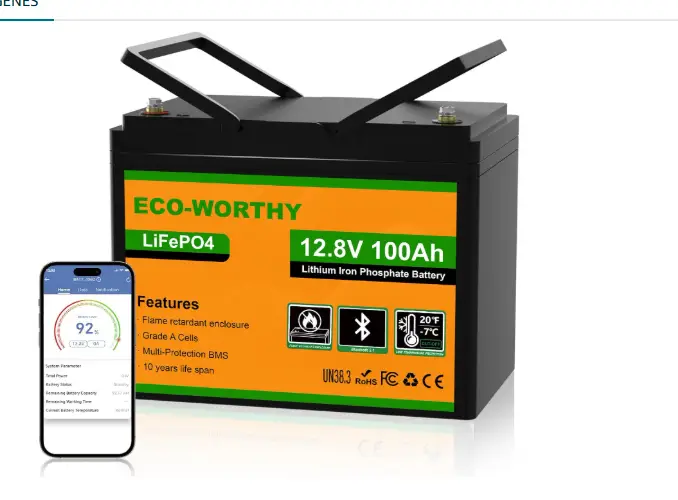
A 12V 100Ah lithium battery is the upgrade path I’d recommend coming from AGM — better cycle life, better real-world performance, and a good match if you’re running solar.
Before you replace it, check this first
Before swapping the battery out, make sure the problem is actually the battery and not somewhere else in the electrical system. Plenty of “worn out” batteries are simply undersized for the actual load, or are suffering from a charging problem upstream. If you haven’t already, it’s worth wiring things correctly from the start — see how to wire an auxiliary battery in a camper van.
FAQ
What are the symptoms of a damaged camper battery?
Fast loss of autonomy, trouble charging, voltage that drops as soon as a load connects, and charging cycles that keep getting shorter. More than one of these together is a strong sign it’s time to check the battery.
How do I check if my leisure battery has lost capacity?
Charge it fully and time how long it powers your normal loads. A runtime that’s noticeably shorter than when the battery was new points to capacity loss from age or use.
Can a damaged battery still charge?
Yes. A deteriorated battery can reach a normal voltage while charging and still discharge fast afterward, because it simply can’t store as much energy as it used to.
How long does a camper leisure battery typically last?
It depends on the battery type, how it’s maintained, and how many charge/discharge cycles it’s been through. AGM batteries generally run 4–7 years under normal use; lithium can go past 10 years with proper care.
What shortens a leisure battery’s life prematurely?
Repeated deep discharges, extreme temperatures, incorrect charging, a faulty regulator, or leaving it stored discharged for long periods all shorten lifespan significantly.
Should I try to repair a damaged battery, or just replace it?
Fully recovering a deteriorated battery is rarely possible. Significant capacity loss or repeated failures are a good reason to replace it rather than risk it causing problems elsewhere in the electrical system.
Conclusion
A worn-out battery doesn’t necessarily stop working outright. Often it keeps charging and running your devices while its real capacity has shrunk enough that it just can’t cover a normal day of camper use anymore.
One telling symptom, in my case: the parking heater wouldn’t start in winter. That’s when I found the real issue behind what turned out to be a battery that had already lost most of its usable capacity — before any measurement confirmed it.
[…] Older battery: may charge poorly even with a healthy panel — see how to tell if your camper battery is damaged or worn out […]
[…] ¿Prefieres verlo en inglés? Aquí tienes la guía equivalente sobre cómo saber si la batería está dañada o agotada: How to Tell If Your Camper Battery Is Damaged or Worn Out → […]
[…] Not sure if the plateau means the battery itself is degraded? → How to tell if your camper battery is bad […]
[…] → How to tell if your camper battery is bad […]
[…] power from the solar panels, and drop considerably once that charge source disappears — see how to tell if your camper battery is damaged or worn out for a full […]
[…] How to tell if the battery is damaged […]