
The consensus on this is settled and it goes like this: PWM controllers are fine for small systems. Under about 150 watts of panel, on lead-acid batteries, save the money and spend it on something else.
That advice is well argued. The maths behind it is correct, and the people giving it know what they’re talking about.
I used a PWM controller for years, and I don’t agree with it.
Not because the calculation is wrong — it isn’t. Because of what the calculation assumes, and because of what happened to my battery.
I’ll give you the physics first, then where I think the standard advice breaks down, and then the part where I tell you what I can and can’t prove.
The short version
- A PWM controller throws away around 20 % of your panel’s output in good conditions
- But the gap widens as conditions worsen — cloud, shade and cold all favour MPPT
- Which means PWM performs worst exactly when you most need the charge
- And a battery that repeatedly fails to reach full charge sulfates and dies early
- I ran a PWM. My AGM didn’t reach a year. I can’t prove the link — but the mechanism is real
What each one actually does
The difference is one thing: whether the controller can convert between voltages.
A PWM controller can’t. It connects the panel to the battery and pulls the panel’s voltage down to whatever the battery is at. The current passes through unchanged.
That sounds harmless until you run the numbers.
A typical 100 W panel has a maximum power voltage of about 17.5 V and a maximum power current of about 5.71 A. Multiply those and you get its rated 100 W.
Now connect it through a PWM to a 12 V battery charging at 14 V:
- The panel still delivers 5.71 A
- But it’s now working at 14 V, not 17.5 V
- 14 × 5.71 = 80 W
Twenty watts gone. Not lost in a cable, not lost in heat — simply never harvested, because the controller can’t do anything with the extra voltage.
An MPPT controller can. It’s a DC-to-DC converter. It takes the panel’s full 100 W at 17.5 V and converts it down to 14 V at a higher current — around 7 A instead of 5.71. Same power, delivered at the voltage the battery wants.
That’s the 20 % figure everyone quotes, and it’s correct.
It’s also the best case.
Where the standard advice breaks down
The 20 % figure assumes good conditions. That’s where the advice gets it wrong, and it’s worth understanding why.
The MPPT’s advantage grows as conditions get worse.
In poor light — cloud, shade, early morning, low winter sun — a panel’s current collapses but its voltage holds up reasonably well. Open-circuit voltage barely moves; it’s the amps that disappear.
So in weak light you have a panel producing, say, 17 V at 1.5 A. That’s 25 W available.
- A PWM pulls it to 14 V and delivers 1.5 A. 21 W.
- An MPPT converts it and delivers about 1.8 A at 14 V. 25 W.
The percentage gap is now larger than it was in full sun, and it’s larger precisely when you have least to spare.
And cold makes it worse. Panel voltage rises as temperature falls, so on a cold clear day there’s even more excess voltage for the PWM to throw away. Winter — when your days are short and your heater is running — is when the PWM wastes most.
Why that matters more than the percentage suggests
Here’s the part nobody joins up.
A lead-acid battery needs to reach its absorption stage and be held there to complete a charge. If it doesn’t get there, sulfate stays on the plates, and each incomplete cycle leaves a little more behind.
A controller that harvests less takes longer to get the battery up to absorption voltage. On a short winter day, or a week parked in shade, “longer” can mean “never”.
So the argument isn’t really about 20 % of your solar output. It’s about whether your battery completes its charge or spends months at partial state of charge — which is what actually kills lead-acid batteries. Here’s what that looked like in my van.
The standard advice — “PWM is fine for small systems” — quietly assumes you get decent sun. If you do, it’s correct. If you park in shade in summer, or live somewhere with real winters, or charge only from solar with no alternator or shore power to catch up, then the conditions where PWM performs worst are your normal conditions.
What actually happened to mine — both of them
I should be careful here, because my experience cuts both ways and it would be easy to tell only half of it.
The PWM failed, and took a battery with it.
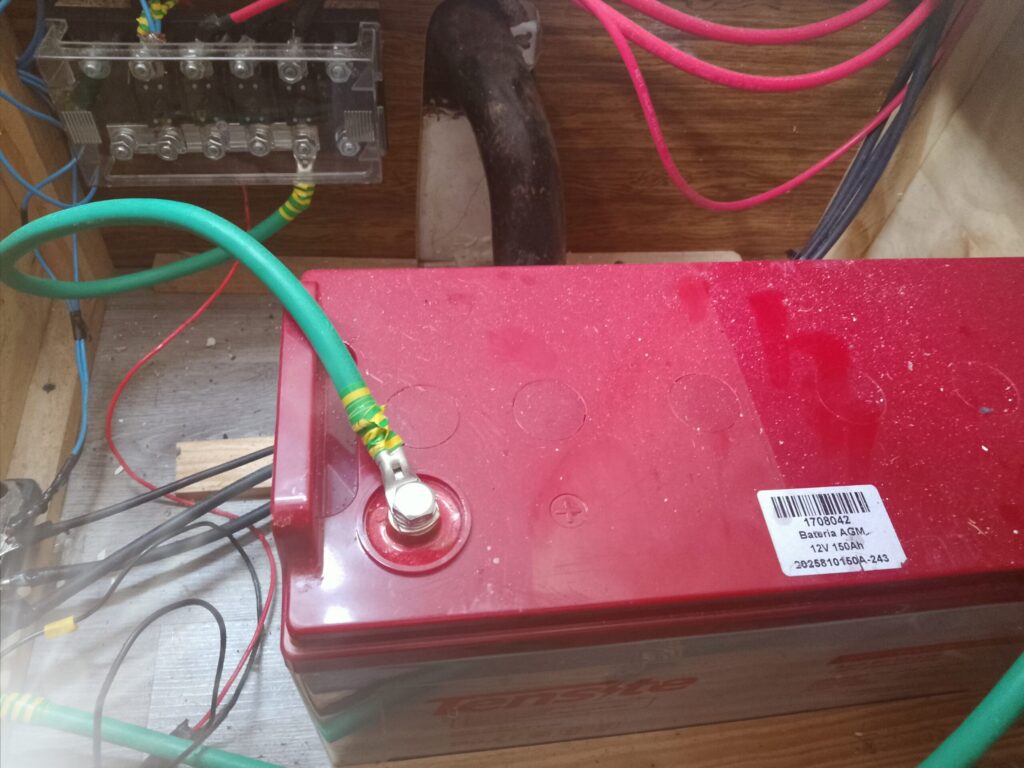
It was one of the small cheap ones. I woke up one morning to a completely dead van — the 100 Ah AGM read 2 volts. When I went looking, the terminal on the PWM controller had melted.
An AGM at 2 volts doesn’t come back. That one cost me the battery as well as the controller.
And then an MPPT failed too.
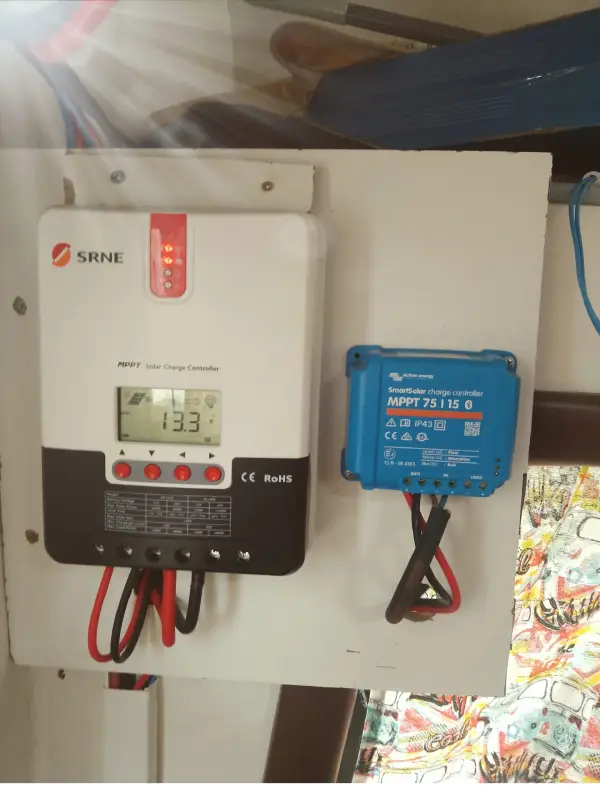
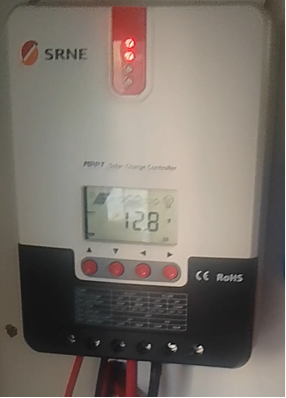
I now run two panels with two controllers, an SRNE and a Victron SmartSolar. The Victron stopped working at under nine months old — it still receives panel voltage, but it won’t hold a Bluetooth connection and won’t complete a firmware update. It’s a warranty case.
If you’re seeing something similar, these are the measurements that tell you whether it’s the controller or the panel.
So let me be plain about this: MPPT is not more reliable. Anyone telling you to pay three times more for peace of mind is selling something. Mine failed sooner than the cheap one did.
What is true is that it charges faster
When both are working, the MPPT visibly outperforms the PWM. The battery comes up quicker and the controller reports more going in.
But I have to flag a caveat, because I’d rather be honest than convincing: I now have two panels and two controllers, where before I had one of each. Some of that improvement is simply more panel area. I can’t cleanly separate the two.
What I can say is that the direction matches the theory, and the theory is well established. If you want to put a number on it for your own panel and battery size, here’s how to estimate real charge time.
And the price is not a small difference
For the same amperage, an MPPT costs more than three times what a PWM does. That’s not a rounding error on a van build budget, and it’s the reason the standard advice exists.
What you get for it is the tracking. An MPPT continuously samples the panel to find the voltage at which it delivers maximum power, holds it there, and re-checks as conditions change. A PWM has no such mechanism — it simply clamps the panel to battery voltage and takes whatever current comes.
That tracking is the whole product. Whether it’s worth 3× depends entirely on your conditions.
| Feature | PWM | MPPT |
|---|---|---|
| Price, same amperage | $30-60 | $120-250 |
| Panel output harvested, full sun | ~80% | ~98% |
| Harvested in cloud or shade | Worse still | Gap widens in its favour |
| Cold weather | Wastes more | Converts the surplus |
| Works with lithium | Not reliably | Yes |
| Sensible panel limit | ~150 W | Any |
| Panels in series | No | Yes |
| Room to expand later | No | Yes |
| Monitoring | Basic screen or none | Bluetooth app typical |
| Reliability | No meaningful difference. Both are electronics in a vibrating vehicle | |
Note the last row. Most comparisons leave it out, or imply that paying more buys you durability. It doesn’t. You’re buying harvesting, and that’s worth a great deal in the right conditions and very little in the wrong ones.
Can you run two controllers on one battery bank?
I do, so let me answer this properly. It’s the situation most people end up in when they add a panel later and don’t want to throw away a controller that still works.
Yes, it works. Each controller reads the battery voltage independently, decides what stage it should be in, and delivers what it can. They don’t need to talk to each other, and they don’t fight over the battery in any dangerous way.
But there are three things worth knowing.
1 · Both must be set to the same battery profile. If one is on AGM and the other on gel or lithium, they’ll target different absorption voltages. The one set higher will keep pushing while the other has already dropped to float, and your battery gets a charge profile that matches neither. Set them identically, including temperature compensation.
2 · They don’t coordinate the absorption timer. Each one decides for itself when absorption is finished, based on what it sees. In practice that means the battery may spend longer at absorption voltage than either controller intended, because as one drops to float the other is still holding the voltage up. It’s not dangerous with lead-acid, but it’s another reason to get the profile right.
3 · And a diagnostic trap that cost me an afternoon.
Because both are connected to the same bank, each one reads a battery voltage that may be arriving through the other’s connection. When my Victron failed, it still displayed a perfectly plausible battery voltage — borrowed from its neighbour.
So if you’re troubleshooting a dual-controller setup, a healthy voltage reading on one controller proves nothing about its own connection. You have to isolate each controller and test it against the battery on its own. I don’t see this mentioned anywhere, and dual setups are common once people expand.
Can you mix a PWM and an MPPT? Technically yes, with the same caveats. But if you’re adding a second controller anyway, there’s little sense in adding another PWM — put the MPPT on the new panel and let the old PWM keep doing what it does.
And is it worth retrofitting an MPPT to replace a working PWM? Only if your panel’s maximum power voltage sits well above the battery’s charging voltage — which is true of essentially any panel over 150 W. If you’re running a genuine 12 V nominal panel with a Vmp near 15 V, the gain is small and the money is better spent elsewhere.
Which one should you buy
Having said all that, here’s where I actually land — and it isn’t “always buy MPPT”.
Buy a PWM if:
- Your panel is under 150 W and it’s a 12 V nominal panel with a Vmp near 15 V
- You have lead-acid batteries
- You have another charging source — alternator, shore power, a generator — that catches the battery up regularly
- You park in open sun most of the time
- The €100 difference is genuinely better spent on more panel or a bigger battery
That’s a real scenario and it’s why the standard advice exists.
Buy an MPPT if:
- You have lithium. This isn’t a preference — a PWM can’t step voltage up, so on a hot day when panel voltage sags, lithium may not charge at all
- Your panels are over 150 W, or wired in series, or you plan to add more later
- You have cold winters, where the extra panel voltage is exactly what a PWM throws away
- Solar is your only charging source
- You park in shade, or under trees, or anywhere the sun isn’t guaranteed
And the line that decides it for most people: if you charge only from solar and you can’t reliably give the battery a full charge every few days, the extra harvest isn’t about efficiency. It’s about whether your battery completes its cycles or slowly sulfates.
What I’d tell someone in my position
I park in shade in summer. I charge from solar only. I have no alternator charging and no shore power for weeks at a time.
Those are exactly the conditions where a PWM performs worst, and they’re my normal conditions rather than my worst case.
So no, I wouldn’t buy a PWM again — not because it’s a bad device, but because the assumption behind the standard advice doesn’t hold for how I live.
But I’d also stop telling people MPPT is the safe choice. Mine failed at nine months. The cheap PWM lasted longer before it went. You’re paying three times more for better harvesting, not for better reliability, and it’s worth being clear about which one you’re buying.
The controller is one piece. If you’re still working out how the whole system fits together, start here.
Frequently asked questions
Is MPPT really worth it over PWM?
It depends on your conditions rather than your system size. An MPPT harvests around 20 % more in good sun, and considerably more in cloud, shade or cold — because a panel in poor light loses current but keeps its voltage, and only an MPPT can convert that surplus. If you charge only from solar and park anywhere shaded, that gap decides whether your battery completes its charge. If you have plenty of sun and another charging source, a PWM is genuinely fine.
Can I use a PWM controller with a lithium battery?
It’s not recommended. A PWM can’t step voltage up, so the panel has to be producing at least the lithium charging voltage — around 14 V — for anything to happen. On hot days panel voltage sags, and in weak light it can fall below that threshold entirely, at which point the battery simply doesn’t charge. With lithium, buy the MPPT.
How much more does an MPPT cost?
Around three times a PWM of the same amperage. That’s a real difference on a van budget and it’s why the standard advice exists. What you’re buying is the tracking — the controller continuously finds the panel’s maximum power point and holds it there — not better build quality or longer life.
Is an MPPT more reliable than a PWM?
No. Mine failed at under nine months while a cheap PWM ran for longer before it went. Both are electronics living in a vibrating, hot, damp vehicle. Buy MPPT for the harvest, not for peace of mind, and keep the receipt either way.
Can a charge controller damage my battery?
Directly, yes — a wrong battery-type setting applies the wrong charge voltages, and a failed terminal can short or stop charging entirely. Indirectly and more commonly, a controller that under-harvests means the battery repeatedly fails to reach full charge, which sulfates lead-acid plates permanently.
Does a PWM work for a 200W panel?
It will function, but it’ll waste more than it does with a 100 W panel. Larger panels have higher maximum power voltages, and everything above the battery’s charging voltage is thrown away. Above about 150 W the losses stop being marginal.
[…] ¿Prefieres verlo en inglés? Aquí tienes la comparativa equivalente entre reguladores MPPT y PWM: MPPT vs PWM: Which Solar Controller → […]
[…] happen, that fuse is the only thing standing between a spark and a fire. The proof is my own melted PWM regulator terminal: a bad connection generated enough localized heat to burn the terminal itself, and while […]
[…] never connects straight to the battery — between panel and battery there always needs to be a solar charge controller, which manages the charge and protects the […]
[…] MPPT vs PWM: Which Solar Controller […]
[…] MPPT vs PWM: which charge controller to choose […]
[…] The other catches of running two controllers on one battery, including a diagnostic trap I fell into, are in MPPT vs PWM for campers. […]