
Undersized wire is the most expensive fault in a 12 V system, because it rarely gets blamed. Everything works at first. Then the inverter starts cutting out, the fridge cycles strangely, and the battery seems to be dying — so people replace the battery.
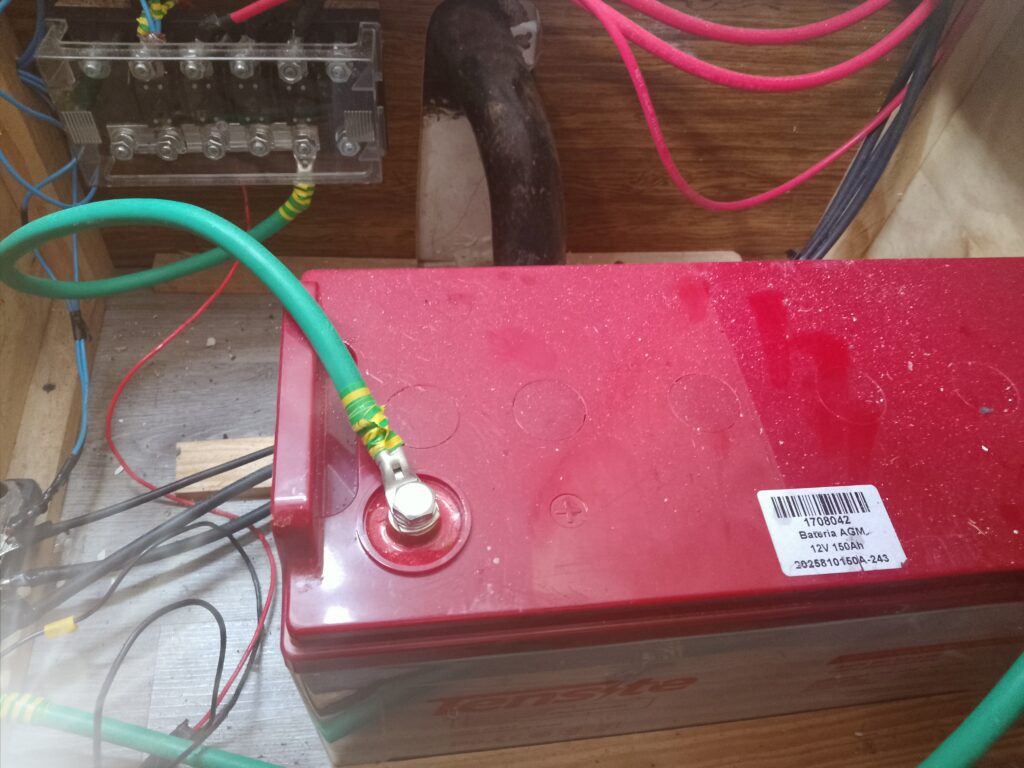
I’ve seen someone spend €300 on a new battery to discover the problem was two metres of cable.
This page isn’t about what cable to buy. It’s about how to tell whether the cable you already have is too thin, using a multimeter and about ten minutes.
“I killed a perfectly good AGM running a 230 V fan overnight through an inverter. That’s the kind of mistake this site is built to save you from.”
The symptoms, and what they get blamed on
What makes this fault so hard to catch is that it imitates other failures. Every symptom below has a more obvious-looking culprit, and the obvious culprit is usually innocent.
| What you see | What gets blamed | What it usually is |
|---|---|---|
| Inverter shuts down when a motor starts | Flat battery | Voltage drop in the cable |
| "Low battery" warning with a charged battery | Faulty inverter | It’s reading what arrives, not what’s there |
| Fridge cools poorly or cycles oddly | Faulty fridge | Receiving under 12 V |
| Battery "doesn’t last like it used to" | Old battery | Energy lost as heat in the cable |
| Solar seems to charge slowly | Bad panel or controller | Loss on the roof-to-controller run |
| Lights dim when something switches on | "Normal" | It isn’t normal |
| Cable feels warm after a while under load | "They all do that" | They don’t. That’s your energy |
If more than one of those sounds familiar, measure before you buy anything. The test at the bottom of this page costs nothing and takes ten minutes.
A water pump that suddenly stops responding gets blamed the same way — before you assume the pump is dead, check the wiring first. The water pump troubleshooting guide covers the electrical checks in the “pump doesn’t run at all” section.
The solar row deserves a note of its own. The panel-to-controller run is usually the longest cable in the van — roof to floor, around obstacles — and it’s the one people size by eye. If your charging looks weaker than it should, start there before blaming the panel or the controller.
Why this is so much worse at 12V
At 120 V, losing three volts in a cable is a rounding error. At 12 V, it’s the difference between a system that works and one that doesn’t.
Two things stack against you.
The current is enormous. Moving 1,000 W through a household outlet takes 8 amps. Moving the same 1,000 W from a 12 V battery takes around 98 amps. Voltage drop is proportional to current, so the same length of cable loses twelve times more in a 12 V system.
And the margin is tiny. A healthy battery sits around 12.6 V at rest and sags to about 12.0 V under load. Most inverters cut out below 10.5 V. That leaves you roughly a volt and a half of headroom for everything — and the accepted standard for critical circuits is to spend no more than 3 % of it, which at 12 V is 0.36 V.
How much drop is acceptable:
- Under 0.36 V — correct
- 0.36 to 0.6 V — tolerable on lighting, not on anything with a motor
- Over 0.6 V — the cable is insufficient, even if the equipment currently runs
That last line matters. A circuit can work perfectly for months at 0.9 V of drop, right up to the first hot day when the battery is at 60 % and the compressor kicks in. Then it doesn’t.
The heat isn’t a side effect. It’s your battery
Every volt lost in a cable turns into heat inside that cable. And that heat comes out of your battery.
Take a 1,000 W inverter pulling 98 A over a 2 m run:
- With 2 AWG, the drop is about 0.35 V and roughly 34 W is dissipated as heat
- With 8 AWG, the drop is about 1.4 V and roughly 137 W is dissipated as heat
Sit with that second number. A hundred and thirty-seven watts, drawn from your battery, warming a cable inside a cabinet, doing nothing for you. It’s an old incandescent bulb burning inside your furniture all evening.
That’s where the autonomy went. Not into the fridge, not into the laptop — into a cable.
The touch test. A cable that feels warm after twenty minutes under load is losing energy. A cable you can’t comfortably hold is no longer an efficiency problem, it’s a safety one: the insulation degrades, then hardens, then cracks.
And check the terminals as well as the cable. A loose or badly crimped terminal concentrates all that heat into a few millimetres instead of spreading it along a metre of copper. The cable can be stone cold while the terminal cooks.
The ten-minute test
You need a multimeter and about ten minutes. If you have two multimeters, or someone to help, it’s easier.
1 · Put a real load on the circuit. Switch on whatever normally causes the problem — the inverter with something demanding, the pump, the fridge starting. Leave it running.
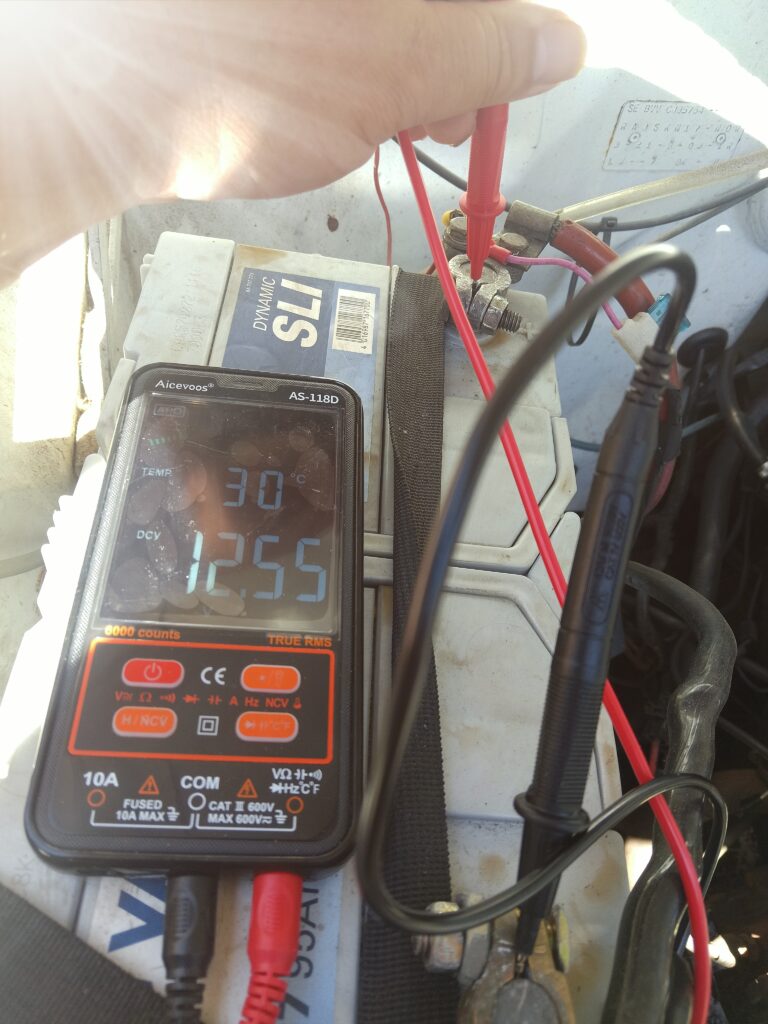
This is the step everyone skips, and it’s why the fault goes undetected for months. With no current flowing there is no voltage drop, and a badly undersized cable measures perfectly.
2 · With the load running, measure at the battery terminals. Directly on the posts, not at a busbar. Write it down.
3 · At the same moment, measure at the appliance terminals — the far end of the cable. Write it down.
4 · Subtract.
Reading the result:
- Under 0.3 V — the cable is fine
- 0.3 to 0.5 V — marginal; it will cause trouble under heavy loads
- Over 0.5 V — the problem is the cable or the connections, not the battery
There’s no interpretation involved. That difference is precisely what’s being lost on the way.
If the difference is large, find where. Repeat the measurement moving along the run: at the fuse, at the busbar, at each joint. Wherever you find a sudden step, that’s your bad point. It’s usually a loose terminal, a poor crimp or an oxidised fuse contact.
And if the difference is small but the voltage is low at both points — the cable is doing its job and the battery is the problem. That’s the next section.
When it isn’t the cable: what a tired battery looks like
If both readings are low and close together, the cable is innocent. Here’s what that looks like from my own installation.
I run a 150 Ah AGM that is less than a year old. It shouldn’t be tired. It is.
What I did to it:
Through the winter, a diesel heater ran most nights. Through the summer, a fan ran all night, many nights in a row. And in summer I park in shade, which is comfortable to live in but means the panels recharge far less than they would in the open.
That heater draws 8 to 12 amps every time it ignites. Here’s what it costs over a night and over a winter, and why the cable feeding it matters more than people think.
So the battery was cycled deep, night after night, and put back only partially. That’s not a fault in the battery. It’s what happens when the system is sized for the average day rather than the hard one.
What the damage looks like now:
The battery still shows a normal voltage at rest. But put any load on it, however small, and the voltage falls off a cliff. That collapse under load, with a healthy resting voltage, is the signature of a lead-acid battery that has lost capacity.
And there’s a second sign that’s easier to measure. When I charge it from a portable power station, that station used to deliver over 330 W into the battery. Today, the same station, the same cables, the same battery — it won’t go above 155 W.
That’s not the charger weakening. A degraded AGM has higher internal resistance, so its terminal voltage rises faster during charge. The charger hits its voltage ceiling sooner, drops out of the constant-current stage early, and tapers. Charge acceptance falling by half is one of the clearest degradation signals you can measure, and almost nobody looks at it.
What I’d tell anyone sizing a system now
Size for at least 20 % more than your full covered load, not for what you calculated as sufficient.
Not because the calculation is wrong, but because real use isn’t the average. It’s the week of cold nights with the heater running. It’s the fortnight parked in shade. It’s the summer where the fan runs until dawn. A bank sized exactly to the calculation spends its life at the bottom of its range, and lead-acid batteries die from being emptied, not from being used.
That 20 % costs money once. Replacing a battery in under a year costs more.
It’s also worth knowing that battery chemistry changes this calculation. Lithium tolerates deep cycling in a way lead-acid never will, and it holds voltage under load instead of sagging. Here’s what that difference looks like in practice.
What to do if the wire is undersized
There’s no partial fix. It has to be replaced.
Doubling up a thin cable with a second one in parallel is a workaround that creates two new problems: current divides unevenly between the two, and you’ve made twice as many terminals to work loose. Fit the correct size.
Three checks before you buy, so you don’t do the job twice:
Measure the routed length, not the straight line. The cable goes around furniture, through conduit and behind panels. It’s often twice what you’d estimate by eye. Run a piece of string along the actual path.
Check the terminals as well. A 2 AWG cable with one badly crimped lug has the same problem concentrated into a centimetre. If a terminal is hotter than the cable, that’s your fault right there — and replacing the cable won’t fix it.
Oversize by one step. Cable is the cheapest component in the build and the most expensive to change once the walls are closed. Everything else — battery, inverter, controller — you can swap in an afternoon. If this cable run is for an auxiliary or second battery rather than a straight replacement, the wiring itself has a few extra rules — covered here.
To work out the size you need for your current and run length, use the wire gauge calculator. It checks both voltage drop and current capacity, because a cable can pass one limit and fail the other.
Where the voltage actually disappears
When the test shows a large difference, most people assume the cable is the culprit. Often it isn’t — the cable is fine and the loss is concentrated in one of four places.
The chassis return. Many van builds use the vehicle body as the negative path instead of running a dedicated cable back to the battery. It works, but the current has to pass through bolted panel joints, paint, seam sealer and whatever corrosion has developed since 2005. That’s a resistance you can’t see and can’t easily inspect.
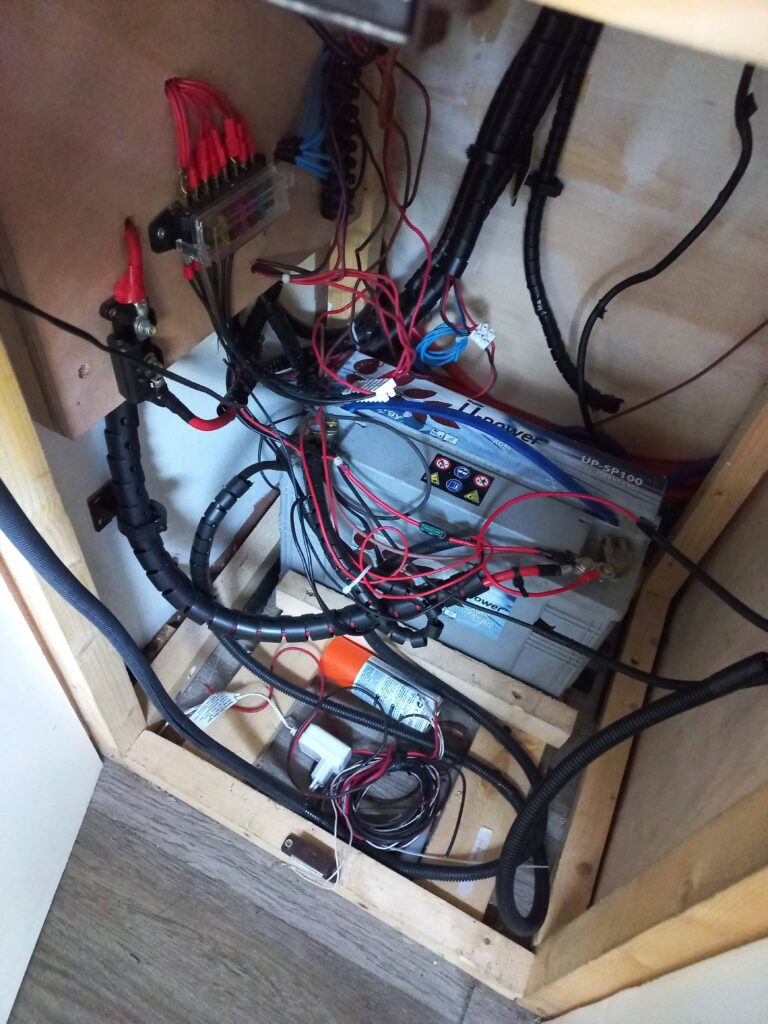
If you’re using chassis return and the test shows a large drop, measure between the appliance’s negative terminal and the battery negative post directly. If most of the loss is there, run a proper negative cable. It’s the single most common hidden fault in older conversions.
The fuse holder. Blade fuse holders in particular. The contact is a spring clip, it oxidises, and it sits in a circuit carrying serious current. A fuse holder that feels warm is telling you something.
Busbars and distribution blocks. Every one adds two connections. They’re convenient and they’re fine when properly torqued, but each is a candidate.
Terminals that were never crimped properly. A twisted-and-taped joint, or a crimp made with pliers instead of a crimping tool, has resistance from day one and gets worse with vibration.
How to find it: repeat the test in stages, walking along the circuit — battery post, fuse, busbar, appliance. The place where the number jumps is your fault. It takes a few minutes and it’s the difference between replacing a cable and tightening a bolt.
One more place undersized cable shows up: if the voltage drop is severe enough, it can trip the fuse protecting that circuit — not because the fuse is faulty, but because it’s doing its job. If your fuse keeps blowing and you’ve ruled out an obvious short, see Why Does the Fuse Keep Blowing in My Camper’s 12V System? for the full diagnostic process.
Frequently asked questions
How do I know if my wire is too thin?
Measure the voltage at the battery terminals and at the appliance terminals at the same time, with the load running. If the difference is more than 0.5 V, the cable or the connections are the problem. Measuring with no load will show nothing, which is why this fault goes undetected for so long.
Can undersized wire damage my battery?
Indirectly, yes. Energy lost as heat in the cable comes out of the battery, so you cycle it deeper than you intended for the same useful output. With lead-acid batteries, repeated deep discharge is what shortens life.
How much voltage drop is acceptable in a 12V system?
Three per cent on critical circuits, which is 0.36 V at 12 V. Up to 10 % is tolerable on lighting and USB. The margin is small because a battery under load already sits near 12.0 V and most inverters cut out below 10.5 V.
Why does my inverter say low battery when the battery is charged?
Because it can only measure what reaches its own terminals. If the cable drops a volt on the way, the inverter sees 11 V while the battery genuinely has 12 V, and it protects itself. Full list of causes here.
Can I just add a second cable in parallel?
It’s not a good solution. Current won’t divide evenly between two cables of different length or condition, and you’ve doubled the number of terminals that can loosen. Fit a single correctly sized cable.
Is a warm battery cable normal?
No. Warm means energy is being lost as heat. If you can’t comfortably keep your hand on it, the insulation is being damaged and it’s a fire risk, not an efficiency issue.
[…] Undersized wire: the symptoms and a ten-minute test […]
[…] ¿Prefieres verlo en inglés? Aquí tienes la guía equivalente con el test de 10 minutos para comprobar si tu cable se ha quedado corto: Undersized Wire in a 12V System: The Symptoms and a 10-Minute Test → […]
[…] Undersized cable for the distance and load. Wire that’s too thin for the amperage and cable run length overheats under normal use, and a correctly-sized fuse will trip to protect it — the fuse isn’t the problem here, the wire gauge is. If you want to check your own cable against the symptoms of this exact issue, see Undersized Wire in a 12V System: The Symptoms and a 10-Minute Test. […]
[…] Undersized Wire in a 12V System: The Symptoms and a 10-Minute Test […]
[…] Undersized Wire in a 12V System: The Symptoms and a 10-Minute Test […]
[…] Undersized Wire in a 12V System: The Symptoms and a 10-Minute Test […]
[…] battery. If undersized wiring in general — not just for an inverter — is what you suspect, Undersized Wire in a 12V System covers the symptoms and a quick […]
[…] Undersized Wire in a 12V System: The Symptoms and a 10-Minute Test […]
[…] Undersized Wire in a 12V System: The Symptoms and a 10-Minute Test […]
[…] the current running through it. If you notice hot cables or terminals, it’s worth checking what wire gauge to use in a 12V camper installation before just re-tightening the […]
[…] Undersized wire: the symptoms and a ten-minute test […]