
Search this question and you’ll find the answer is yes.
You’ll also find that most of the pages telling you so sell lithium batteries or air conditioners. That isn’t a conspiracy — they know their subject and their numbers are broadly right. But “yes, with 600 amp-hours of lithium” is a different answer depending on whether the person saying it profits from the 600 amp-hours.
I don’t sell anything. So here’s the arithmetic, and then the two things that actually worked for me — one of which costs nothing and is already fitted to your vehicle.
The short version
- A 13,500 BTU rooftop unit pulls around 137 amps at 12 V while running
- Overnight you need 400 to 800 Ah of lithium — a four-figure battery bank
- Startup surge means a 3,000 W inverter minimum, and it still may not start
- Your vehicle’s own air conditioning cools better than any of it, and costs nothing
- Evaporative coolers make a closed van worse. I used one for a summer
“I killed a perfectly good AGM running a 230 V fan overnight through an inverter. That’s the kind of mistake this site is built to save you from.”
The numbers
The figure that matters isn’t watts. It’s amps out of the battery, because that’s what your bank actually has to deliver.
A rooftop RV air conditioner runs on 120 V, which means it goes through your inverter — and the inverter is only about 85 % efficient. That loss counts.
A 13,500 BTU rooftop unit, the standard size on most RVs:
- Running draw: about 1,400 W
- Through the inverter: 1,400 ÷ 0.85 = 1,647 W
- At 12 V: 1,647 ÷ 12 = 137 amps
For comparison, that’s roughly thirty times what a 12 V compressor fridge draws.
And there’s the startup surge. The compressor pulls three to five times its running power at the instant it starts — so 4,000 to 7,000 W for a fraction of a second. That means a 3,000 W inverter as an absolute minimum, and peak currents in the 350-500 A range. With a 2,000 W inverter it simply won’t start, no matter how healthy the battery is.
But it doesn’t run continuously. Like a fridge, it cycles. In genuinely hot weather expect a 60 to 70 % duty cycle overnight — less if the van is well insulated, more if it isn’t.
So for eight hours at 65 % duty:
137 A × 8 h × 0.65 = around 710 amp-hour
The soft starter: the cheapest way to make this work
If you already have a rooftop air conditioner and you’re trying to run it off-grid, this is the first thing to look at — and it costs a fraction of everything else on this page.
The problem it solves. The compressor’s startup surge is three to five times its running power. That surge is what trips inverters, sags battery voltage and forces you to buy a much larger inverter than the running load would suggest. And it isn’t a one-off: over an eight-hour night the compressor restarts dozens of times, so it’s a repeated stress, not a single event.
What a soft starter does. It ramps the compressor up in a controlled way instead of hitting it with full current instantly. Manufacturers claim a reduction in startup surge of up to 75 %.
What that changes in practice:
| Without soft starter | With soft starter | |
|---|---|---|
| Startup surge, 13,500 BTU | 3,300-4,500 W | around 1,000-1,500 W |
| Inverter needed | 3,000 W continuous / 6,000 W surge | often 2,000 W is enough |
| Approximate inverter cost | $700-1,200 | $350-600 |
The arithmetic is unusually clear. A soft starter costs around $300. Dropping from a 3,000 W inverter to a 2,000 W one saves more than that. You end up ahead on the purchase and with a system that trips less.
What it does not do: it doesn’t reduce the running consumption at all. Your air conditioner still draws the same 137 amps once it’s going, and the battery bank you need for the night is unchanged. Anyone suggesting otherwise is overselling it.
So the honest summary: a soft starter fixes the surge problem, which is real and expensive. It does nothing for the capacity problem, which is the bigger one. Both need solving before this works off-grid.
What each type costs you
| Type | Running | Amps at 12 V | 8 h overnight |
|---|---|---|---|
| Rooftop 15,000 BTU (120 V) | 1,700 W | 167 A | ~870 Ah |
| Rooftop 13,500 BTU (120 V) | 1,400 W | 137 A | ~710 Ah |
| Portable AC (120 V) | 1,000 W | 98 A | ~510 Ah |
| Rooftop 12 V DC (no inverter) | ~480 W | 40 A | ~210 Ah |
| Evaporative cooler | ~80 W | 7 A | ~56 Ah |
| Roof fan | ~25 W | 2 A | 16 Ah |
Overnight figures assume a 65 % duty cycle in hot weather, except the evaporative cooler and fan, which run continuously.
The one row that changes the answer
A 12 V DC rooftop unit skips the inverter entirely and uses a DC compressor. At 40 A it’s a third of the draw of the 120 V equivalent. It’s the only air conditioning that works off-grid without an absurd battery bank — and it costs $1,800 to $3,000.
If you’re sizing an inverter for any of the 120 V options, do the surge calculation first: inverter sizing calculator including startup surge.
How long will your battery actually run it?
Pick your unit, your battery and how hard the night is. The result updates as you change it.
The result is optimistic. It doesn’t count the inverter’s own consumption, the capacity a battery loses with age, or anything else you have running. In practice, take 15 to 20 % off.
And note what happens when you select AGM: the number is bad, but reality is worse. An AGM can’t physically supply 137 amps whatever its rating says — the voltage sags and the inverter trips before the capacity runs out. Why that happens.
What I actually tried, and what each one cost me
I’ve never had a rooftop air conditioner. What I have done is try four other things over several summers, and three of them taught me something the spec sheets don’t.
1 · A 120 V fan through the inverter — and the battery it killed
The obvious first move: a mains fan running overnight through the inverter. Its display read 46 W. That seemed like nothing.
It wasn’t. Measured with a clamp meter on the battery side, the actual draw was 65 to 85 W — nearly double. I tried a second fan from a different brand and got the same result.
Three things stack up, and none of them are on the label:
- Power factor. An induction motor draws current out of phase with voltage, typically at a power factor around 0.65. The display shows active power; the inverter has to supply apparent power, which is 46 ÷ 0.65 = about 70 VA. Your battery pays for the VA.
- Inverter efficiency collapses at low load. Running a 1,000 W inverter at 46 W is 5 % of its rating, nowhere near where it’s efficient.
- The inverter’s own draw. 4 to 18 W continuously, just for being switched on all night.
Eight hours of that “46 W” fan cost roughly 600 Wh. My 150 Ah AGM has about 900 Wh usable. Two thirds of the battery, every night, for a fan. Repeated enough times, that’s what finished it off.
The lesson: if you’re going to run a fan all night, run a 12 V one. No inverter, no power factor problem, and around 2 A instead of 6.
2 · An evaporative cooler — and what I do with it now
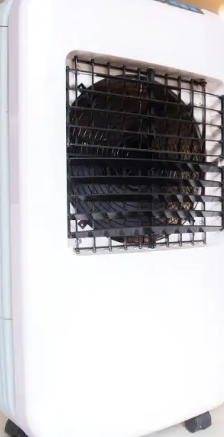
I used one for a whole summer, powered by a portable power station. It lasted two to three hours before the station was flat.
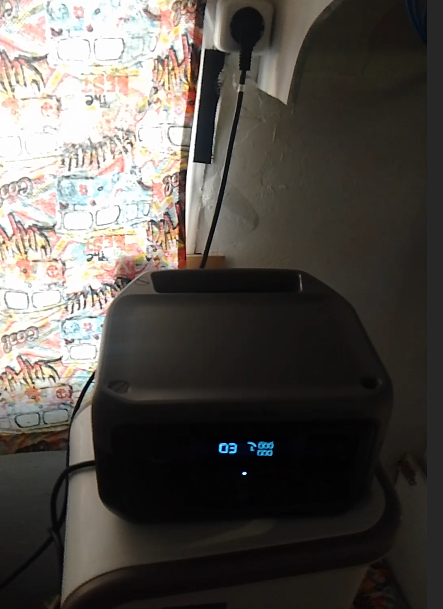
The first fifteen or twenty minutes felt good, as long as I sat right in front of the outlet, ten or fifteen centimetres away. After that, the body starts sweating normally again as if nothing were on. And after an hour or more, walking into the van it felt heavier than before I switched it on — outside heat plus all the humidity the machine had been adding.
Why: an evaporative cooler lowers temperature by adding water vapour. Outdoors that disperses. Inside six cubic metres it accumulates. And your body cools itself by evaporating sweat — so once the air is saturated, the sweat can’t evaporate and you feel hotter even at a slightly lower temperature. The device removes your own cooling system.
And here’s what I do now: I run the same unit dry — no water, and with the pump switched off.
Like that it’s simply a fan, and it works better than it ever did as an evaporative cooler. It moves air, it adds no humidity, and it draws less because the pump that lifts water to the cooling pad isn’t running. The machine I bought to cool the van does its best work with the feature it was sold for switched off entirely.
3 · A portable AC unit I never used in the van
I owned one. I never installed it in the van, and knowing the numbers, I’m glad.
Beyond the 98 amps, portables have a problem specific to small spaces: they exhaust hot air through a hose, and they draw the air to cool the condenser from inside the van. That creates negative pressure, and hot outside air comes back in through every gap. In a vehicle that isn’t sealed like a house, you lose a large part of the cooling you just paid for.
4 · The vehicle’s own air conditioning — the one that worked
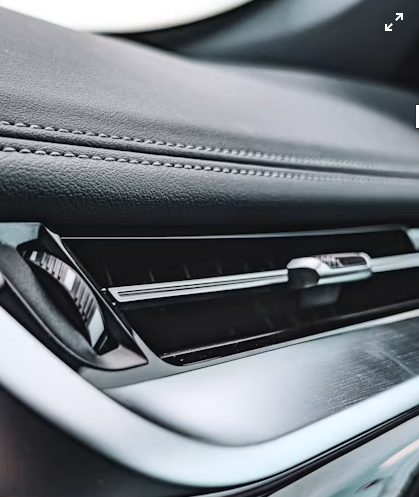
My Ford Transit had factory air conditioning, and for the time it worked it was better than anything else I tried.
The method is as simple as it sounds. Park, start the engine, turn the cab AC on, and go sit in the back. Within half an hour the difference is dramatic, with 35 to 38 °C outside. Not the partial relief of a fan — actual cold air, the same as any car.
Three advantages nothing else can match:
- It’s already installed. No cost, no hole in the roof, no added weight.
- It doesn’t touch your house battery. It runs off the alternator while the engine turns.
- It out-cools every camper unit. A vehicle AC system moves far more cooling capacity than a 12 V rooftop.
And one drawback that decides everything: the engine has to be running.
That rules out the night — noise, fuel, and you’re not going to sleep with the engine on. It burns diesel at idle. And in many places, leaving a parked vehicle running is prohibited.
But for the worst part of the day, that stretch between four and seven in the afternoon when the van is unlivable, it’s the most effective and cheapest solution that exists. Half an hour of engine and the interior stays habitable for a good while afterwards.
There’s something I find curious about this. In the same van I fitted a hot water system that took heat from the engine coolant, and it never worked properly — twenty minutes of running for five seconds of lukewarm water. The air conditioning does the same thing in reverse, worked perfectly, and cost me nothing. Sometimes what came with the vehicle beats what you buy for it.
What it really costs
The unit is the cheap part. That’s the sentence you won’t find on any product page.
The equipment:
- Rooftop 120 V, 13,500 BTU: $700 to $1,400
- Rooftop 12 V DC: $1,800 to $3,000
- Portable: $150 to $400
- Evaporative cooler: $120 to $400
What almost nobody adds up:
Installation. Six to ten hours of shop time if you’re not fitting it yourself.
The roof vent you give up, if you use that opening for the unit.
Roof reinforcement. A rooftop unit weighs 45 to 80 lb, and it sits at the highest point of the vehicle, which is the worst place for weight distribution and handling.
A 3,000 W inverter, if you go the 120 V route. That’s $400 to $900 on its own, and it’s not optional — the surge won’t start on less.
And above all, the batteries. To run it off-grid you need 400 to 800 Ah of lithium. At current prices that’s $2,000 to $4,500, which is more than the air conditioner, the inverter and the installation put together.
That last line is what turns a $1,500 project into a $6,000 one. And it’s the line that doesn’t appear on the box.
The honest summary:
| If you… | Then |
|---|---|
| Always stay at campgrounds with hookups | Any 120 V unit works. Buy the cheapest reliable one |
| Want it off-grid, occasionally | 12 V DC rooftop, 200 Ah lithium, a few hours a night |
| Want it off-grid, all night, in real heat | 12 V DC rooftop and 400 Ah+ of lithium. Budget accordingly |
| Have a normal van battery and hope | It won’t work. The numbers are above |
Cool the person, not the van
Before spending anything, it’s worth being clear about what you’re actually trying to achieve.
An air conditioner cools the volume of air in the van — roughly six cubic metres, plus the walls, the furniture and the water tanks, all of which have absorbed heat all day and are radiating it back. That’s an enormous thermal load, and it’s why the numbers are so brutal.
But you don’t need the van at 20 °C. You need to be able to sleep.
And your body doesn’t cool by being in cold air — it cools by evaporating sweat. Moving air does that far more effectively than still cold air, which is why a fan pointed at you feels better than its 25 watts should be able to deliver.
That’s the whole reason a 2-amp roof fan competes with a 137-amp air conditioner on the thing that actually matters. The air conditioner is winning a different contest.
The practical version:
- Air moving directly over you does more than the same energy spent cooling the whole space
- Two openings and a fan beat one expensive machine, on most nights
- The air conditioner earns its place on the nights when the outside air itself never drops — and those are fewer than people expect
None of this makes air conditioning useless. It makes it the last thing to try, not the first.
What actually makes the van livable
This is where most people end up after seeing the numbers, and the answer is better than it sounds.
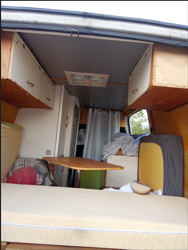
A roof fan with extraction. The most effective thing per dollar spent, by a wide margin. It draws around 2 A, you can run it all night without thinking about the battery, and by pulling air out it forces cooler air in through the windows. The difference between a van with a roof fan and one without is enormous, and it costs a fraction of any air conditioner.
Turn the fan off too. When a rooftop air conditioner reaches its set temperature the compressor stops, but on the default setting the circulation fan keeps running — drawing power all night for no cooling benefit. Most units have a mode, which Coleman call “Auto Cool”, that shuts the fan down along with the compressor. One button, and over eight hours it adds up.
Shade, which is free. A van in full sun and the same van under a tree can differ by ten degrees. No electrical installation competes with choosing where you park.
The color of the van, which is worth more than any setting. The Fit RV own two comparable vans, one yellow and one black, and parked them side by side in the same driveway. The measured difference was 14 °F on the exterior skin and around 20 °F inside. Twenty degrees, achieved by paint — more than most air conditioners are asked to deliver.
If you’re still choosing a vehicle, this belongs in the decision, ahead of most of the electrical planning. And if you already have a dark van, it explains why your results won’t match anyone else’s numbers: every runtime figure you read online assumes their vehicle and their color.
Insulation and reflective covers. Insulation isn’t only for winter — in summer it stops the sun-heated shell from radiating inwards all night. And reflective covers on the cab windows remove a large share of the heat that gets in, because that’s where the van behaves like a greenhouse.
Cross ventilation. Two openings facing each other move far more air than one large one. A roof vent open and a window on the opposite side does more than a badly positioned fan.
A 12 V fan rather than a 120 V one, as covered above. Same cooling, a third of the current, and no inverter running all night.
The engine’s air conditioning for the worst hour, as covered above.
And the one nobody wants to hear: move the van. Two hundred metres of altitude, or getting closer to the coast, changes the night more than any equipment you can install. That’s the advantage of living on wheels, and it costs nothing in amp-hours.
Frequently asked questions
Can you run an RV air conditioner on battery power?
Technically yes, but the battery bank required is the problem. A 13,500 BTU rooftop unit draws about 137 amps at 12 V through an inverter, and overnight at a realistic duty cycle that’s roughly 710 amp-hours. You need 400 to 800 Ah of lithium — a four-figure investment in batteries alone. A 12 V DC rooftop unit cuts that by about two thirds and is the only version that works off-grid without an absurd bank.
· How long will a 100Ah battery run an RV air conditioner?
Around twenty minutes, and that assumes lithium. A 100 Ah lithium gives about 90 usable amp-hours; a 13,500 BTU unit pulls 137 amps while running. An AGM of the same rating can’t even supply that current, so it will sag and trip the inverter rather than running at all.
What size inverter do I need for an RV air conditioner?
3,000 W as an absolute minimum, and that’s for the compressor’s startup surge rather than its running load. The surge is three to five times the running power — 4,000 to 7,000 W for a fraction of a second. With a 2,000 W inverter it won’t start regardless of battery condition.
Do evaporative coolers work in a camper van?
Badly, and the reason is physical rather than a matter of quality. They cool by adding water vapour, and inside a closed van that humidity accumulates within an hour. Once the air is saturated your body can’t evaporate sweat, so you feel hotter even at a slightly lower temperature. I used one for a summer; I now run the same unit dry, with the pump off, as a plain fan — and it works better that way.
How much does it cost to add air conditioning to a camper?
The unit is $700 to $1,400 for a 120 V rooftop, or $1,800 to $3,000 for 12 V DC. Add installation, roof reinforcement, a 3,000 W inverter for the 120 V route, and — the largest item — the batteries needed to run it off-grid, which can be $2,000 to $4,500. That’s what turns a $1,500 project into a $6,000 one.
How do you cool a camper van without air conditioning?
A roof fan with extraction is the most effective thing per dollar: about 2 amps, and you can run it all night. Add shade, insulation, reflective covers on the cab windows and cross ventilation. If your vehicle has factory air conditioning, half an hour of engine at the hottest part of the afternoon leaves the interior habitable for hours.
[…] ¿Prefieres verlo en inglés? Aquí tienes la guía equivalente sobre si es viable alimentar el aire acondicionado con batería: Can You Run an RV Air Conditioner on Battery Power? → […]
[…] Can You Run an RV Air Conditioner on Battery Power? The Real Numbers […]
[…] Can You Run an RV Air Conditioner on Battery Power? The Real Numbers […]