
Most guides tell you to add up your watts and add 20 %. Do that and your inverter will shut down the first time the fridge compressor kicks in.
The reason is startup surge. A compressor, a pump or a power tool pulls three to five times its rated power for a fraction of a second when it starts. Your inverter has to cover that instant, not just the steady load. Almost nothing you’ll read online accounts for it.
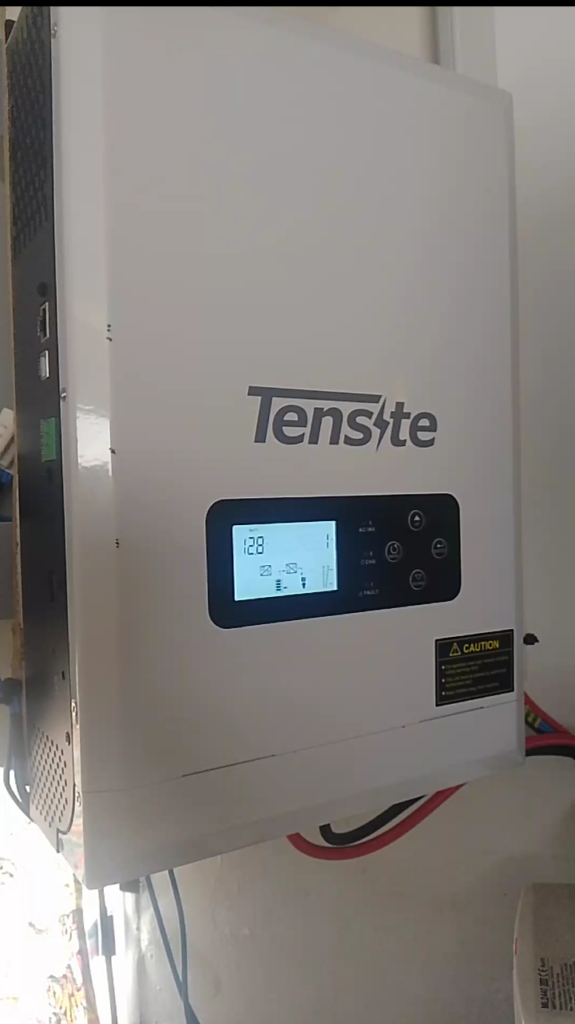
“I killed a perfectly good AGM running a 230 V fan overnight through an inverter. That’s the kind of mistake this site is built to save you from.”
This calculator does. Tick what you’ll run at the same time and it gives you the continuous load, the peak load, the inverter size that covers both, the DC current it will pull from your battery, and the wire gauge and fuse you need.
It works the same whether your outlets are 120 V or 230 V. The current drawn from the battery depends on watts and battery voltage, not on your mains standard.
Inverter size calculator
Tick the appliances you’ll run at the same time and set how many. The result updates automatically.
Tick an appliance to see your result.
Startup surge by appliance
Anything with a motor or a compressor pulls far more than its rated power for the first fraction of a second. This is the column nobody publishes, and it’s the one that decides whether your inverter cuts out.
| Appliance | Continuous | Surge factor | Peak draw |
|---|---|---|---|
| LED lights | 5-15 W | 1× | same |
| Phone charger | 10-20 W | 1× | same |
| 24" LED TV | 30-40 W | 1× | same |
| Laptop | 60-90 W | 1× | same |
| Compressor fridge | 40-60 W | 3-5× | 150-300 W |
| 12V water pump | 50-90 W | 3× | 150-270 W |
| Blender | 300-600 W | 2-3× | 900-1,800 W |
| Toaster | 800 W | 1× | same |
| Coffee maker | 800-1,200 W | 1× | same |
| Microwave (800 W rated) | 1,200-1,400 W | 2× | 2,400-2,800 W |
| Electric kettle | 1,500 W | 1× | same |
| Hair dryer | 1,500-2,000 W | 1× | same |
| Power drill / power tool | 500-800 W | 3-5× | 1,500-4,000 W |
| Portable air conditioner | 800-1,200 W | 3-5× | 2,400-6,000 W |
Two things worth noting. A microwave labelled "800 W" refers to its cooking output — it actually draws around 1,300 W from the outlet. And air conditioning is in a different league entirely: here’s what it does to a battery.
What each inverter size will actually run
| Inverter | Runs comfortably | Won’t run |
|---|---|---|
| 300 W | Laptop, phones, small TV, lights | Anything with a heating element or motor |
| 600 W | + small blender, light hand tools | Microwave, kettle, hair dryer |
| 1,000 W | + coffee maker, toaster | Hair dryer, kettle, air conditioning |
| 1,500 W | + small microwave, electric kettle | Large power tools, air conditioning |
| 2,000 W | + hair dryer, full-size microwave | Air conditioning |
| 3,000 W | + power tools, small air conditioner | Industrial loads |
One warning about the number on the box. An inverter advertised as "2000 W" is often rated at 2,000 W peak and only 1,000 W continuous. Check the manufacturer’s spec sheet for the continuous figure — that’s the one that matters. If yours already cuts out under load, work through the seven causes here.
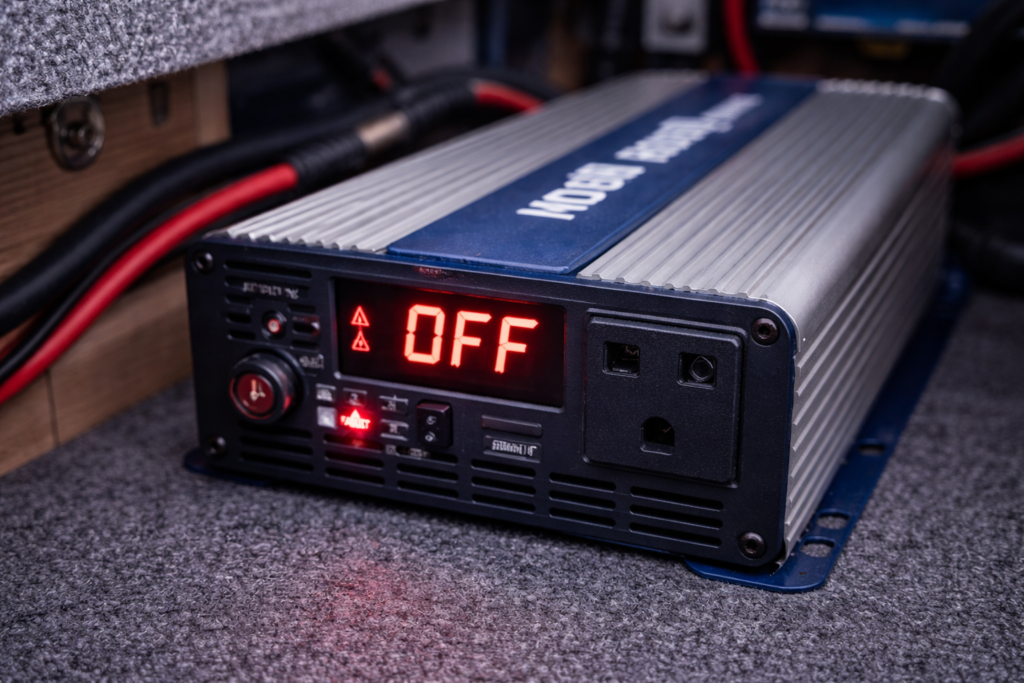
Current draw, wire gauge and fuse size
This is where 12 V systems catch people out. Moving 1,000 W through a 120 V outlet at home takes 8 amps. Moving the same 1,000 W from a 12 V battery takes around 98 amps. That’s why battery cable is so much thicker than anything you’ve wired in a house.
| Inverter | Amps at 12 V | Amps at 24 V | Battery cable | Fuse |
|---|---|---|---|---|
| 300 W | 29 A | 15 A | 8 AWG | 40 A |
| 600 W | 59 A | 29 A | 6 AWG | 80 A |
| 1,000 W | 98 A | 49 A | 2 AWG | 125 A |
| 1,500 W | 147 A | 74 A | 1 AWG | 175 A |
| 2,000 W | 196 A | 98 A | 1/0 AWG | 250 A |
| 3,000 W | 294 A | 147 A | 3/0 AWG | 350 A |
Figures assume 85 % inverter efficiency and a short cable run — up to about 6 ft (2 m) each way. Longer runs need thicker wire. And whatever size cable you land on, it still needs a fuse sized to protect it, not the inverter — here’s how to pick that fuse.
Those amp figures also tell you something about your battery. A 3,000 W inverter pulling 294 A is asking for more current than most 100 Ah AGM batteries can physically deliver — they’re limited to roughly 0.3-0.5C, so 30-50 A. Lithium handles 1C, meaning 100 A from the same nominal capacity. Here’s what that difference looks like in use.
Two things people get wrong here.
The first is forgetting that the run is doubled. If your inverter sits 6 ft from the battery, the current travels 6 ft out and 6 ft back — 12 ft of cable, and both legs count toward voltage drop.
The second is skipping the fuse, or fitting it on the wrong side. The fuse goes on the positive cable as close to the battery terminal as possible. It isn’t there to protect the inverter — it’s there to stop a shorted cable from becoming a fire, and that only works if it’s at the battery end.
If your wiring is already in and you suspect it’s undersized, here are the symptoms and a ten-minute test.
Pure sine vs modified sine
Most articles explain this with marketing language. Here’s the practical version: what actually breaks.
Modified sine wave inverters produce a stepped approximation of AC rather than a smooth curve. Cheaper, and for some loads it makes no difference at all.
What runs fine on modified sine: incandescent bulbs, heating elements, simple tools with universal motors, most basic chargers.
What suffers on it:
- Anything with an induction motor — fans, pumps, compressor fridges. They hum audibly, run hotter and lose life. A fridge compressor on modified sine can draw noticeably more current for the same cooling.
- Switching power supplies — some laptop chargers refuse to start, others buzz.
- Anything with sensitive electronics — audio equipment picks up interference, some devices with digital clocks run fast or slow.
- Medical equipment. If you run a CPAP machine, use pure sine. This isn’t a preference, it’s a requirement — several manufacturers void the warranty on modified sine and some units simply won’t run.
Pure sine wave produces a clean waveform identical to grid power. Everything works. It costs roughly 30-50 % more.
How I’d decide. If you’re only charging phones and running a laptop, modified sine is fine and the money is better spent on battery. The moment you have a compressor fridge, a water pump, or anything medical, buy pure sine. The price difference is smaller than one replacement fridge compressor.
What the inverter itself costs you
Every guide tells you to size an inverter for your loads. Almost none mention what the inverter costs you just by being switched on, or why the number on your appliance is not the number leaving your battery.
I found this out by ruining a battery.
The night I killed a 150 Ah AGM
I had a 230 V fan running overnight through the inverter. The fan’s display read 46 W. Reasonable, I thought — 46 W for eight hours is under 400 Wh, and a 150 Ah AGM should shrug that off.
It didn’t. The battery went down far more than it should have, and after enough nights like that it never recovered.
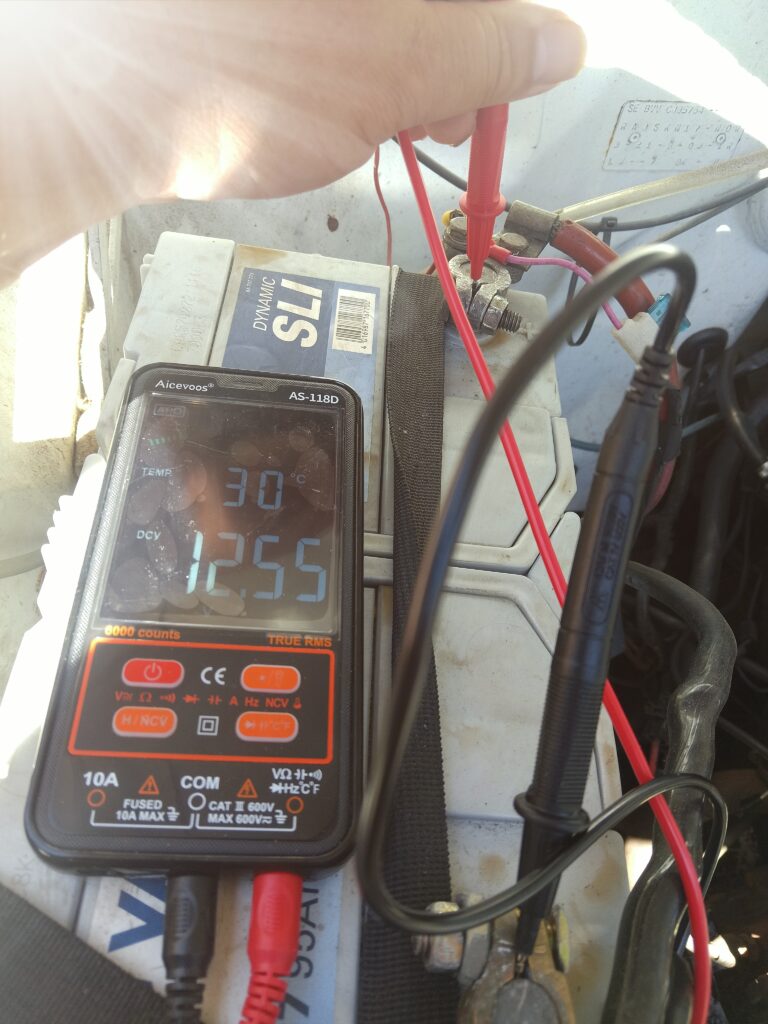
So I measured properly, with a clamp meter on the battery side. The actual draw was between 65 and 85 W — nearly double the display. I tried a second fan from a different brand and got the same result.
Why the numbers don’t match
Three things stack up, and none of them appear on the appliance label.
Power factor. An induction motor doesn’t draw current in phase with voltage. Its power factor is typically 0.6 to 0.7. The display shows active power — 46 W — but the inverter has to supply apparent power, which is 46 ÷ 0.65 = around 70 VA. Your battery pays for the VA, not the W.
Inverter efficiency is worst at low load. An inverter rated at 90 % efficiency hits that figure near its rated output. Run a 1,000 W inverter at 46 W and you’re operating at 5 % of capacity, where efficiency collapses.
No-load draw. Simply being switched on, an inverter pulls between 0.3 and 1.5 A at 12 V — that’s 4 to 18 W burned continuously, whether anything is plugged in or not. Leave it on for a week doing nothing and it’s eaten several amp-hours a day.
What this means for your calculation
Eight hours of that fan cost roughly 600 Wh. A 150 Ah AGM holds about 1,800 Wh nominal, but you can only safely use half of it — around 900 Wh. So one night with a “46 W” fan consumed two thirds of my usable capacity. Repeat that regularly and the battery dies early, which is exactly what happened.
Practical takeaways:
- For anything with a motor, assume 40-50 % more draw than the label states. If you want to be precise, divide the rated watts by 0.65.
- Switch the inverter off when you’re not using it. Not standby — off.
- If you’re running something small overnight, look for a 12 V version. A 12 V fan doing the same job draws a fraction of the current, because there’s no inverter and no power factor problem in the path.
I’ve since seen the same effect on a portable power station: a load that pulled 350 W on startup settled at 150 W, and the runtime the manufacturer quoted assumed the second figure, not the first.
None of this is on the box. All of it comes out of your battery.
The inverter is one of five places the calculation goes wrong. Here are the other four, and the correction factor I use now.
Frequently asked questions
What size inverter do I need for a camper van?
It depends on what you run at the same time, and on the startup surge — not just the continuous watts. A compressor fridge rated at 50 W pulls up to 250 W the instant it starts. As a rule, size the inverter to cover 125 % of your continuous load or 55 % of your peak load, whichever is higher. For most van builds that lands between 1,000 W and 2,000 W.
What can I run on a 2000W inverter?
A full-size microwave, a hair dryer, a coffee maker, a toaster and an electric kettle — one at a time. What it won’t run is air conditioning, which needs 3,000 W or more once you count the compressor surge. Check whether your 2000 W figure is continuous or peak; many are peak only.
How much power does an inverter use by itself?
· Between 0.3 and 1.5 A at 12 V with nothing plugged in — roughly 4 to 18 W burned continuously. Over a week of being left switched on, that alone can pull several amp-hours a day from your battery. Switch it off, not to standby.
How long will my battery last with an inverter?
Divide your usable capacity by the actual draw, and note that the actual draw is usually higher than the appliance label. A 100 Ah AGM gives about 50 Ah usable; a 100 Ah lithium gives about 90 Ah. A load labelled 46 W can pull 65-85 W from the battery once power factor and inverter efficiency are counted.
Do I need a pure sine wave inverter?
If you’re only charging phones and laptops, modified sine is fine. If you run a compressor fridge, a water pump or anything medical such as a CPAP machine, buy pure sine. Induction motors run hot and lose life on modified sine, and several CPAP manufacturers void the warranty.
What size fuse do I need between the battery and inverter?
Around 125 % of the continuous DC current. A 1,000 W inverter at 12 V draws about 98 A, so a 125 A fuse. Fit it on the positive cable as close to the battery terminal as possible — it’s there to protect the cable, not the inverter.
[…] here: Size your inverter Work out your consumption Fix what’s […]
[…] ¿Prefieres verlo en inglés? Aquí tienes la calculadora equivalente, incluyendo la potencia de arranque: Inverter Size Calculator for Camper Vans — Including Surge Power → […]
[…] Inverter Size Calculator for Camper Vans — Including Surge Power […]
[…] Inverter Size Calculator for Camper Vans — Including Surge Power […]
[…] here: Size your inverter Work out your consumption Fix what’s […]
[…] Inverter Size Calculator for Camper Vans — Including Surge Power […]
[…] Inverter Size Calculator for Camper Vans — Including Surge Power […]
[…] here: Size your inverter Work out your consumption Fix what’s […]
[…] site is built to save you from.” — Gustavo, why I measure everythingStart here: Size your inverterWork out your consumptionFix what’s […]
[…] here: Size your inverter Work out your consumption Fix what’s broken The Tensite inverter, installed permanently […]
[…] Inverter Size Calculator for Camper Vans — Including Surge Power […]
[…] Inverter Size Calculator for Camper Vans — Including Surge Power […]
[…] Inverter sizing calculator — including startup surge […]
[…] Inverter Size Calculator for Camper Vans — Including Surge Power […]