
Almost every article on this answers the wrong question.
They tell you a 12 V compressor fridge draws 30 to 60 watts. That’s true, and it’s nearly useless on its own — because that figure barely changes. A fridge in a cold spring and the same fridge in a hot August both draw about 45 watts while the compressor is running.
What changes, enormously, is how long it runs.
A 12V compressor fridge uses about 40–50 W while running, which works out to 22–76 Ah per day depending on temperature (around 40 Ah at 25 °C).
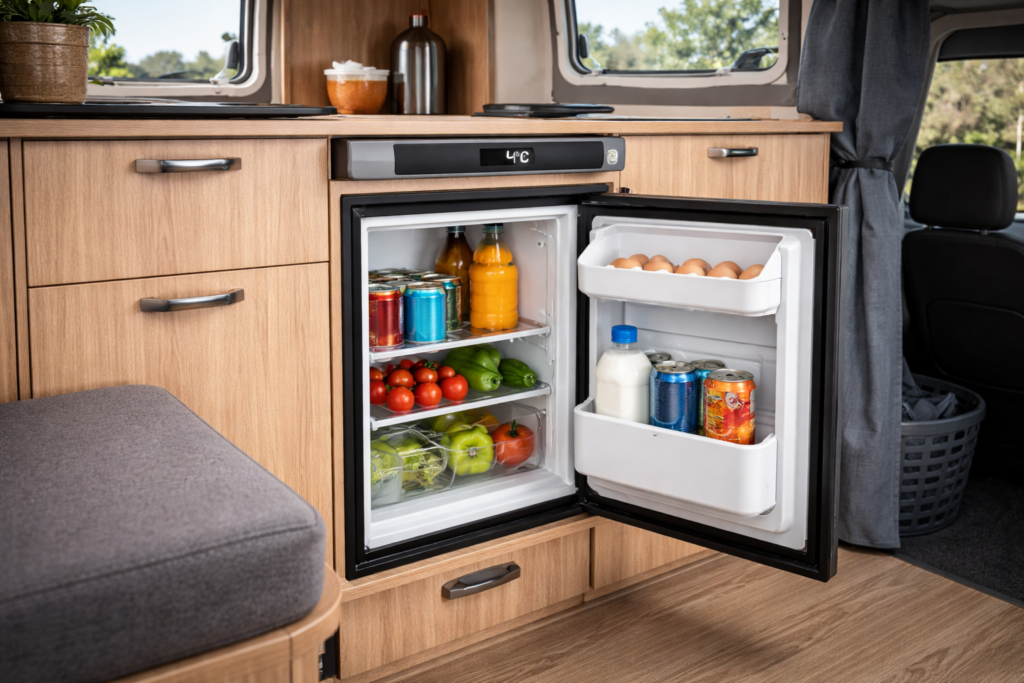
That’s the number that decides whether your battery lasts one night or three. The same fridge can use 22 amp-hours a day or 76, and the difference has almost nothing to do with the fridge.
This page is about that: what actually sets the duty cycle, how to measure your own, and why the cheap 12 V cooler you were considering is the worst possible choice on both counts.
“I killed a perfectly good AGM running a 230 V fan overnight through an inverter. That’s the kind of mistake this site is built to save you from.”
The short version
- Running wattage is nearly constant: about 45 W for a typical 40-50 L unit
- Daily consumption ranges from 22 to 76 Ah for the same fridge
- The variable is duty cycle — what fraction of the hour the compressor runs
- A thermoelectric cooler uses 2 to 3 times more energy and never reaches a safe temperature
The number everyone quotes, and why it misleads
A 12 V compressor fridge draws 40 to 50 watts while the compressor runs. At 12 V that’s roughly 3.5 to 4 amps.
This figure is remarkably stable. It’s set by the compressor — most van fridges use a Danfoss/Secop BD35 or similar — and the compressor either runs or it doesn’t. It doesn’t run harder because it’s hot outside.
So where does the variation come from?
From the thermostat. The fridge cools to its set temperature, the compressor stops, the contents warm up, and it starts again. The proportion of each hour it spends running is the duty cycle, and that’s what heat, insulation and your habits actually change.
Same fridge, same 45 watts, two different days:
- Cold day: 25 % duty cycle, 6 hours running, 22 Ah
- Hot day: 85 % duty cycle, 20.4 hours running, 76 Ah
Three and a half times the energy, from an identical appliance.
That’s why quoting the running wattage tells you so little, and why a single measured figure from someone else’s van is a starting point rather than an answer.
For a typical 40-50 litre compressor fridge drawing 45 W while running, set to around 4 °C. Ambient means the temperature inside the van, not outside — and inside is usually warmer.
| Ambient | Duty cycle | Hours running | Per day | Amp-hours |
|---|---|---|---|---|
| 15 °C / 59 °F | ~25% | 6 h | 270 Wh | 22 Ah |
| 20 °C / 68 °F | ~35% | 8.4 h | 378 Wh | 31 Ah |
| 25 °C / 77 °F | ~45% | 10.8 h | 486 Wh | 40 Ah |
| 30 °C / 86 °F | ~55% | 13.2 h | 594 Wh | 49 Ah |
| 35 °C / 95 °F | ~70% | 16.8 h | 756 Wh | 63 Ah |
| 40 °C / 104 °F | ~85% | 20.4 h | 918 Wh | 76 Ah |
A sanity check against a real measurement. Build A Green RV measured a Norcold NB 751 with a Danfoss BD35 compressor over two days at 80 °F (27 °C), using an inline watt-meter. Result: 42 Ah per day, 3.6 A while running, roughly 50 % duty cycle. That sits exactly where this table predicts, which is a reasonable reason to trust the rest of it.
⚠ Be honest about which row is yours
Plan for the hot row, not the average one. A system sized for 31 Ah a day will fail in July — and it will fail at three in the morning, which is when the fridge stops and nobody notices until breakfast.
The three types, and what each one costs you
Three different technologies get sold as “12V fridges”, and the difference in what they take from your battery is enormous.
| Type | Draw | Per day | Where it belongs |
|---|---|---|---|
| Compressor 12/24 V | 40-50 W cycling |
22-76 Ah | The only sensible choice for battery and solar |
| Absorption (12V / 230V-120V / gas) | 80-150 W on electric |
over 165 Ah | On gas when parked. Never on battery |
| Thermoelectric (Peltier) | 40-70 W continuous |
75-140 Ah | Day trips, plugged in while driving |
The absorption fridge deserves a warning. On gas it’s efficient and it’s why they exist. On its 12 V electric element it’s a resistive heater — over 2,000 Wh a day, which is more than most van battery banks hold in total. Some RVs will happily let you select electric mode off-grid, and it will empty the battery in a few hours. Use gas when parked, electric only on shore power or while driving.
And the 230V/120V domestic fridge question, because people ask. Yes, you can run one through an inverter. No, it isn’t a good idea. You pay the conversion losses, you pay the inverter’s own draw — 4 to 18 W continuously, whether the fridge is running or not — and the inverter has to stay switched on twenty-four hours a day to catch each compressor start. A 12 V compressor fridge connected directly to the battery avoids all three. More on what an inverter costs you here.
The 12V cooler that isn’t a fridge
Before compressor fridges came down in price, I bought a thermoelectric cooler — one of the cheap ones with a small fan in the lid. It cost me about €20.
It barely cooled anything. It could keep something already cold from warming up for a while, but it never worked as a fridge. For a trip of several days it was useless, and in practice I ended up putting a bag of ice in it to do the job it was supposed to do itself. Eventually I took it out of the van.
That’s the part everyone who’s owned one recognizes. Here’s the part almost nobody knows.
It uses more energy than a real fridge. Considerably more.
A thermoelectric cooler uses the Peltier effect: current through a junction moves heat from one side to the other. There’s no compressor, no cycling, and no thermostat worth the name in the cheap ones. It runs continuously the whole time it’s switched on.
| Thermoelectric | Compressor | |
|---|---|---|
| Draw while running | 40-70 W | 40-50 W |
| Duty cycle | ~100% | 25-85% |
| Daily consumption | 75-140 Ah | 22-76 Ah |
| Cooling achieved | 15-20 °C below ambient | Set temperature, regardless |
| At 30 °C ambient, reaches | 10-15 °C | 4 °C |
| Food safe? | No | Yes |
The part that surprises people
The cooler that doesn’t cool properly uses two to three times more energy than the fridge that does. It’s the worst outcome available on both counts — and it’s sold at a price that makes it look like the sensible choice.
Why it can’t reach a safe temperature. A Peltier element only moves heat across a fixed differential — typically 15 to 20 °C below ambient. On a 30 °C day inside the van, the best it manages is 10 to 15 °C. Food safety needs below 5 °C. It isn’t refrigeration, it’s “slightly less warm”, and that’s why mine only worked with a bag of ice in it.
A compressor doesn’t work that way. It reaches its set temperature and holds it whether the van is at 15 °C or 40 °C — it just runs for longer.
Where a thermoelectric cooler does make sense: a day trip, plugged into the vehicle while driving, keeping drinks cool. That’s it. As the fridge in a camper it’s the most expensive option per amp-hour you can buy.
And for scale at the other end: if a fridge at 4 to 5 amps already looks demanding, air conditioning asks for 98.
What actually changes your duty cycle
If the duty cycle is what decides your consumption, these are the things that move it. Most of them are free.
Ventilation behind the fridge. The compressor and condenser have to dump heat somewhere, and if that heat sits in a sealed cabinet the fridge is fighting itself. A fridge built into a tight box with no airflow can run half again as long as the same unit with a vent at the bottom and another at the top. This is the single biggest thing most people get wrong at build stage, and it’s almost impossible to fix afterwards.
Where the van is parked. Direct sun on the side the fridge sits against raises the ambient around it well above the cabin temperature. Shade is worth more than any setting.
How cold you set it. Every degree colder costs run time. If you’re storing drinks and vegetables rather than raw meat, 6 °C does the job that 2 °C is doing.
What you put in it, and at what temperature. Loading warm food or drinks means the compressor runs for hours pulling that thermal mass down. Chill things on shore power before you leave if you can — it’s a one-off cost paid at the campsite rather than a repeated one paid by your battery.
How often the door opens. Cold air falls out every time, and the compressor has to replace it. In hot weather, frequent opening can add 20 to 40 % to the daily figure. Grouping what you need into one trip genuinely helps.
Insulation of the fridge itself. This is the difference between two units with identical compressors and identical labels. It’s also the thing that separates a cheap 12 V fridge from an expensive one, and it doesn’t appear on the spec sheet as a number.
Voltage arriving at the fridge. A fridge receiving 11.6 V instead of 12.6 V because of undersized cable works harder and runs longer for the same cooling. It’s an easy thing to check and a common one to find. Symptoms and test here.
The setting on your fridge that protects the battery
Almost every 12 V compressor fridge uses a Danfoss/Secop BD-series compressor, and that compressor has a battery protection setting most owners never touch. It decides at what voltage the fridge shuts itself off to avoid flattening your battery.
| Setting | Cuts out at | Restarts at |
|---|---|---|
| Low — usual factory default | 10.4 V | 11.7 V |
| Medium | 11.4 V | 12.5 V |
| High | 11.8 V | 12.9 V |
⚠ Most fridges ship on “low”
That means your fridge will keep running until the battery reaches 10.4 V — far past the point where a lead-acid battery is being damaged. An AGM should never go below about 12.0 V under load. The fridge protects itself from an undervoltage fault. It does not protect your battery.
On lead-acid, set it to “high”. The fridge stops earlier, you lose some cooling on a bad night, and the battery survives to do it again next week. On lithium, “medium” is usually fine, because the BMS handles the real cut-off.
How to change it: on most units it’s a jumper or a small switch on the compressor’s control module, behind the fridge. Some newer models expose it in the digital menu. Look in the manual for “battery protection” or “voltage cut-out”.
It takes five minutes, costs nothing, and it’s the single most useful thing you can do to stop the fridge slowly killing the battery. Check the values against your own manual — they vary slightly between compressor models.
How to measure yours over 24 hours
Everything above is a model. Your fridge, in your van, in your climate, is a number you can measure — and it’s the only one that really matters for sizing a system.
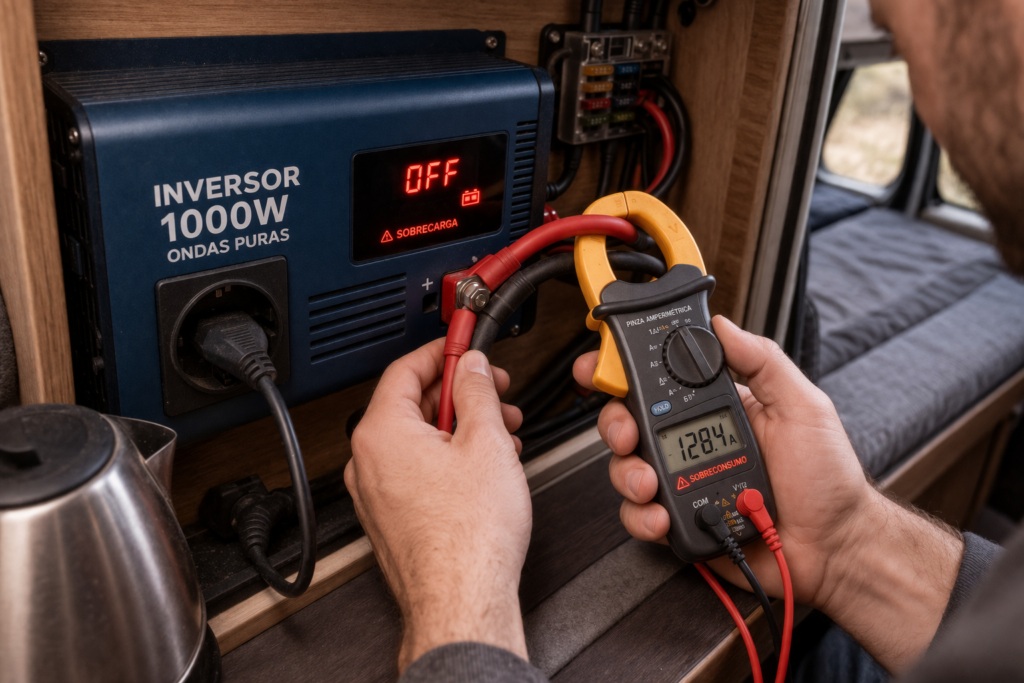
What you need: a battery monitor with a shunt, or an inline DC watt-meter. The cheap watt-meters cost around $20 and are adequate for a test, though not something to leave permanently installed.
How to do it:
- Start with the battery charged, and note the reading.
- Isolate the fridge if you can — measure on its own circuit rather than the whole system. If you can’t, run the test with everything else switched off.
- Use the van normally for 24 hours. Open the door as you would. Put food in. Don’t baby it, because you’re measuring real use, not best case.
- Note the ambient temperature, ideally the maximum and minimum inside the van. Without that, the number means nothing next season.
- After 24 hours, read the accumulated watt-hours or amp-hours.
Converting the result:
If the meter reads 420 Wh over 24 hours:
420 Wh ÷ 12 V = 35 Ah per day
That’s your figure — for that temperature. Repeat it once in summer and once in winter and you have the range your system actually has to cover.
One honest note about cheap meters. Build A Green RV ran exactly this test and reported that the meter reset its accumulated total partway through, for no apparent reason, and that its internal wiring looked light for its claimed rating. Treat a $20 meter as a measuring instrument for a two-day test, not as permanent installed equipment.
Sizing the battery for it
The fridge is the largest continuous load in most vans, and it runs whether you’re awake or not. So it’s the load the system should be designed around, not the one added at the end. It’s usually not the only continuous-ish draw either — if you’ve added a 12V hot water system, that one has its own power profile worth accounting for separately, covered here.
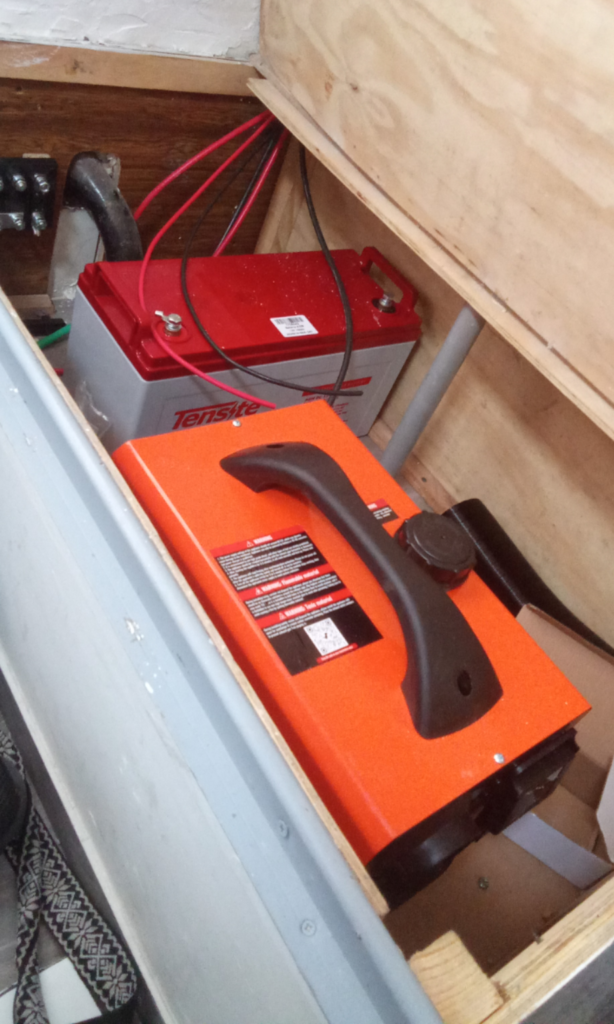
Start with the number, not the fridge. Take your daily amp-hours from the table or from your own measurement — and take the hot-weather figure, not the average. Call it 50 Ah a day for a typical fridge in summer.
Then apply what your chemistry actually gives you:
- AGM 100 Ah → about 50 Ah usable → one day, and that’s the whole battery gone, with nothing left for lights, pump or charging a laptop
- AGM 200 Ah → about 100 Ah usable → two days, more realistically a day and a half with other loads
- Lithium 100 Ah → about 90 Ah usable → just under two days
- Lithium 200 Ah → about 180 Ah usable → three days plus
This is where the AGM-versus-lithium argument stops being theoretical. A 100 Ah AGM sized “for the fridge” is a battery that reaches 50 % every single day, and lead-acid batteries die from being emptied. That’s how you get a battery that fails inside two years. The full comparison, including what a degraded AGM looks like.
And solar has to cover the same number. If the fridge takes 50 Ah a day, your panels have to put 50 Ah back in — before anything else. In good summer sun a 200 W panel might deliver 50 to 60 Ah, so a single 100 W panel does not cover a fridge in July, whatever the packaging says.
The practical rule: work out the fridge first, in hot weather, then size the battery and the panels around it, then add everything else. Doing it the other way round — battery first, fridge added later — is how most under-sized systems get built.
And the fridge is only one line on the list. There are five errors in the calculation itself, and every one of them makes your real consumption higher than your figure.
The overnight number is the one that matters
Daily consumption is useful for sizing, but it hides the question people actually care about: will the fridge still be running in the morning?
The day and the night are not the same.
At night the van is cooler, so the duty cycle drops — maybe 25 % instead of 45 %. Over twelve hours that’s about three hours of running, so roughly 135 Wh, or 11 Ah.
That sounds comfortable. But consider what else is true at night:
- Solar contributes nothing. Every amp-hour comes out of the battery.
- The battery is at its lowest point of the cycle, because it’s been discharging since sunset.
- Nobody is watching. If the fridge cuts out at 3 a.m., you find out at breakfast, along with the food.
So the sizing question isn’t only “does the battery cover the day”. It’s “does the battery still have usable capacity at 6 a.m., after twelve hours with no charging” — and that’s where a bank sized to the daily average comes up short.
A rough guide: if your battery is at 50 % when the sun goes down, an AGM has nothing left to give. It should be near full at sunset, not half.
Why the fridge is what kills batteries
There’s a reason the fridge deserves this much attention, and it isn’t the total energy.
It’s that the fridge runs every night, all night, all year. No other load does that. Lights go off. The laptop gets charged and unplugged. The pump runs for seconds at a time. The fridge keeps cycling while you sleep, in December and in August.
That means the fridge is what determines how deep your battery goes every single night — and lead-acid batteries don’t die from being used. They die from being emptied, repeatedly, and put back only partially.
I know this because it’s what happened to mine. My 150 Ah AGM is under a year old and already degraded: normal voltage at rest, collapse under any load, and charge acceptance that has halved. The causes were a heater running through winter nights and a fan running through summer ones — the same pattern a fridge produces, just seasonally. What that degradation looks like in detail.
The practical conclusion: size the bank so the fridge takes it to 70 or 80 % overnight, not to 50 %. That means roughly 20 % more capacity than the calculation says you need.
That margin costs money once. Replacing a battery every eighteen months costs more, and it costs it repeatedly.
Frequently asked questions
How many watts does a 12V fridge use?
· Between 40 and 50 watts while the compressor is running, which at 12 V is roughly 3.5 to 4 amps. That figure barely varies. What varies is how long the compressor runs, and that’s what determines your daily consumption.
How many amp-hours does a 12V fridge use per day?
Between 22 and 76 Ah for the same fridge, depending on temperature. Around 40 Ah at 25 °C ambient, rising to 63 Ah at 35 °C. Plan for the hot figure — a system sized for the average will fail in summer.
How long will a 100Ah battery run a 12V fridge?
An AGM 100 Ah gives about 50 Ah usable, so roughly one day with a fridge alone and nothing else connected. A lithium 100 Ah gives about 90 Ah usable, so just under two days. Both assume no other loads, which is never the case in practice.
Does a 12V fridge run continuously?
No. The compressor runs until the set temperature is reached, then stops, then restarts as the interior warms. That cycling is why daily consumption is far lower than 45 W × 24 hours. In hot weather or with poor ventilation the cycles get longer and closer together.
Is a thermoelectric cooler cheaper to run than a compressor fridge?
No — it’s considerably more expensive. A Peltier cooler runs continuously with no meaningful cycling, using 75 to 140 Ah a day against 22 to 76 for a compressor fridge. It also can’t reach a food-safe temperature: it only cools 15 to 20 °C below ambient.
Can I run a household 230V fridge in a camper?
· You can, through an inverter, but it costs you three ways: conversion losses, the inverter’s own draw of 4 to 18 W continuously, and the need to leave the inverter switched on around the clock so it catches each compressor start. A 12 V compressor fridge connected directly to the battery avoids all three.
How much solar do I need for a 12V fridge?
Enough to replace its daily consumption before covering anything else. A fridge using 50 Ah a day in summer needs roughly 200 W of panel in good conditions just to break even. A single 100 W panel does not cover a fridge in hot weather, whatever the packaging suggests.
[…] here: Size your inverter Work out your consumption Fix what’s […]
[…] ¿Prefieres verlo en inglés? Aquí tienes la guía equivalente sobre el consumo de la nevera 12V: 12V Fridge Power Consumption → […]
[…] 12V Fridge Power Consumption: Why the Wattage Isn’t the Number That Matters […]
[…] 12V Fridge Power Consumption: Why the Wattage Isn’t the Number That Matters […]
[…] here: Size your inverter Work out your consumption Fix what’s […]
[…] 12V Fridge Power Consumption: Why the Wattage Isn’t the Number That Matters […]
[…] 12V Fridge Power Consumption: Why the Wattage Isn’t the Number That Matters […]
[…] 12V Fridge Power Consumption: Why the Wattage Isn’t the Number That Matters […]
[…] here: Size your inverter Work out your consumption Fix what’s broken The Tensite inverter, installed permanently near the battery — its LCD […]
[…] 12V Fridge Power Consumption: Why the Wattage Isn’t the Number That Matters […]
[…] 12V Fridge Power Consumption: Why the Wattage Isn’t the Number That Matters […]
[…] How much power a 12V camper fridge actually uses […]
[…] 12V Fridge Power Consumption: Why the Wattage Isn’t the Number That Matters […]