
Every guide to hot water in a van says the same thing about engine heat exchangers. Free hot water. Zero running cost. Uses waste heat you’re producing anyway. If you drive before you park, it’s the obvious answer.
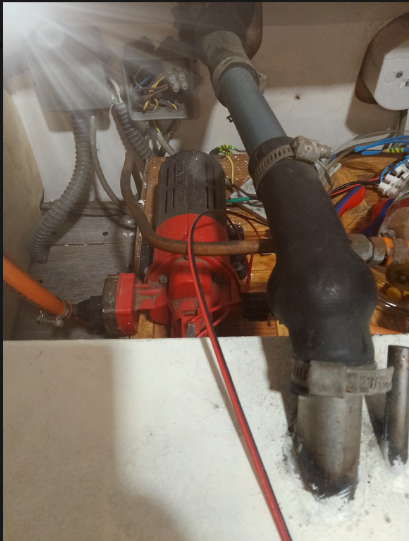
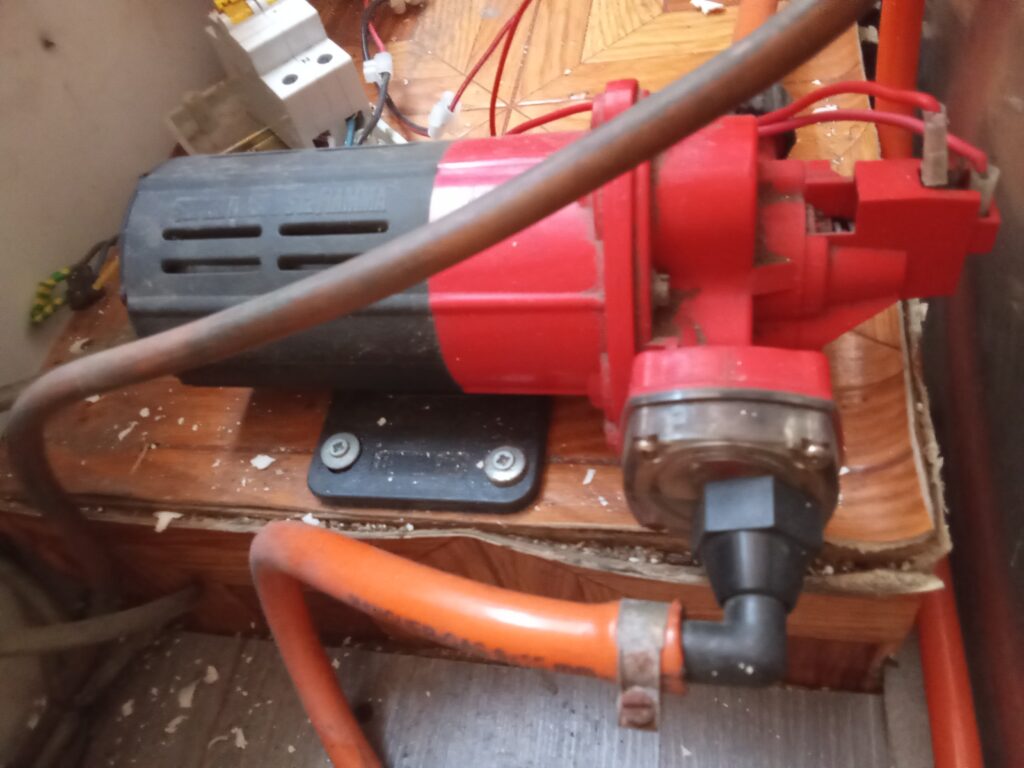
I paid close to €1,000 to have one fitted. It’s plumbed into the coolant circuit, with a 12 V control panel on the cabinet door where you set the temperature you want at the tap.
Here’s what it actually delivered. The installer told me to switch it on, set the temperature, and drive for at least twenty minutes so the coolant came fully up to heat. I did exactly that. I opened the tap and got water that was barely warm for a few seconds, and then it went cold and stayed cold.
I took the van back and showed him. He told me that’s the range the device has — it doesn’t heat more than that. And that was the end of it.
It wasn’t broken. That’s the part that took me a long time to understand, and it’s why I’m writing this page rather than a complaint. The system was doing what that kind of system does. What was missing was a component that nobody in the process mentioned, including me, because I didn’t know to ask.
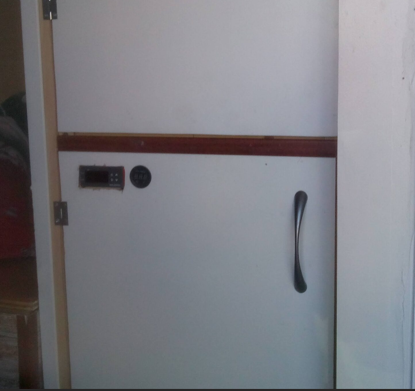
What went wrong, and why it wasn’t a fault
The symptom is specific enough to diagnose: warm for a few seconds, then cold. That’s not a failing component. That’s a system with nowhere to store heat.
Here’s the physics, and it’s brutal.
A van shower running at a modest 4 litres a minute, taking water from about 15 °C up to a comfortable 40 °C, needs roughly 7 kilowatts of continuous heat transfer. Not stored energy — continuous, for as long as the tap is open.
Seven kilowatts is a lot. It’s more than most van diesel heaters produce at full output.
Now think about where that heat is supposed to come from. The engine coolant, via a heat exchanger. And the engine is switched off, because you’re parked and about to have a shower.
With the engine off, the coolant isn’t circulating. The water pump is driven by the engine. So the exchanger has access to whatever hot coolant happens to be sitting in the pipework immediately around it — a litre or two — and nothing more.
That litre or two gives up its heat almost instantly. That’s your few seconds of warm water. After that the exchanger is passing cold water past coolant that’s already given everything it had, and you get cold.
So the installer was telling the truth. That is the range that device has. It just isn’t the range anyone described to me before I paid for it.
The component that was missing: a calorifier
The systems that actually work don’t heat water on demand. They heat a tank while you drive, and you draw from the tank when you stop.
That tank is called a calorifier. It’s an insulated cylinder — typically 10 to 20 litres in a van — with a coil inside it connected to the engine coolant circuit. While you’re driving, the coolant runs through the coil and heats the whole tank. When you park, you have 10 to 20 litres of genuinely hot water, and it stays hot for hours because the tank is insulated.
That’s the difference between the two, and it’s the whole page:
- Heat exchanger with no storage: heats water at the moment you draw it, needs the engine running and circulating, gives you seconds
- Calorifier: heats a tank in advance, works with the engine off, gives you a shower
Most guides use “heat exchanger” and “calorifier” loosely, as if they were the same thing. They aren’t. One of them is a shower and the other one is what I bought.
If you’re being quoted for a coolant-based hot water system, the question to ask is this: how many litres does it store, and where is the tank? If there isn’t a straight answer to that, you’re buying my system.
The options that actually exist, ranked by what they cost you
Here’s what’s available, and the honest version of what each one asks from you.
Gas instant heater. A small propane unit, either the cheap outdoor type or a proper built-in like a Truma. Heats water on demand with no tank and no engine involvement. Costs are low — $150 to $200 for a portable, around $500 for an in-line unit. This is the one I’d fit if I did it again.
Calorifier on the engine coolant. The version of my system that works. Needs a tank, and needs you to drive most days. If you park up for a week, you have cold water on day two.
Diesel combi unit. Webasto Dual Top, Truma Combi, Autoterm Flow. These heat the van and the water from the same burner, which is elegant, and they don’t need the engine. They’re also the most expensive thing in this list by a distance.
Electric — and this is where my site’s usual subject comes in. Heating water electrically is the most expensive way to do it in a van, by a long way. Raising 10 litres by 25 °C takes about 1,000 Wh. That’s an entire 100 Ah AGM’s usable capacity, for one small tank of hot water. A 12 V immersion element is too slow to be useful, and a 230V/120V one needs a large inverter and empties the bank. If someone offers you an electric water heater for a van, do the arithmetic before you agree.
Solar shower bag. Twenty euros, hangs in the sun, gives you a genuinely hot shower on a summer afternoon. Useless in winter, useless in the morning, and honestly better than what I paid €1,000 for.
Kettle and a basin. Not a system, but it’s what most people actually do most of the time, and nobody admits it.
| System | Cost | Needs | Works parked up? |
|---|---|---|---|
| Gas instant heater | $150-500 | Propane, flue | Yes |
| Calorifier on coolant | $500-1,000 | Daily driving | Only if you drove today |
| Heat exchanger, no tank | $800-1,200 | Engine running | No |
| Diesel combi unit | $1,500-3,000 | Diesel, 12 V | Yes |
| Electric tank | $200-600 | 1,000 Wh per tank | Shore power only |
| Solar shower bag | $20 | Sun, and patience | Summer afternoons |
What I’d do today
A gas instant heater. For a fifth of what I spent, it heats water whenever I want it, whether I’ve driven that day or not, and it doesn’t ask anything of the battery.
I’ll be straight about the limits of that recommendation: I haven’t owned one. I’m not going to tell you it’s flawless when what I actually have is a €1,000 device that doesn’t work and a clear idea of why. What I can say is that it solves the specific thing that made mine useless — it doesn’t depend on the engine having run.
And there’s an honest footnote to the whole story.
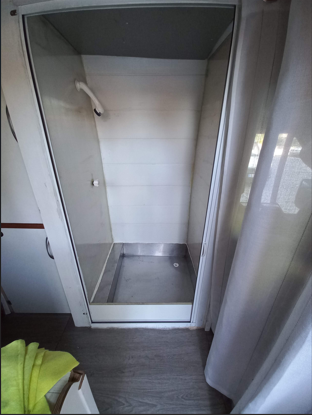
The period when I really lived in that van was a month or two after a workplace accident, and I couldn’t shower properly anyway because of the injury to my ankle. It was also summer. So the truth is I barely used the system before I found out it didn’t work.
That’s not a defence of the purchase. It’s the reason it took me so long to discover I’d wasted the money — and it’s a pattern worth recognising, because van systems get bought during the build and tested months later, when the person who fitted them has moved on.
What I’d tell someone about to spend this money
Ask what the system stores, not what it produces. A hot water system is defined by its tank. Litres of storage, and where the tank is. If nobody can answer that, there is no tank, and you’re buying seconds of warm water.
Test it before you pay the final invoice. Not a demonstration on the workbench — an actual shower, with the engine off, the way you’ll use it. I paid, drove away, and found out weeks later.
And be honest about how you’ll actually live. If you drive most days, coolant systems make sense. If you park up for a week at a time, they don’t, regardless of how well they’re built. My mistake wasn’t buying a bad product. It was buying a good product for a life I don’t lead.
Frequently asked questions
Why does my camper van hot water go cold after a few seconds?
Because there’s no storage. A heat exchanger with no tank can only pass on the heat sitting in the coolant right next to it, and with the engine off the coolant isn’t circulating. That’s a litre or two of hot liquid, which gives up its heat almost immediately. What you need is a calorifier — an insulated tank with a coil inside that’s heated while you drive and holds the heat afterwards.
Is an engine heat exchanger worth it for hot water?
Only with a calorifier tank, and only if you drive most days. The version without storage needs the engine running to give you anything, which is the opposite of what you want when you’re parked. I paid close to €1,000 for that version and got a few seconds of lukewarm water. If you park up for a week at a time, a coolant system is the wrong choice however well it’s built.
How much power does it take to heat water in a van?
More than most people expect. Raising 10 litres by 25 °C takes about 1,000 watt-hours — the entire usable capacity of a 100 Ah AGM, for one small tank. And a running shower at 4 litres a minute needs roughly 7 kilowatts of continuous heat transfer, which is more than most van diesel heaters produce at full output. This is why electric water heating rarely makes sense off-grid.
What’s the difference between a calorifier and a heat exchanger?
A heat exchanger transfers heat between two circuits at the moment water flows through it. A calorifier is an insulated tank with a heating coil inside, so it stores hot water for later. Most guides use the terms loosely as if they were the same thing. They aren’t — one gives you a shower when parked and the other doesn’t.
What’s the cheapest way to get hot water in a camper van?
A gas instant heater, at roughly $150 to $200 for a portable unit or around $500 built in. It works whether or not you’ve driven, and it doesn’t touch the battery. Below that, a solar shower bag costs $20 and gives a genuinely hot shower on a summer afternoon — which is more than my €1,000 system ever managed.
How do I check a hot water system before buying it?
Ask two questions: how many litres does it store, and where is the tank. If there’s no straight answer, there’s no storage. Then insist on testing it the way you’ll use it — engine off, parked, a full shower — before you pay the final invoice. Mine was signed off on a description rather than a demonstration, and I found out weeks later.