
If your inverter keeps shutting off, it’s almost never broken. In most cases it’s doing exactly what it should: protecting itself because something in the installation isn’t giving it what it needs.
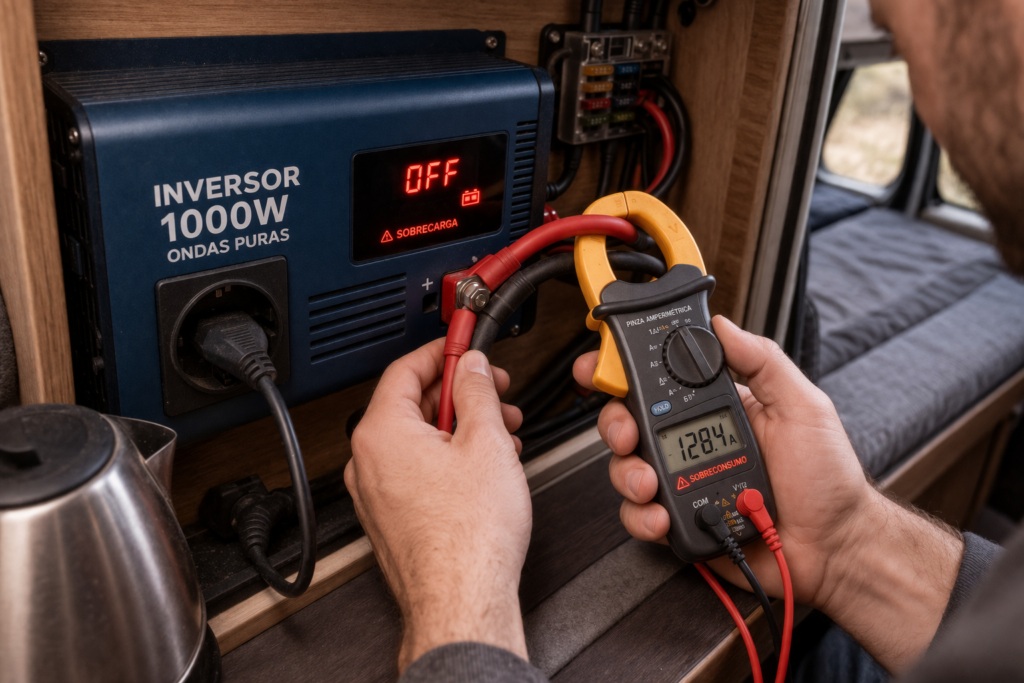
Which means replacing it won’t help. What helps is working out which of seven causes is yours, and that’s done with measurements, not guesswork.
The order matters too. Two of these causes look identical from the outside — a tired battery and an undersized cable both make the inverter report low voltage. One costs a few pounds to fix and the other costs a few hundred. There’s a single measurement that tells them apart, and it’s worth doing before you buy anything.
“I killed a perfectly good AGM running a 230 V fan overnight through an inverter. That’s the kind of mistake this site is built to save you from.”
Start here: when exactly does it shut off?
The moment it cuts out tells you where to look. Before taking anything apart, find your case:
- The instant a motor or compressor starts (fridge, pump, power tool) → insufficient surge capacity, or a battery that can’t deliver the current
- A few seconds after a heavy load comes on → voltage drop in the cable
- After running fine for twenty or thirty minutes → thermal protection
- When the battery hasn’t been charged for a while → battery flat or at end of life
- Randomly, with no pattern → loose or corroded connection
- It has never worked properly since installation → wrongly sized from the start
Each of those has a different check. They’re below in the order you should work through them.
Diagnostic table
| Symptom | Likely cause | How to confirm it | Fix |
|---|---|---|---|
| Cuts out when the fridge or pump starts | Startup surge above what the inverter can supply | Multiply the appliance rating by 3-5 and compare with the inverter’s continuous rating | Larger inverter, or don’t run that appliance on it |
| Cuts out under heavy load and the cable is warm | Undersized cable | Differential voltage test | Thicker cable, or shorten the run |
| Reports "low battery" with a charged battery | Voltage drop on the way | Measure at battery and at inverter simultaneously | Larger cable gauge |
| Cuts out after 20-30 minutes | Thermal protection | Touch the casing — if it’s hot, that’s it | Improve ventilation, move it off the wall |
| Cuts out earlier every month | Battery losing capacity | Measure at rest after 2 h — under 11.5 V on an AGM means damage | Replace the battery |
| Cuts out at random | Loose or corroded terminal | Move each cable while measuring under load | Re-torque and clean connections |
| Cuts out with any load at all | Wrongly sized from the start | Recalculate the whole system | Resize inverter, battery or both |
Work through it in that order. The first two checks cost nothing and rule out roughly half the possibilities. Replacing the battery before doing them is the most common way of spending several hundred pounds and still having the same fault a month later.
The seven causes, in the order you should check them
1. Voltage drop in the cable
The most common cause, and the one most often mistaken for a dead battery.
At 12 V the currents are enormous — a 1,000 W inverter pulls around 98 A. Push that through a cable that’s too thin or too long and you lose voltage on the way. The inverter receives less than the battery actually holds, sees a number below its cut-off, and protects itself.
How to confirm it: with a heavy load running, measure the voltage at the battery terminals and at the inverter terminals at the same moment. A difference of more than 0.5 V means the cable or the connections are your problem. Full test and what to do about it here.
The fix: thicker cable, or a shorter run. And remember the current travels out and back — an inverter two metres from the battery means four metres of conductor.
2. The battery can’t deliver the current
Different from the battery being flat. A battery can be fully charged and still be unable to supply the current the inverter demands all at once.
Every chemistry has a limit. An AGM tolerates roughly 0.3C to 0.5C, so a 100 Ah AGM comfortably delivers 30 to 50 A. Lithium handles around 1C — 100 A from the same nominal capacity. That’s why a 1,000 W inverter runs happily on a 100 Ah lithium bank and struggles on a 100 Ah AGM.
How to confirm it: if the differential test shows less than 0.3 V but the voltage falls at both points together, the cable is fine and the battery is the limitation.
The fix: more capacity, a different chemistry, or a smaller inverter. AGM vs lithium under load.
3. The load exceeds what the inverter can supply
The most obvious cause and the easiest to rule out, so do it early.
Two traps here. The first is adding up badly: if the fridge is already running and you switch on the coffee maker, the inverter has to supply both at once. The second is trusting the big number on the box, which is usually the peak rating rather than the continuous one. An inverter sold as “2000 W” may only sustain 1,000 W.
How to recognise it: it cuts out immediately when you connect one specific, demanding appliance, and comes back as soon as you unplug it.
The fix: find the continuous rating in the manufacturer’s spec sheet, and don’t run appliances whose combined draw exceeds it. Work out what you actually need here.
4. Startup surge
The inverter can be comfortably sized for your normal load and still fall short for half a second.
A fridge compressor, a water pump or a power tool draws three to five times its rated power at the instant it starts. A fridge rated at 50 W can demand 250 W for a moment. If the inverter can’t cover that spike, it cuts out — even though it handles the running load without difficulty.
How to recognise it: it fails at exactly the same moment every time, when one particular appliance starts, and works perfectly the rest of the time. In my case the inverter made a loud click, started beeping, and had to be reset manually.
The fix: size for the peak, not the average. That’s what the inverter calculator is for.
5. Bad connections
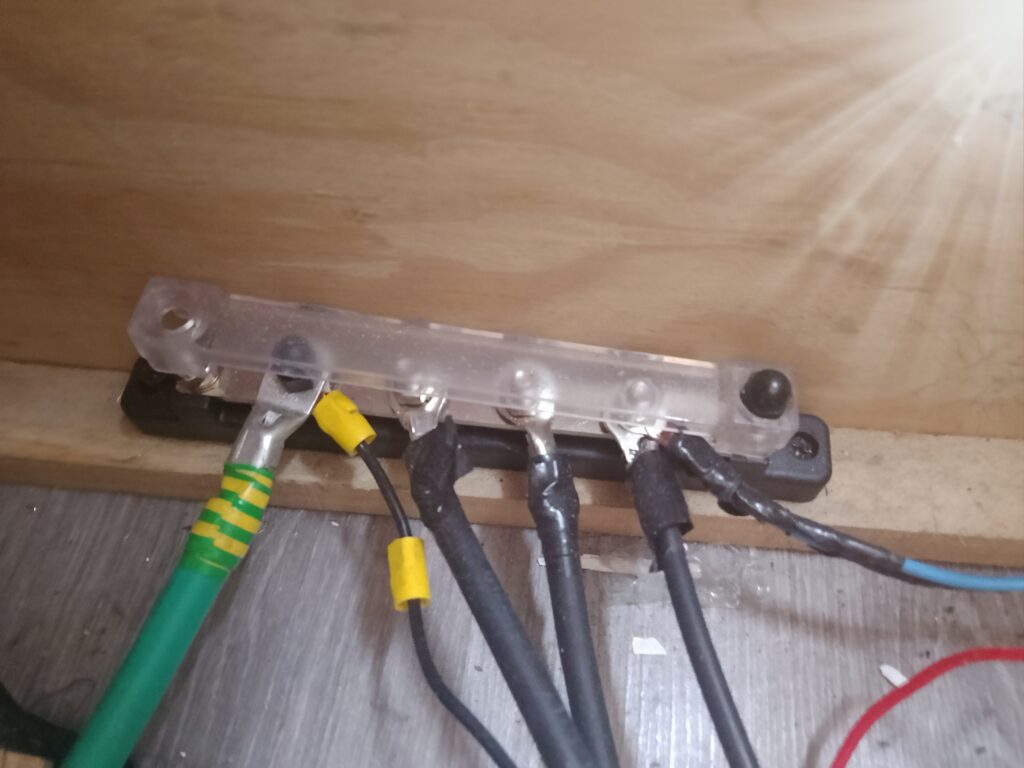
A loose terminal or a badly crimped lug creates resistance at a single point. Voltage is lost there and heat is generated there.
Vehicle vibration loosens bolts over months, and corrosion attacks terminals from the other direction. This is more likely in a van than in any fixed installation, because a van shakes for hours at a time.
How to confirm it: with the inverter loaded, gently move each cable while watching the meter. If the reading jumps around, you’ve found it. Also look for discoloured metal or deformed plastic — that’s heat that’s been happening for a while.
The fix: re-torque every terminal, clean off oxidation, and redo any crimp you’re not confident about.
These same loose or corroded connections are also one of the most common reasons a fuse keeps blowing repeatedly instead of the inverter simply shutting off — the underlying fault is the same, just protected by a different component. See Why Does the Fuse Keep Blowing in My Camper’s 12V System? for the full diagnostic walkthrough.
6. Thermal protection
Inverters generate heat and need to shed it. Mounted in a closed cupboard, pushed against a wall, or with the fan intake blocked, they reach their temperature limit and shut down.
How to recognise it: it works fine for twenty or thirty minutes, then stops. After cooling, it works again. Touch the casing — if it’s hot, that’s your answer.
The fix: clear space around it, don’t mount it in a sealed cabinet, keep the vents unobstructed, and keep it out of direct sun in summer.
7. Battery at end of life
An old battery holds a normal voltage at rest and collapses the moment you ask it for current. And it gets worse each month.
How to confirm it: leave the battery with no load and no charging for two hours, then measure. Below 11.5 V on an AGM means it’s damaged.
The fix: replace it. And work out what killed it, because the same conditions will kill the next one. Repeated deep discharge is the usual culprit.
When it really is the inverter: a 300W unit that died slowly
Everything above assumes the inverter is fine and something else is wrong. Usually that’s true. But not always, and this is what the exception looks like.
I had a small 300 W inverter mounted on the side of the bed, for charging a phone and a laptop and not much else. Modest use, well within its rating.
It didn’t fail suddenly. It degraded.
First it got noisier. Then noisier again. Over months the noise kept increasing, which I ignored because it still worked.
Then it began struggling to start loads. I’d plug something in and the conversion would take longer, or falter, or simply not happen. Eventually it became intermittent: sometimes it worked, sometimes it didn’t, with nothing changed on either side.
What was happening
Two things, and both were made worse by the same habit.
The fan. Small inverters use small fans with modest bearings. Rising noise usually starts there, and a failing fan means the electronics run hotter than they were designed to.
The capacitors. Every inverter contains electrolytic capacitors, and heat is what kills them. As they degrade, the inverter loses its ability to deliver the brief current surge a load needs at the moment of switching on. That’s exactly the symptom I had: fine once running, unreliable at the moment of connection.
And the habit that accelerated both: I left it switched on.
An inverter that’s powered up is drawing current and generating heat continuously, even with nothing plugged in. Mine sat there quietly cooking itself for hours at a time, doing nothing useful.
What I’d do differently
Switch it off when you’re not using it. Not standby — off. This costs you nothing and it’s the single biggest thing you can do for its life. It also saves the 4 to 18 W it burns doing nothing.
Give it air. Mine was on the side of the bed in a fairly enclosed spot. Small inverters get mounted wherever there’s room, and wherever there’s room is usually where there’s no airflow.
Treat rising noise as a warning. Inverters don’t get louder for no reason. By the time it’s noticeably noisier than it was, something is already wearing out.
How to tell this apart from everything else on this page: the other causes are situational — they appear with a specific load, at a specific moment, under specific conditions. Genuine inverter failure is progressive. It gets worse month by month, across every load, regardless of the state of the battery. If the pattern is deterioration over time rather than a repeatable trigger, that’s the one case where replacing the unit is the right answer.
And then it stopped working altogether. There was no dramatic failure, no smoke, no blown fuse — it simply reached the point where it couldn’t do the job any more.
Frequently asked questions
Why does my inverter keep shutting off?
In most cases it’s protecting itself, not failing. The seven usual causes are voltage drop in the cable, a battery that can’t deliver the current, a load above the inverter’s continuous rating, startup surge, a loose connection, thermal protection, or a battery at end of life. The moment it cuts out tells you which one — immediately on a motor starting points to surge, after twenty minutes points to heat.
Why does my inverter say low battery when the battery is charged?
Because it can only measure what arrives at its own terminals. If the cable loses a volt on the way, the inverter sees 11 V while the battery genuinely holds 12 V, and it shuts down to protect itself. Measure at both ends with the load running — a difference over 0.5 V means the cable, not the battery.
Can a good battery still cause the inverter to cut out?
Yes. Being charged and being able to deliver current are different things. A 100 Ah AGM comfortably supplies 30-50 A; a 1,000 W inverter asks for 98 A. The battery isn’t flat, it simply can’t supply that rate. Lithium of the same nominal capacity handles roughly double.
Why does my inverter turn off when the fridge starts?
Startup surge. A compressor pulls three to five times its rated power for a fraction of a second — a 50 W fridge can demand 250 W at that instant. The inverter may handle the running load perfectly and still fall short for that half second.
How do I know if the inverter itself is faulty?
Genuine inverter failure is progressive, not situational. The other causes appear with a specific load at a specific moment; a failing unit gets worse month by month across every load, often with increasing noise from the fan and growing difficulty starting anything. If the pattern is gradual deterioration rather than a repeatable trigger, the inverter is the problem.
Does an inverter use power when nothing is plugged in?
Yes — between 0.3 and 1.5 A at 12 V, so roughly 4 to 18 W burned continuously just by being switched on. Over a night that’s more than most people’s lighting. Switch it off rather than leaving it in standby.
[…] Start here: Size your inverter Work out your consumption Fix what’s broken […]
[…] Why Your Inverter Keeps Shutting Off: 7 Causes […]
[…] Why Your Inverter Keeps Shutting Off: 7 Causes and How to Tell Them Apart […]
[…] Why Your Inverter Keeps Shutting Off: 7 Causes and How to Tell Them Apart […]
[…] Why Your Inverter Keeps Shutting Off: 7 Causes and How to Tell Them Apart […]
[…] Why Your Inverter Keeps Shutting Off: 7 Causes and How to Tell Them Apart […]
[…] Why Your Inverter Keeps Shutting Off: 7 Causes and How to Tell Them Apart […]
[…] Why Your Inverter Keeps Shutting Off: 7 Causes and How to Tell Them Apart […]
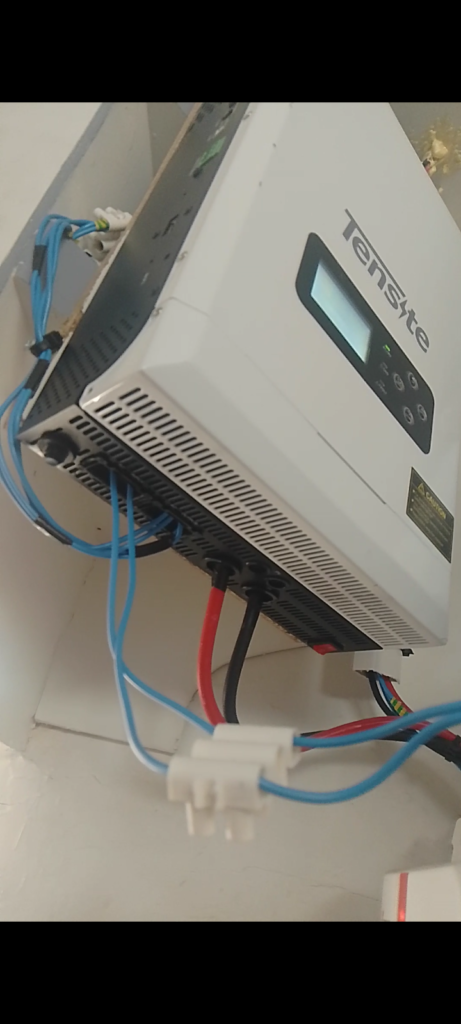
[…] here: Size your inverter Work out your consumption Fix what’s broken The Tensite inverter, installed permanently near the battery — its LCD shows terminal voltage […]
[…] Why Your Inverter Keeps Shutting Off: 7 Causes and How to Tell Them Apart […]
[…] Why Your Inverter Keeps Shutting Off: 7 Causes and How to Tell Them Apart […]
[…] Why Your Inverter Keeps Shutting Off: 7 Causes and How to Tell Them Apart […]