
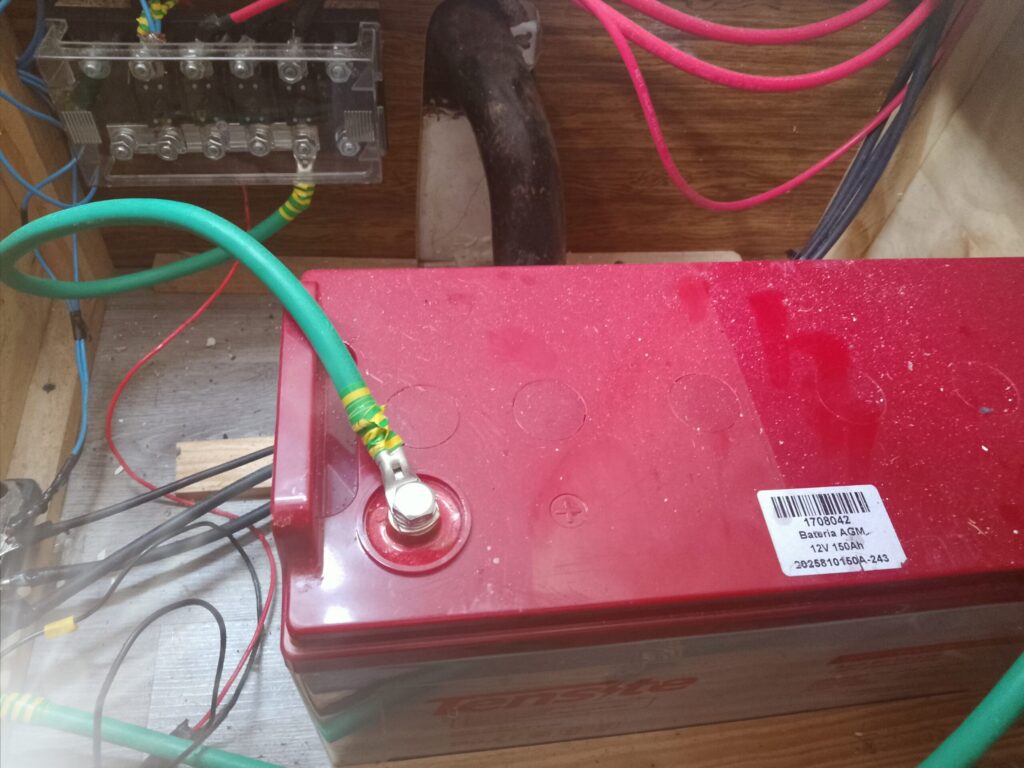
My AGM battery is 150 amp-hours, it cost €250, and it is under a year old. It still works — and it will never hold a full charge again.
Not dead — it still starts the day looking healthy. It shows a normal resting voltage, the charge controller reports it as full, and nothing on any display says there’s a problem. But put any load on it and the voltage falls off a cliff, and it accepts charge at less than half the rate it used to.
Search this question and you’ll find plenty of articles listing the reasons AGM batteries fail early. They’re broadly correct. What none of them do is measure it — and there’s one measurement, easy to take, that tells you the battery is going long before anything else does.
This is what happened to mine, what the numbers looked like, and how to check yours.
The short version
- A 150 Ah AGM, under one year old, badly degraded
- Cause: months at partial state of charge, not deep discharge alone
- Symptom one: normal voltage at rest, collapse under any load
- Symptom two: charge acceptance fell from 330 W to 155 W — same charger, same cables
- That second one is the earliest warning available, and almost nobody looks at it
What I did to it
None of this was abuse. It was ordinary use of a system that turned out to be sized for the average day rather than the hard one.
Through the winter, a diesel heater ran most nights. Not all night at full output, but cycling through the cold hours, every night, for months.
Through the summer, a fan ran all night. Many nights in a row, through the hot part of the year.
And in summer I park in shade. Which is the right decision for living in a van — it’s the difference between sleeping and not sleeping — but it means the panels recharge far less than they would in open sun.
I charge from solar only. No alternator charging, no shore power for weeks at a time.
Put those together and the pattern is this: the battery was emptied every night and only partially refilled every day. Not once. For months.
That’s the condition that kills lead-acid, and it’s more damaging than the occasional deep discharge everyone worries about.
And then one of the panels stopped charging altogether.
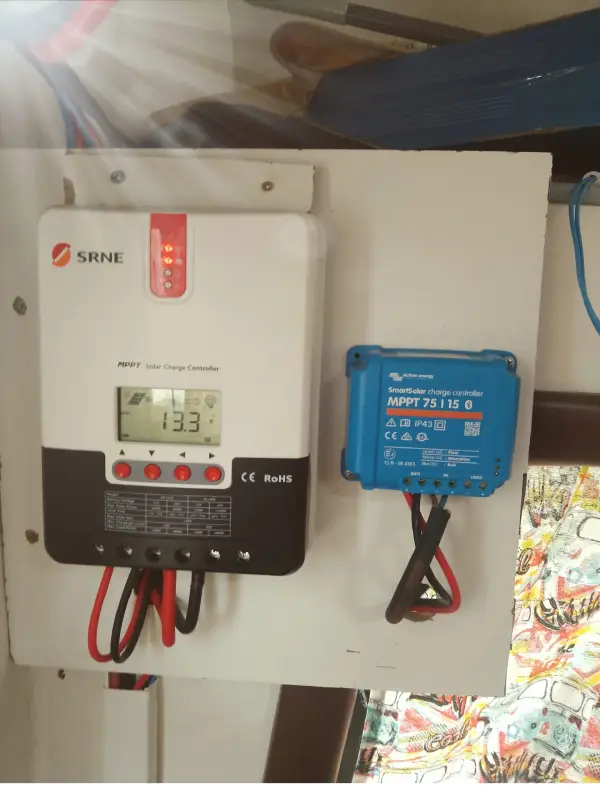
The Victron MPPT controller feeding it failed at under nine months old. So for part of that time — and I genuinely don’t know how long, which is the uncomfortable part — I was running on roughly half the charging capacity I thought I had.
This is the detail that matters most, and it’s the one nobody warns you about: a failed controller announces nothing.
There’s no alarm. No error on the other controller. No light on the panel. The battery voltage still looked plausible, the system still charged — just less. From inside the van, a day with one controller dead and a day parked in shade look identical.
I only found out because I went looking. By then the battery had been living on a partial charge for months.
So the honest version of what killed my battery is four things stacked:
- Heavy nightly loads, winter and summer
- Parking in shade, which halves what the panels deliver
- Charging from solar only, with no alternator or shore power to catch up
- A charge controller that quietly stopped working and told nobody
Any one of those on its own is survivable. All four together, for months, is not.
If you charge from solar only, check what’s actually going into the battery — not just what the battery says. How to test a solar charging chain in five measurements.
The two symptoms, and what they measure
A degraded lead-acid battery doesn’t announce itself either. It looks fine right up until you ask it for something.
Symptom one: normal at rest, collapse under load
At rest, my battery reads what a healthy AGM should read. Leave it two hours with nothing charging and nothing drawing, and the voltage sits where it’s supposed to sit. Any voltage-based state-of-charge display will tell you it’s fine.
Then apply a load — any load — and it falls off a cliff.
Not a gentle sag. A collapse, immediately, out of proportion to what’s being asked of it. Switch the load off and it recovers most of the way back within seconds.
What that means physically: the battery’s internal resistance has risen. Sulfation has reduced the active plate area available to react, so the same current now produces a much larger voltage drop inside the battery itself. The capacity number on the label hasn’t changed. What’s changed is the battery’s ability to deliver it. This voltage-collapse-under-load test is one of several signs worth checking before you write a battery off — here’s the full set.
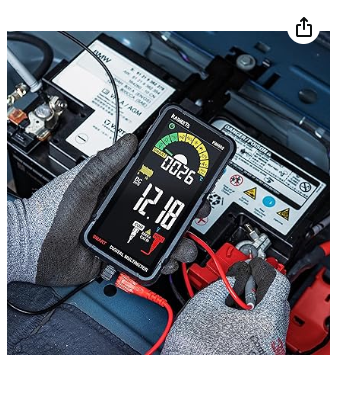
How to check yours: measure at rest after two hours with no charge and no load. Then switch on something demanding and measure again immediately. A healthy AGM sags modestly and holds. A tired one drops fast and keeps dropping.
Symptom two: charge acceptance halved — the one nobody checks
This is the earlier warning, and it’s easier to measure than the first.
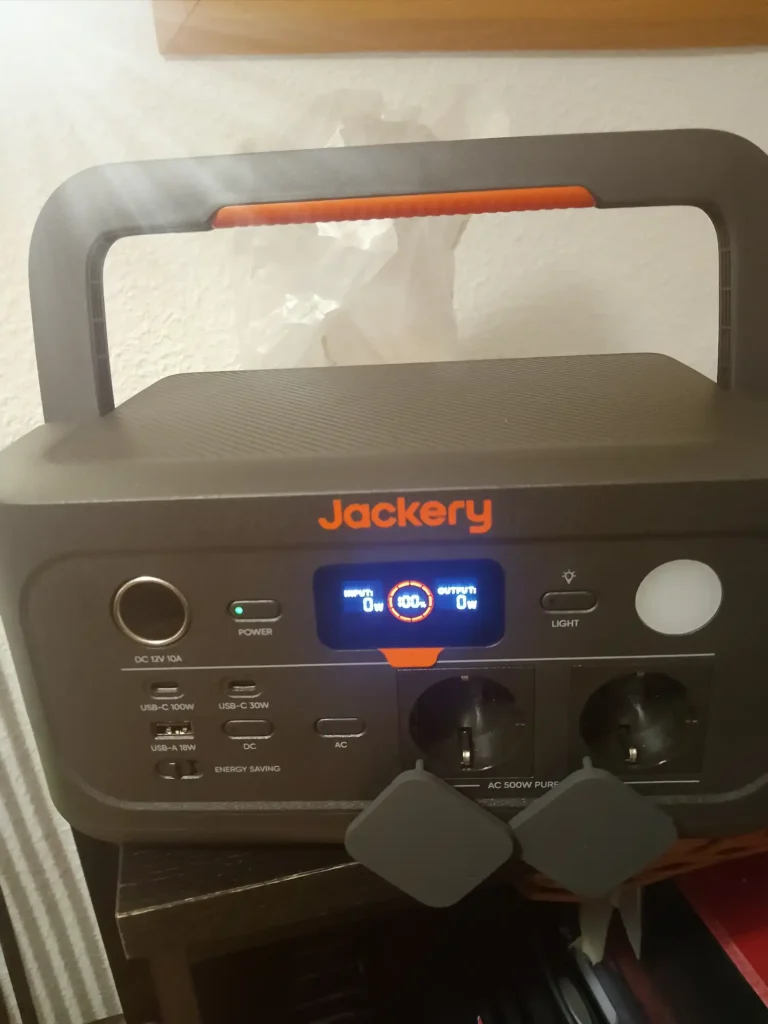
When I charge my battery from a portable power station, that station used to deliver over 330 W into it.
Today — same station, same cables, same battery — it will not go above 155 W.
Less than half.
And that isn’t the charger weakening. Here’s the mechanism:
As lead-acid degrades, internal resistance rises. During charging, that higher resistance means the battery’s terminal voltage climbs faster for the same current. The charger — which works in constant current until it hits a voltage ceiling, then tapers — reaches that ceiling much sooner. It drops out of the constant-current stage early and settles into a low trickle.
So the charger isn’t failing. It’s doing exactly what it’s designed to do, in response to a battery that can no longer absorb energy at the rate it once did.
Why this is the measurement to watch: capacity loss is hard to test without discharging the whole battery and timing it. Charge acceptance you can see on any charger with a display, in the first five minutes, without disturbing anything.
How to check yours: connect a charger capable of more current than the battery normally takes, on a battery that’s genuinely low. Note the wattage or amperage it settles at during the first minutes. Write it down. Repeat in six months.
If that number has dropped substantially with the same charger, the same cables and a similar starting state of charge, your battery is on its way out — and you’ll know months before it strands you.
Why partial charging is worse than deep discharge
Everyone worries about the 50 % rule — don’t take a lead-acid battery below half. It’s good advice and it isn’t the whole story.
What actually killed mine was never reaching 100 %.
Here’s the difference. A lead-acid battery stores energy by converting lead sulfate on its plates back into active material during charging. When it discharges, sulfate forms again. That cycle is normal and reversible.
But it’s only fully reversible if the charge completes.
If the battery is charged to 80 % and left there, some of that sulfate doesn’t get converted back. It stays. And sulfate that stays long enough crystallises into a hard form that no normal charging will remove. Each incomplete cycle leaves a little more behind.
That’s why the pattern matters more than the depth.
- One deep discharge to 30 %, followed by a full recharge → recoverable
- Months of gentle cycling between 60 % and 85 %, never reaching full → permanent damage
The second one feels safer. It’s the one that kills batteries.
And it’s exactly what a solar-only system in shade produces. The panels top the battery up during the day, the charge controller never gets it into the final absorption stage, and the battery spends its entire life in the range where sulfation accumulates.
Which is why the absorption stage matters more than people think. A charge controller needs to hold the battery at 14.4-14.7 V for a period — often an hour or more — to complete the conversion. Reaching 13.8 V and stopping is not a full charge, however green the light is. And if your controller is set to the wrong battery profile, it may never attempt it. Charge voltages by battery type.
The practical version:
- Getting to 100 % occasionally matters more than never going below 50 %
- If you go a fortnight without a full charge, find a way to give it one — shore power, a generator, a long drive
- A battery that lives permanently between 60 and 85 % is being consumed, slowly, whatever the display says
The other way an AGM dies: overcharging
Everything above describes a battery that never got charged enough. There’s an opposite failure, and it’s just as common — it just happens to different people.
AGM batteries are sealed. You can’t top them up with distilled water, because there’s no way in. Whatever electrolyte they leave the factory with is all they will ever have.
And most RV converters are configured for flooded lead-acid. A three-stage converter designed for flooded batteries runs a bulk stage that can reach 16 volts. Flooded batteries tolerate that — they gas, they lose a little water, and you top them up.
An AGM at 16 volts gasses too. But it can’t be topped up, so that electrolyte is gone permanently. Enough cycles like that and the battery dries out internally, loses capacity, and dies — while looking perfectly normal from the outside.
AGM wants 14.4 to 14.7 volts absorption, and 13.5 to 13.8 float. Not 16.
Who this happens to: people who leave the vehicle plugged into shore power with the factory converter, exactly the opposite situation to mine. The battery is always full, never deeply discharged, treated carefully — and cooked slowly by a charger set for the wrong chemistry.
How to check: measure the voltage at the battery terminals while the converter or charger is in its bulk stage, on a battery that’s genuinely low. If you see anything above 15 volts on an AGM, that’s your problem.
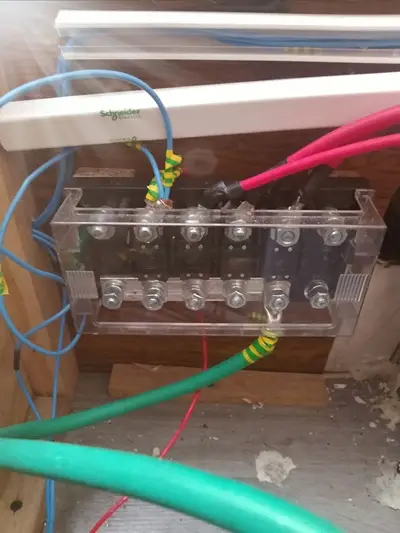
And this is the same setting people get wrong on solar controllers. Charge voltages by battery type.
Heat, which halves everything
A number that deserves more attention than it gets:
Lead-acid battery life roughly halves for every 8 to 10 °C above 25 °C.
Not degrades. Halves.
A battery rated for six years at 25 °C is a three-year battery at 35 °C, and an eighteen-month battery at 45 °C. And the inside of a van in summer reaches those temperatures easily — more so if the battery sits in an enclosed cabinet with no airflow, next to an inverter that’s generating its own heat.
This is why the same battery, in the same van, gives completely different service in northern Europe and in southern Spain. It’s also why comparing your experience to someone else’s is often meaningless without knowing where they live.
What helps:
- Put the battery in the coolest part of the vehicle, which is usually low down and out of the sun’s path
- Give it airflow. A battery in a sealed box next to an inverter is being cooked by its neighbour
- Don’t mount it against an exterior panel that gets direct sun
None of this is expensive, and all of it is far easier to do at build stage than afterwards.
And no, it wasn't a cheap battery
Worth addressing, because it’s the first explanation people reach for.
There is real variation in quality. Cheap AGMs use thinner plates and worse internal construction, and they deliver fewer cycles for the same nominal capacity. If you buy a 150 Ah AGM for €90, you’re getting a 150 Ah battery in the sense that the label says so.
Mine is a Tensite 150 Ah and it cost €250. Mid-range, from a recognised manufacturer, not the cheapest thing on the shelf.
It still didn’t last a year.
Which is the point of this page. A better battery would have lasted longer — maybe eighteen months instead of ten. It would not have survived the conditions, because no lead-acid battery survives months at partial state of charge with half its charging capacity silently missing.
Buying quality buys you margin. It doesn’t buy you immunity. If the system underneath is wrong, a €250 battery dies in a year and a €400 one dies in two, and both of them are you paying to learn the same lesson.
Fix the charging first. Then buy the good battery.
Where it is now
I should be clear about something: the battery isn’t dead. I’m still using it.
That’s the part that makes this hard to spot, and it’s why so many people are running a degraded battery without knowing.
What it does now: whatever I do, it will not hold a full charge. Leave it in the sun all day, charge it from an external supply, give it as long as it wants — it settles at around half. And the moment I put any load on it, however small, the voltage drops to 12 volts and stays there.
So it still powers things. Lights work. The system comes on. Nothing announces a fault.
But I now have a 150 Ah battery that behaves like a 70 Ah one, and it will never be anything else. The sulfation is crystallised, and no charger, no desulfation cycle and no amount of patience is going to reverse that.
This is what “degraded” actually looks like from the driver’s seat. Not a failure. A quiet halving of everything you paid for, that you only notice when you start comparing what you’re getting to what you should be getting.
Which is exactly why the two measurements above matter. By the time the symptoms are obvious enough to act on, the damage is already permanent.
What I'd do differently
Size for 20 % more than the calculation says. Not because the arithmetic is wrong, but because real use isn’t the average day. It’s the week of cold nights with the heater running. It’s the fortnight parked in shade. A bank sized exactly to the calculation spends its life at the bottom of its range.
Fit a shunt-based battery monitor. Voltage alone told me nothing until it was too late. A shunt counts amp-hours in and out, which is the only honest measure of what’s actually happening. It would have shown me the charging shortfall months before the damage.
Check that each charging source is actually working. My controller died silently. If I’d been watching what went in each day rather than what the battery said, I’d have caught it in a week.
Write down the charge acceptance figure now, while the battery is healthy. It costs nothing and gives you a baseline to compare against later.
And buy lithium if the money is there. I chose AGM to avoid spending double up front, and I’ve written elsewhere about how that arithmetic actually worked out. Lithium doesn’t sulfate, doesn’t care about sitting partially charged, and would have survived everything described on this page. The full comparison, with the cost per kWh over the battery’s life.
Frequently asked questions
Why did my AGM battery die so fast?
The most common cause isn’t deep discharge, it’s never reaching a full charge. A lead-acid battery that lives between 60 and 85 % accumulates sulfation on its plates with every incomplete cycle, and that damage is permanent. Solar-only systems in shade produce exactly that pattern. Undersized capacity, high temperatures and a charging source that has quietly failed all make it worse.
How do I know if my AGM battery is degraded?
Two signs. Measure at rest after two hours with no charge or load, then apply a demanding load and measure again — a healthy AGM sags modestly, a degraded one collapses. And watch charge acceptance: if a charger that used to push 30 amps into the battery now tapers to 15 within minutes, internal resistance has risen and the battery is going.
Is it worse to discharge deeply or to never fully charge?
Never fully charging is worse over time. One deep discharge followed by a complete recharge is recoverable. Months of shallow cycling that never completes the absorption stage leaves sulfate behind on every cycle, and eventually it crystallises into a form no charger will remove.
How long should an AGM battery last in a camper?
Four to six years with proper charging and moderate discharge. Mine didn’t reach one, because it was cycled every night and only partly refilled every day — and because one of my charge controllers failed without saying so.
Can a sulfated AGM battery be recovered?
Light sulfation sometimes responds to a desulfation cycle, which some smart chargers offer. Crystallised sulfation from months at partial charge is permanent. If the battery shows normal resting voltage but collapses under load, you’re generally past the point of recovery.
Can a faulty charge controller kill a battery?
Yes, and it’s easy to miss because nothing announces it. A failed controller means less charge going in, so the battery lives at partial state of charge and sulfates. Mine failed at nine months and nothing indicated it — the system still charged, just less. From inside the van it looked identical to a cloudy week.
[…] You charge it fully but it dies fast anyway → Why My AGM Battery Died in Under a Year […]