
If you’ve got a camper van or motorhome and you’ve noticed the leisure battery isn’t charging — or charging poorly — while you drive, you’re not alone: it’s one of the most common faults, and also one of the most misunderstood. The good news is that most of the time it isn’t serious or expensive to fix, but you do need to understand how the system actually works before you start swapping parts at random.
“I killed a perfectly good AGM running a 230 V fan overnight through an inverter. That’s the kind of mistake this site is built to save you from.” — Gustavo, why I measure everything
Start here: Size your inverter Work out your consumption Fix what’s broken
In my case, with the old Transit I still have, I had to replace the original alternator because it was starting to fail. My mechanic recommended keeping the old one (even running at half capacity as a spare) because finding parts for a vehicle this age can get complicated. Before reaching that conclusion, I went through a diagnostic process where it genuinely wasn’t clear whether the fault was the alternator, the battery, or both at once — I cover that process further down, because it’s exactly the kind of check a lot of people skip, and they end up replacing parts that were never the real problem.
The rest of this guide (relay types, DC-DC boosters, and the lithium case) is based on well-documented industry information — I haven’t personally installed those specific devices myself.
Quick reference: symptom → likely cause → what to check first
| Symptom | Likely cause | What to check first |
|---|---|---|
| Voltage doesn’t rise at all when starting the engine | Fuse, relay, booster, or wiring | Measure the leisure battery with the engine running |
| Rises a little, but never reaches 13.5V | Voltage drop or bad connection | Check cables, earths, and connections |
| Only charges sometimes | Automatic relay, D+ signal, or loose connection | Check relay activation |
| Charges at first, then drops off | Smart alternator or an undersized booster | Check voltage while actually driving |
| Leisure battery won’t hold a charge | Battery worn out | Measure at rest and under load |
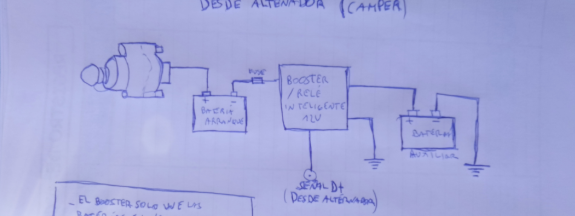
Why two batteries don’t just charge each other on their own
The first thing a lot of people don’t realize: connecting the starter battery straight to the leisure battery with a plain cable isn’t safe or efficient. You need something in between that decides when and how to pass energy from one battery to the other. Without it, you risk draining the starter battery (leaving you unable to start the engine) or overcharging the leisure battery with no control at all.
There are mainly two ways to solve this:
Split-charge relay vs. DC-DC booster
Split-charge relay
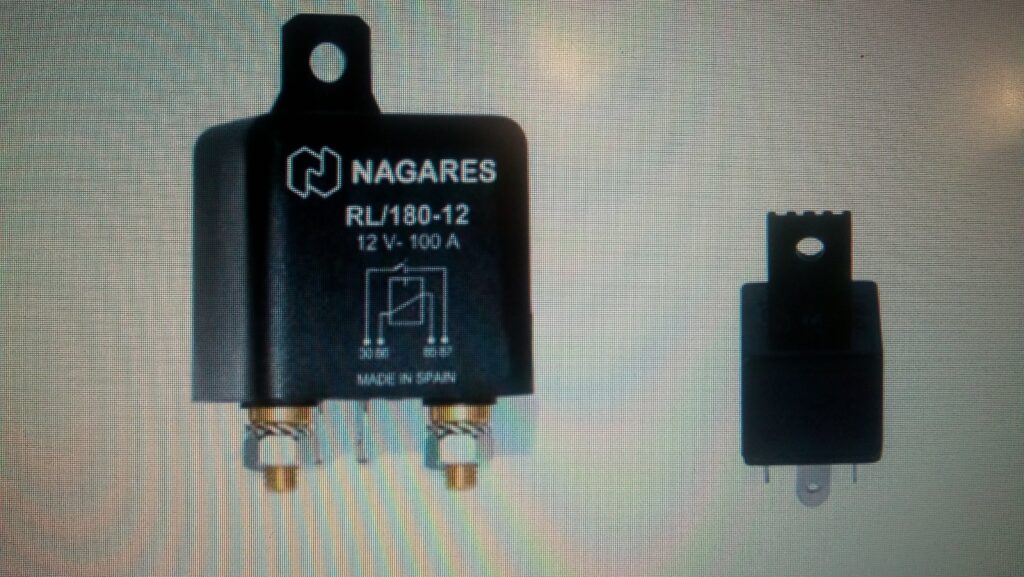
This is the simplest and cheapest system. It sits between the main battery and the leisure battery, and its job is to join them only while the engine is running and the alternator is supplying charge. The rest of the time it keeps them completely separate so each works independently.
There are two variants, depending on how they detect that the alternator is active:
- Automatic: triggers when it detects a voltage rise at the input as the alternator switches on.
- D+ excitation: needs a wire connected to the alternator’s D+ output to know it’s running.
These come in different voltage configurations (12V, 24V, or 12V/24V), and each model has a maximum current rating set by the manufacturer — it’s important to pick one that matches your setup.
On older vehicles with a conventional alternator, a split-charge relay can work fine if it’s correctly sized. On many modern vans with a smart alternator, though, voltage can drop while driving and the leisure battery won’t get a stable charge. In those cases a DC-DC booster is usually the better call.
DC-DC booster (buck-boost)
This is a more advanced system. It also sits between both batteries, but instead of simply joining them, it acts as a voltage booster: it maintains a stable charge curve suited to what the leisure battery needs, even if the input voltage drops — which is common with the smart alternators on modern vehicles.
In practice, the booster slightly “tricks” the alternator: it draws energy from the main battery to feed the leisure battery, and the alternator, sensing that charge is being pulled from the main battery, keeps supplying energy to compensate.
DC-DC booster/charger I’d recommend: REDARC BCDC1250D (50A), with a built-in MPPT solar regulator so it can charge from a solar panel and the alternator at the same time. Compatible with AGM, Gel, lead-acid, and lithium. This is an affiliate link — if you buy through it I earn a small commission, at no extra cost to you.
⚠️ Important: this model is designed for battery banks over 200Ah. If your setup is smaller (for example, a 100–150Ah AGM like the ones I run), this unit could be oversized for your system — check with the manufacturer or a professional before installing it on a smaller bank.
The special case of lithium with a split-charge relay
If you have (or are planning to install) a lithium leisure battery, be careful with traditional split-charge relays: they could technically be used, but the alternator would need at least double the capacity of the lithium battery, since the relay makes the alternator carry its full charging load directly. If you’re not sure your alternator has that margin, the safest move is to check with a professional before installing a relay with a lithium battery — or go straight for a booster, which handles that kind of load much better.
→ AGM vs Lithium in a Camper Van: What the Difference Actually Looks Like
Common causes even when the system is already installed
If you already have a relay or booster installed and the leisure battery still isn’t charging properly, the usual causes are:
- A blown or faulty fuse in the charging circuit between the alternator and the leisure battery — check it visually first, it’s the quickest thing to rule out.
- Damaged, corroded, or loose wiring between the alternator and the charging system, interrupting current flow.
- A faulty or misconfigured voltage regulator, which can stop the correct voltage from reaching the leisure battery.
- A worn-out or deeply discharged leisure battery, which can look like a charging-system fault when the battery itself is actually the problem.
- Heavy loads while driving (fridge, inverter, connected devices) competing with the charge trying to come in.
How to check it yourself with a multimeter
Before suspecting an expensive component, run this basic check:
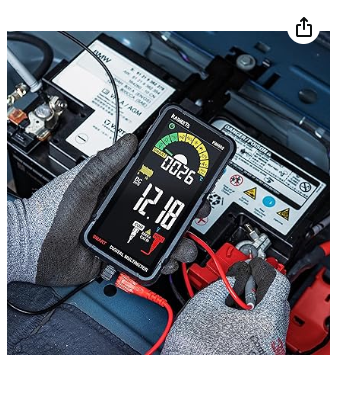
- With the engine off, measure the leisure battery’s voltage (it should read between 12V and 12.8V if it’s reasonably charged).
- Start the engine and measure again at the same point. If the charging system is working, you should see it climb to roughly 13.5–14.4V.
- If there’s no voltage rise when you start the engine, check the charging circuit’s fuse first — it’s the most common cause, and the easiest to check.
- If the fuse is fine, check the wiring and connections for corrosion or looseness before suspecting the relay, booster, or alternator itself.
For that first reading to mean anything, the battery needs to have rested for a few hours with no charging and no load on it — right after driving or unplugging from hookup, the voltage is still settling and will read artificially high. Once it’s rested, here’s roughly what the resting voltage tells you:
| Resting voltage | Approx. state of charge |
|---|---|
| 12.7V or higher | 100% |
| 12.5V | 75% |
| 12.4V | 50% |
| 12.2V | 25% |
| 12.0V or lower | Discharged |
Not the alternator? Check these too
Why the camper battery drains on its own: if the alternator is charging fine but the battery still keeps dropping, there may be hidden loads or another issue elsewhere in the system.
How to tell if the camper battery is damaged or worn out: rule out that the fault isn’t the alternator or the wiring at all, but the battery itself simply reaching the end of its useful life.
When it’s not clear whether it’s the alternator, the battery, or both
This is exactly what I went through with the Transit: it genuinely wasn’t clear whether the fault was the alternator, the battery, or a combination of the two. Here are the checks I ran — the same ones mechanics use:
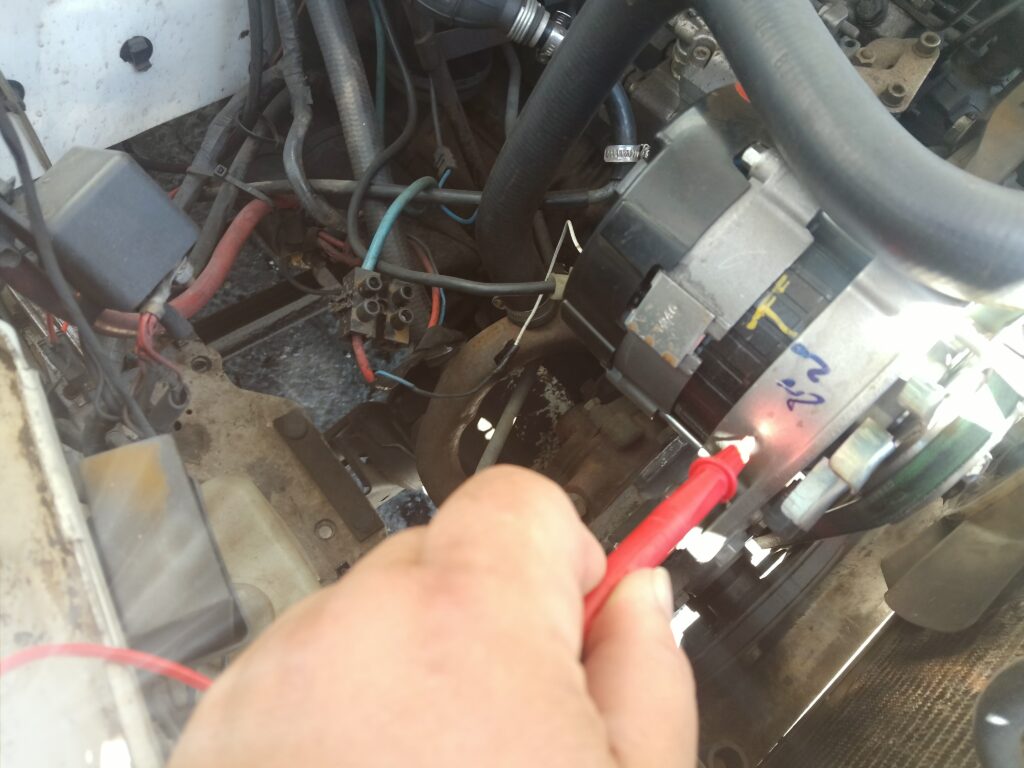
- Measure directly at the alternator output: with the multimeter set to 20V DC, measure between the positive terminal (the alternator’s output) and ground, with the engine idling. Then rev slightly and check whether the output voltage rises. If it doesn’t rise, the fault is likely in the alternator itself or its regulator.
- Check that the ground/earth connection is actually good: this gets overlooked constantly, and it’s what threw me off the most at first. Take voltage readings at different ground points on the vehicle relative to the battery’s positive terminal. If the ground isn’t good at some point, current doesn’t return properly, and electrical components don’t get a clean 12V even though the battery and alternator are both perfectly healthy. This gets mistaken for a faulty battery or an alternator that “won’t charge properly” very easily, when the real problem is a bad ground connection.
- Isolate overnight parasitic draw: when you’re not sure if the fault is the alternator, the ground, the battery, or a mix of several things, disconnect the negative terminal (or the positive, if that’s not accessible) while the vehicle sits overnight. This rules out some system silently drawing current and dropping the battery’s voltage before you get a chance to check anything the next day.
If you’ve run through all of this and still can’t find the cause, the safest move is to see a professional experienced with camper electrical systems — a wrong diagnosis at this point can end up damaging the battery, the alternator, or both.
FAQ
How do I know if the alternator is charging the leisure battery?
The simplest way is to measure the leisure battery’s voltage with a multimeter. With the engine off it usually reads between 12.4 and 12.8V. Once you start the engine, voltage should rise to roughly 13.8–14.6V if the charging system is working correctly.
Can a blown fuse stop the leisure battery from charging?
Yes. A blown fuse in the line connecting the alternator to the leisure battery cuts off charging completely. It’s one of the first things worth checking when the battery stops charging.
Do I need a booster to charge the leisure battery?
It depends on the vehicle. On many modern campers with smart alternators, installing a booster (DC-DC charger) is recommended, or even necessary, for the leisure battery to get a proper charge. On older vehicles an automatic relay is usually enough, provided the system is well designed.
Can a faulty automatic relay stop charging?
Yes. If the relay isn’t correctly joining the starter battery to the leisure battery while the engine runs, the leisure battery won’t receive current from the alternator even if the alternator itself is working fine.
Does cable gauge affect how the leisure battery charges?
Yes. A cable that’s too thin causes a voltage drop that reduces charging efficiency. Using the right gauge helps the battery receive the voltage it needs and charge properly.
What should I check if the leisure battery isn’t charging from the alternator?
Start with the alternator’s output voltage, the fuses, the condition of the relay or booster, the electrical connections, and wiring continuity. If all of that checks out, it’s worth checking the condition of the leisure battery itself too.
[…] One of the most common issues in a camper install: everything looks properly connected, but the leisure battery still drains on its own, or won’t hold a charge. In reality, most faults aren’t in the components themselves but in how the install was put together — a poor ground, cable with too much voltage drop, or a misconfigured relay/booster. I cover these causes in detail, including how to check each one yourself with a multimeter, in why the leisure battery isn’t charging from the alternator. […]
[…] If the battery won’t charge from the alternator while driving, the fault is more likely the alternator, relay, or booster — not the battery itself. See why the leisure battery isn’t charging from the alternator. […]
[…] ¿Prefieres verlo en inglés? Aquí tienes la guía equivalente sobre por qué la batería auxiliar no carga con el alternador: Why Isn’t My Camper’s Leisure Battery Charging From the Alternator? → […]
[…] f the voltage stall shows up right after driving, the alternator connection is the usual suspect → Leisure battery not charging from the alternator […]
[…] With the engine off, measure the leisure battery, then measure again after starting the engine — if you have an alternator charging system, you should see a coherent change in voltage or current → Leisure battery not charging from the alternator […]
[…] Why the battery isn’t charging from the alternator […]