
Quick answer
- Divide the amp-hours you want to refill by the hours you drive, then add about 20% for losses.
- For a 150 Ah battery, a 20 A to 30 A DC-DC charger is a sensible size for most vans.
- Size the fuse and cable for the charger’s current, not for the battery.
A DC-DC charger that is too small takes all day to refill the battery. One that is too big costs more and needs thicker cable and a bigger fuse. The right size comes from three numbers: how much battery you use, how long you drive, and what your alternator can give.
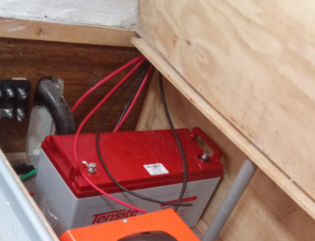
I have not installed a DC-DC charger myself. My camper has a single 150 Ah AGM battery, charged by solar and by a power station through an inverter-charger, so I will use that battery as the worked example and be clear that the sizing is a calculation, not a test. If you still need to understand what a DC-DC charger does, start with DC-DC charger vs shore power.
The basic rule
The charger’s amps are the amp-hours you need to put back, divided by the hours you drive, plus a margin for losses.
I_{charger} = \frac{Ah_{used} \times 1.2}{hours\ driven}The 1.2 is a rule-of-thumb 20% margin for conversion losses and for the battery accepting less current as it fills. Round up to the next standard size, which is usually 20 A, 25 A, 30 A or 40 A depending on the brand.
Two things cap the result. The charger cannot give more than the alternator can spare after the vehicle’s own needs, and the battery has a maximum charge current it should accept, so a small battery does not need a big charger.
Example with a 150 Ah AGM battery
My battery is a single 150 Ah AGM. Lead-acid batteries last longer if you do not discharge them below about 50%, so the usable part is roughly 75 Ah. In winter the heater runs all night and the battery sits at 12.1–12.2 V in the morning, so it is low but not empty.
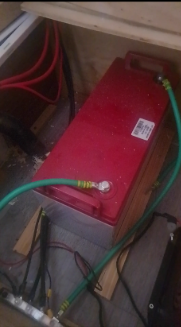
I do not measure amp-hours, so I estimate from what the battery does. One real data point: in summer, a 40 W fan running 8 hours overnight takes the battery from 12.7 V to about 12.1–12.2 V by morning. It is a 220 V fan on the inverter, so the battery supplies a bit more than 40 W: about 3.3 A at 12 V plus inverter losses, which is roughly 30 Ah in 8 hours. In winter the diesel heater runs the same 8 hours, wired straight to 12 V right next to the battery with no inverter and no long cable. I still wake up at 12.1–12.2 V after a sunny day, so its overnight use is probably in the same range, around 30 Ah. After a cloudy day the battery starts lower and ends at 11.9–12.0 V. These readings are taken with the load on, so they sit lower than a resting voltage. The table shows what a use of about 30 Ah means for the charger size. Replace the daily use with your own.
| Daily use (Ah) | Driving per day | Ah to refill with 20% margin | Charger needed |
|---|---|---|---|
| 30 (my night, estimate) | 1 h | 36 | about 36 A, so 40 A |
| 30 (my night, estimate) | 2 h | 36 | about 18 A, so 20 A |
| 30 (my night, estimate) | 3 h | 36 | about 12 A, so 15 A |
| 60 (a heavier day) | 2 h | 72 | about 36 A, so 40 A |
The lesson is that driving time matters as much as the charger size. A small charger that runs for four hours does the same job as a big one that runs for two. To measure your own daily use, see our guide on how many amp-hours your camper battery needs (Spanish original; English slug to confirm).
What if you drive less than an hour a day?
That is my case, and it changes the answer. The charger can only give back what it has time to deliver. Turn the formula around: the amp-hours returned equal the charger’s amps times the hours driven, divided by 1.2.
| Charger | Returned in 1 hour of driving | Returned in 30 minutes |
|---|---|---|
| 20 A | about 17 Ah | about 8 Ah |
| 30 A | about 25 Ah | about 12 Ah |
| 40 A | about 33 Ah | about 17 Ah |
With a use of about 30 Ah a night, a 30 A charger driven for one hour does not quite refill the battery, and half an hour does not come close. The honest conclusion is that on short trips a DC-DC charger is a top-up, not the whole solution. It works best together with solar, and it makes the most sense if you drive an hour or two every day, or you take longer trips in winter.
Before going to a bigger charger to fix short trips, remember the limit: a bigger charger asks more from the alternator, the cable and the fuse (next section).
Count every load, not just the heater
The nightly figure is the heater or the fan, but the battery also feeds everything else. Add them all up with this simple rule:
Ah = \frac{W}{12} \times hoursDivide the watts by 12 to get amps, then multiply by the hours the device runs. If the device is on the 220 V side, it goes through the inverter, so add roughly 15% for losses as a rule of thumb. In my van the other loads are LED lights, a laptop and phone charging, and the water pump. They are small one by one, but together they add to the heater’s use, and the water pump runs in short, frequent bursts.
A good habit is to list each device, its watts and its hours, and add them up. It takes five minutes and it is far more reliable than guessing.
Limits: alternator, cable, fuse and battery type
Alternator. The charger draws power from the alternator while the engine also needs power for lights, fans and everything else. Do not choose a charger so big that it takes most of what the alternator can give. Check the alternator’s rating before you buy.
To find your alternator’s rating, look for the label on the alternator itself (it usually shows the amps), or check the vehicle’s workshop manual or the part number with the parts supplier. If you cannot find it, ask a workshop. The DC-DC charger’s input current is a little higher than its output current, because of the voltage conversion and losses, so leave some margin.
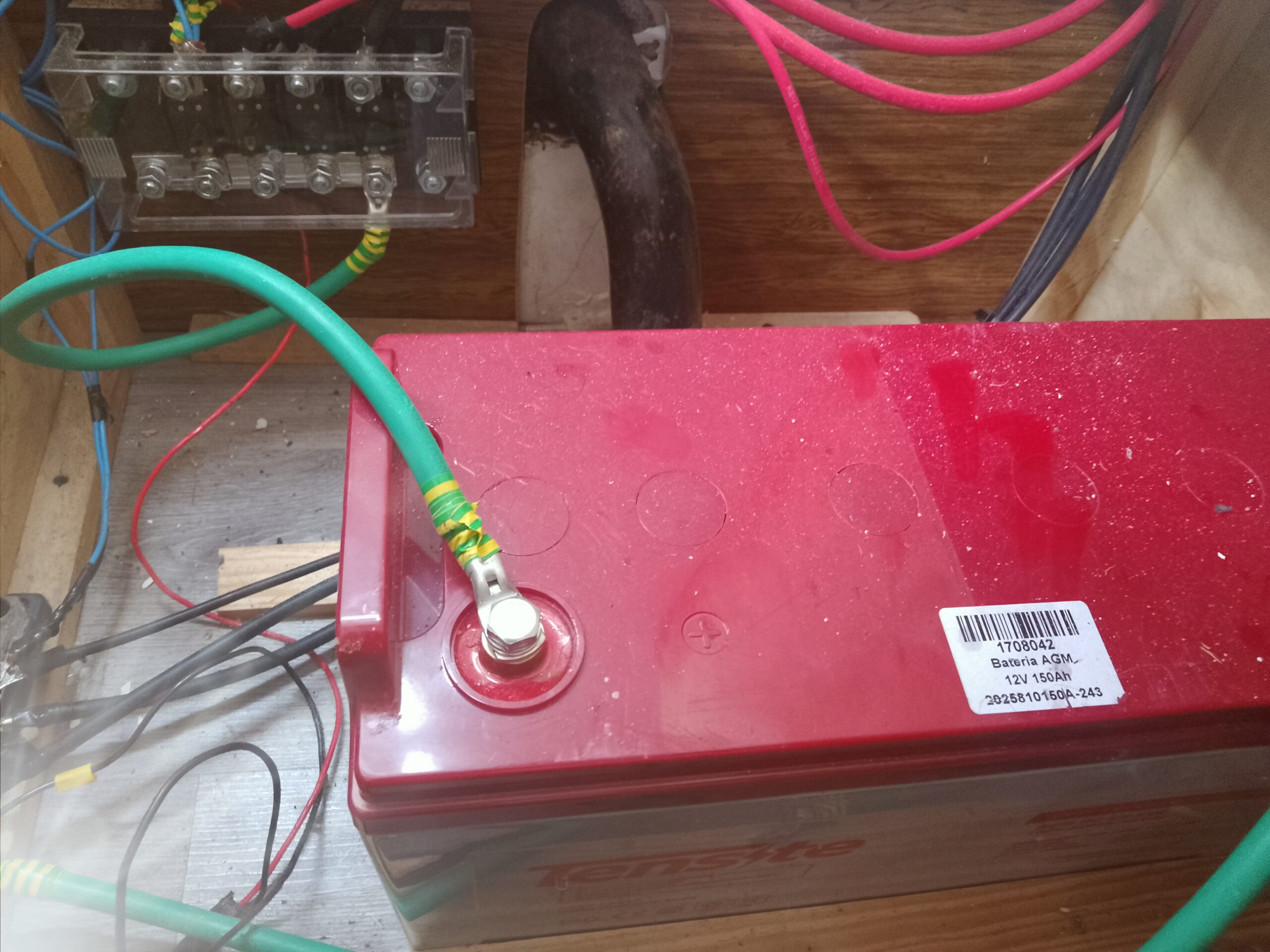
Cable and fuse. Both are chosen for the charger’s current, not for the battery’s size. The cable gets thicker as the current rises and as the run gets longer, because a thin or long cable loses voltage and the charger then charges less. Put a fuse in the positive cable near each battery, and take the exact fuse value from the charger’s manual. Our Spanish guides cover the details: cable section and where to place fuses.
Battery type. An AGM battery accepts a limited charge current, so a charger far above what the battery can take is wasted. A lithium battery accepts much more and can pull the alternator’s full output for a long time, which is one more reason to check the alternator first.
Where to mount it. If the battery is in the middle of the van, the cable run to the engine is a few metres, so it matters. As a general rule, mount the charger close to the camper battery and keep both cables as short as the layout allows. A long cable adds voltage drop, and that makes the charger work harder for the same result. Check the cable guide above for the section to use at your length.
To confirm before publishing: the exact fuse rule from the manual of the charger model you recommend, and the English slugs of the two linked pages.
Quick size guide by battery
A starting point only: confirm with your own daily use and the formula above.
| Battery | Starting size | Why |
|---|---|---|
| 100 Ah | 20 A | Enough for most weekend use with a couple of hours of driving |
| 150 Ah (my AGM) | 20–30 A | Matches the example above |
| 200 Ah or more | 30–40 A | More capacity to refill, check the alternator first |
| Lithium of any size | Follow the maker’s limit | It can accept more current than an AGM |
FAQ
What size DC-DC charger do I need for a 150 Ah battery?
Usually 20–30 A. Work it out with the formula: Ah to refill, times 1.2, divided by the hours you drive.
Can a DC-DC charger be too big?
Yes. It costs more, needs thicker cable and a bigger fuse, and can take too much from the alternator or give more current than the battery should accept.
Is 30 A enough?
For most single-battery vans, yes. With a 150 Ah battery, 30 A refills roughly 100 Ah in about four hours of driving after losses.
Does the cable size depend on the charger or the battery?
On the charger’s current and the cable length. The battery size does not set it.
Do I need a DC-DC charger if I have solar?
Solar covers the sunny days. A DC-DC charger covers winter and cloudy periods when you drive. They work together.
Does the size change with lithium?
Yes. Lithium accepts more current, so a larger charger can make sense, as long as the alternator can supply it.
Internal links and close
Related reading (English slugs to confirm before publishing):
- DC-DC charger vs shore power
- How to connect an auxiliary battery (Spanish original)
- Cable section for a 12 V camper installation (Spanish original)
Close: work out your daily amp-hours, pick the charger from the formula, and size the fuse and cable for the charger, not for the battery.