
If you go looking for how many amps a diesel heater draws, you’ll find numbers that don’t agree with each other. Eight to ten amps on startup, says one source. Seventeen or eighteen, says another. One to one and a half amps running, most of them agree on that part.
They’re all telling the truth. They’re just measuring at different moments, and none of them says so.
A diesel heater doesn’t have one startup. It has two, separated by a minute or two, and the second one catches people out because by then they’ve stopped watching.
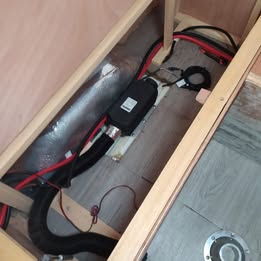
I’ve run one through winters in a motorhome charged only by solar. I can tell you what the meter does, what the lights do, and what a season of running it overnight did to a 150 Ah AGM — which is the part almost nobody writes about, because it takes a year to find out.
The running consumption is not the problem. It was never the problem.
The two startups, and why the published numbers disagree
Here’s what actually happens when you press the button, in order.
First, the glow plug. A ceramic element heats up to ignite the fuel. This is the biggest single draw in the whole cycle and it lasts a couple of minutes. Depending on the unit, the glow plug alone is 8 to 12 amps.
Then the combustion fan starts, at low speed, feeding air to the chamber. It’s running while the glow plug is still on. That’s why some people report 17 or 18 amps — they measured during the overlap, when both are drawing at once. Others measured the glow plug before the fan joined in and got 10. Neither figure is wrong.
Then the glow plug switches off. Combustion is self-sustaining now and the element isn’t needed. Current drops sharply. If you were watching a meter, you’d think it was over.
And then the blower ramps up. This is the second startup, and it’s the one nobody mentions. The heater has to move warm air into the van, so the main fan spins up to whatever level you set. That’s another rise in current — smaller than the glow plug, but longer, because the fan doesn’t stop.
You can see both without any instrument. In my van the lights dim twice: once when the glow plug fires, and again a minute or two later when the fan comes up. Two separate dips, clearly separated. If your lights only dim once, you stopped paying attention.
Why this matters more than the numbers do. A system that copes with a brief 10 A glow plug may still struggle when the fan adds its load on top of a battery that’s already been pulled down. And an undersized cable makes both dips deeper, because the voltage sags further under each one.
If your lights dim hard on ignition, here’s the ten-minute test that confirms it.
And there’s a third draw at the end. When you switch a diesel heater off it doesn’t stop. It runs a cool-down cycle for several minutes, burning off residual fuel and cooling the chamber with the fan. That’s more current after you thought you’d finished. Never cut the power to a diesel heater to switch it off — let it complete the cycle, or you’ll coke up the burner and eventually pay for it.
What a night actually costs
Now the arithmetic, because the running figure is genuinely small and that’s what misleads people.
Startup: roughly 10 A for two minutes. That’s about 0.33 Ah.
Running on low: 1 to 1.5 A. Over eight hours, 8 to 12 Ah.
Running on high: 2 to 4 A. Over the same eight hours, 16 to 32 Ah.
Cool-down: around 2 A for five minutes. 0.17 Ah.
So a full night on low costs somewhere around 10 amp-hours. On a 100 Ah AGM with 50 Ah usable, that’s a fifth of your battery. Uncomfortable but survivable.
And that’s assuming your appliance figures are accurate, which they usually aren’t. Five reasons your real consumption is higher than your calculation.
Except that isn’t how most people run it.
If the heater is on a thermostat, it doesn’t run continuously. It heats the van, reaches temperature, shuts down — cool-down cycle and all — and then starts again when the van cools. Every one of those restarts is another glow plug cycle.
Six restarts in a night is six more glow plug ignitions and six more cool-downs. That’s another 3 Ah on top, and it’s 3 Ah that nobody counts because it doesn’t appear in any published figure.
So the practical advice is the opposite of what feels sensible. Don’t set it warm and let it cycle. Set it low and let it run continuously. You use less electricity, less fuel, and the burner stays cleaner because it isn’t repeatedly cooling and re-igniting.
And a caution about the ratings. A 5 kW heater in a small van is almost always the wrong choice — it will overheat the space fast, then cycle constantly, which is the expensive pattern described above. A 2 kW unit running steadily beats a 5 kW unit switching on and off, on every measure that matters.
The expensive one failed where the cheap one doesn’t
I’ve owned both kinds, and the result was the opposite of what I expected.
First, an Autoterm Planar 2D. Around €600, installed permanently in the van, and I had it for five years. Well built, parts available separately — I replaced the fuel pump on it myself.
Then a Vevor 8 kW. €96.90 in September 2025, the all-in-one portable type with a 5-litre tank built in. I’ve had it through one full winter.
The Planar wouldn’t start when the battery got low.
As the bank came down towards a true 12 V, it started refusing to ignite. Sometimes it struggled and eventually caught. Sometimes nothing.
The reason is the glow plug. It needs its 8 to 10 amps, and if the battery can’t hold voltage under that load, the control unit sees an undervoltage and cuts out to protect itself.
This is where the difference between lead-acid and lithium stops being theoretical. One sags under load, the other holds a flat curve.
And that happens in winter — the season of least sun, worst battery performance and greatest need. A heater that won’t start on the coldest night of the year is not doing the job you paid for.
The Vevor starts at voltages where the Planar had already given up. Same van, same 150 Ah AGM, same two panels. It is simply less demanding at the moment of ignition, which is where the other one failed.

What eventually retired the Planar was a recurring pump fault. I fitted a new pump and the error came back, which pointed at the control unit. I sold the van with it still faulting, because the next repair wasn’t worth guessing at.
The honest caveat, and it matters. Five years is not one winter. The Planar ran a long time before it failed and the Vevor hasn’t yet had the chance to prove whether it lasts. I’m not telling you the cheap one is better built — it obviously isn’t.
What I am telling you is this: for a sixth of the money, the cheap one has done the same job and starts in the conditions where the expensive one didn’t. And when it does fail, I replace the whole unit for less than a genuine Planar fuel pump costs.
One difference that’s real, though. On the Planar you replace parts. On the Vevor you replace the heater. At €97 that isn’t much of a complaint, but if you like being able to fix things, it’s a fair reason to pay more.
Fuel: less than the manufacturer claims
The electrical side gets all the attention, but people also want to know what it costs in diesel — and here the numbers are unusually good.
Vevor state 0.16 to 0.62 L/h for this unit.
I measured 1.5 litres over about ten hours. That’s 0.15 L/h — below even the bottom of their own range.
In US terms, roughly 0.04 gallons per hour.
Why it comes out low. I run it continuously on a low setting rather than letting it cycle. The published range assumes you’ll sometimes push it hard, and at full output the figure climbs fast. Steady and low is cheaper on fuel for the same reason it’s cheaper on electricity: no repeated ignition cycles.
What that means in practice. The 5-litre tank built into the unit gives me around 33 hours of running — roughly four cold nights before it needs filling.
Put the two costs side by side for one eight-hour night:
- Diesel: 1.2 litres, call it €1.60
- Electricity: about 10 Ah out of the battery
The diesel is the cheap part. The amp-hours are what you actually pay for, especially in the months when the sun isn’t putting them back.
And a warning about very large units. An 8 kW heater sounds like more fuel than a 2 kW one, and at full output it is. But nobody runs 8 kW in a van — you run it low. The size affects how hard it has to work, not what it burns at idle. What does hurt is an oversized unit that heats the space too fast and then cycles, because every cycle is a fresh ignition.
What a winter of it did to my battery
Everything above is arithmetic. This part is what actually happened, and it’s the reason I wrote the page.
Ten amp-hours a night is not a large number. That was my mistake — I looked at it, decided it was manageable, and stopped thinking about it.
What I didn’t account for is when those amp-hours get taken.
The heater runs in winter. In winter the days are short, the sun is low, and my panels were producing a fraction of their summer output. The season that demands the most from the battery is the season that gives it the least back. Those two curves move in opposite directions, and where they cross is where the battery lives.
Add to that: I park in shade, and I charge from solar only. No alternator charging, no shore power for weeks at a time.
So the pattern through that winter was: take 10 to 15 Ah out every night, put back perhaps 8 or 10 during the day. A small deficit, repeated for months.
A lead-acid battery does not survive that, and the way it dies is quiet.
Every time it fails to reach a full charge, sulfate crystals stay on the plates. They don’t dissolve on the next partial charge either. They accumulate, they harden, and the capacity they occupy is gone permanently. Nothing on your display tells you this is happening. The voltage looks normal. The lights work. The heater starts.
What eventually told me was the charge acceptance. My 150 Ah AGM used to take over 330 W from a portable power station. By the end it wouldn’t go above 155 W — less than half, same charger, same cables, same sun.
That battery was under a year old.
The full account of what killed it is here, including the charge acceptance figures that gave it away.
The heater didn’t kill it on its own. A summer of overnight fans and a habit of parking in shade did their share. But the heater was the load that ran through the months when the battery had the least chance of recovering, and that’s what made it decisive.
What I’d do differently. Not stop using the heater — it’s the best thing in the van on a cold night, and I’d rather have it than the battery. But I’d size the bank for the winter deficit rather than the summer average, and I’d have some way of getting the battery to full that doesn’t depend on December sunshine. A shore-power charger used once a fortnight would have saved that battery, and it costs a fraction of replacing it.
The cable it comes with is not the cable it needs
Diesel heaters ship with a wiring loom, and on the cheaper units that loom is thin. Thin enough that it’s fine on a bench and marginal in a van.
The reason is the glow plug. Ten to twelve amps is a real current, and the supplied cable is often sized as though the heater drew its running figure of 1.5 A.
What that does. Voltage drops across the cable during the glow plug phase. The heater sees less than it should, the element heats more slowly, ignition takes longer — and a longer glow plug cycle means more amp-hours, not fewer. An undersized cable makes the heater more expensive to run, not just less safe.
It also makes ignition failures more likely on a cold morning when the battery is already low. That’s the classic symptom: works fine in the afternoon, refuses to light at 6 a.m.
What to fit instead:
- 4 mm² / 12 AWG minimum for a typical run of two to three metres
- 6 mm² / 10 AWG if the heater is further away, or if the battery is at the other end of the van
- Fuse at 15 to 20 A, on the positive, as close to the battery terminal as you can get it
- Connect it directly to the battery, not to a distribution board shared with other loads. The glow plug’s draw will pull the voltage down for everything else on that circuit
Size the cable for your own run here — enter the current and the round-trip length.
And measure the run properly. The current goes out on the positive and back on the negative, so a heater three metres from the battery is a six-metre run. Half the people sizing this cable use three and wonder why the lights dim.
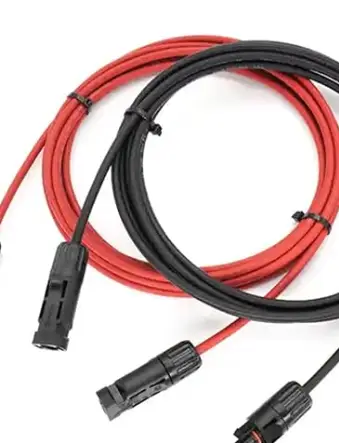
A quick way to check what you already have. Switch the heater on and watch the lights during the glow plug phase. A brief, slight dim is normal. A dim that’s obvious across the whole van, or that makes an LED flicker, means the voltage is sagging further than it should — and the cable is the first place to look.
Frequently asked questions
How many amps does a diesel heater use?
Between 8 and 12 amps during the glow plug phase at startup, lasting a minute or two, then 0.5 to 2 amps once it’s running. Published figures disagree because some measure the glow plug alone and others measure it while the combustion fan is also running, which is where the 17-18 amp readings come from. Both are correct — they’re different moments in the same sequence.
Why won’t my diesel heater start in winter?
Usually the battery, not the heater. The glow plug needs 8 to 10 amps, and if the bank can’t hold voltage under that load the control unit sees an undervoltage and shuts down to protect itself. This is worst in winter because the days are short, the battery charges less and the cold reduces its performance. Measure the resting voltage before assuming a fault — on an AGM, anything below 12.4 V is your answer.
Will a diesel heater drain my battery overnight?
About 10 amp-hours over eight hours on a low setting, which is a fifth of a 100 Ah AGM’s usable capacity. That’s manageable on its own. The problem is that it happens in the months when solar puts back the least, so a small nightly deficit repeats for weeks and the battery never reaches a full charge. That’s what damages lead-acid, not the amp-hours themselves.
Are cheap Chinese diesel heaters any good?
Mine has been. I ran an Autoterm Planar 2D for five years at around €600, then a Vevor 8 kW at €97 for a full winter. The Vevor hasn’t failed, and it starts at voltages where the Planar had already begun refusing. The branded unit is better built and you can replace individual parts — on the cheap one you replace the whole heater. One winter isn’t five years, and I’d say so, but for a sixth of the price it has done the same job.
How much diesel does a heater use per hour?
I measured 1.5 litres over ten hours on mine, which is 0.15 L/h — roughly 0.04 US gallons. The manufacturer claims 0.16 to 0.62 L/h, so real use came in below their own minimum. Running it low and continuously is what keeps it there; forcing it to full output pushes it toward the top of the range.
What cable and fuse does a diesel heater need?
At least 4 mm² or 12 AWG for a two to three metre run, 6 mm² or 10 AWG if it’s further, with a 15 to 20 A fuse on the positive as close to the battery as possible. The loom supplied with cheap units is often sized for the running current rather than the glow plug, and an undersized cable makes ignition slower — which costs more amp-hours, not fewer.
Should I buy a 2 kW, 5 kW or 8 kW heater?
Output matters less than how you run it, because in a van you run any of them low. What hurts is an oversized unit heating the space too quickly and then cycling, since every restart is a fresh glow plug ignition. For most conversions a 2 kW running steadily is better than a 5 kW switching on and off. My own unit is an 8 kW, and it spends its life on the lowest setting.
[…] ¿Prefieres verlo en inglés? Si te interesa el consumo eléctrico exacto de estos calefactores, aquí tienes el detalle: Diesel Heater Power Consumption: Startup Draw → […]
[…] Diesel Heater Power Consumption: The Startup Is Not One Spike […]