
Every van build starts the same way. You list your appliances, you add up the watts, you divide by 12, you multiply by the hours, and you get a number. Then you buy a battery slightly bigger than that number and feel organised.
Mine said I needed about 60 Ah a day. In practice I was going through closer to 100.
That gap isn’t one big mistake. It’s five small ones that all point the same direction, and they multiply rather than add. Every one of them makes your real consumption higher than your calculated consumption — none of them makes it lower.
I’ll go through all five with the numbers I measured, and at the end I’ll tell you the correction factor I now use instead of doing the arithmetic properly.
Error 1: the label is a rating, not a measurement
The number printed on an appliance is what the manufacturer declares. It is not what the device pulls out of your battery, and with anything containing a motor the two aren’t close.
The reason is power factor. A resistive load — a kettle, an incandescent bulb, a heating element — draws current in step with the voltage, and watts really are volts times amps. A motor doesn’t. It draws current slightly out of step, so the current flowing through your cables is higher than the useful power suggests.
For a small induction motor the power factor is typically around 0.65. That means an appliance doing 46 W of useful work is pulling something closer to 70 W from the system.
I measured the fan that runs all night in my van. Rated 46 W on the label. Measured at the battery: between 65 and 85 W depending on speed.
That’s a 40 to 80 % error on a single device, before anything else in this list has happened. And it’s the device that runs longest — eight hours a night, every night in summer.
Which appliances this hits: anything with a compressor or a motor — fridges, fans, water pumps, extractor fans, air conditioners. Which it doesn’t: LED lights, USB charging, laptops, heating elements. Those are close enough to their label that you can use it.
Two power stations, and the same answer
Here’s a way to check the label without a meter, using something you probably already own.
I run the same fan overnight from two portable power stations. A Jackery Explorer 500, which holds 518 Wh, and an EcoFlow River 2, which holds 256 Wh. The Jackery gets me about eight hours. The EcoFlow gets me about three and a half.
Work backwards from that.
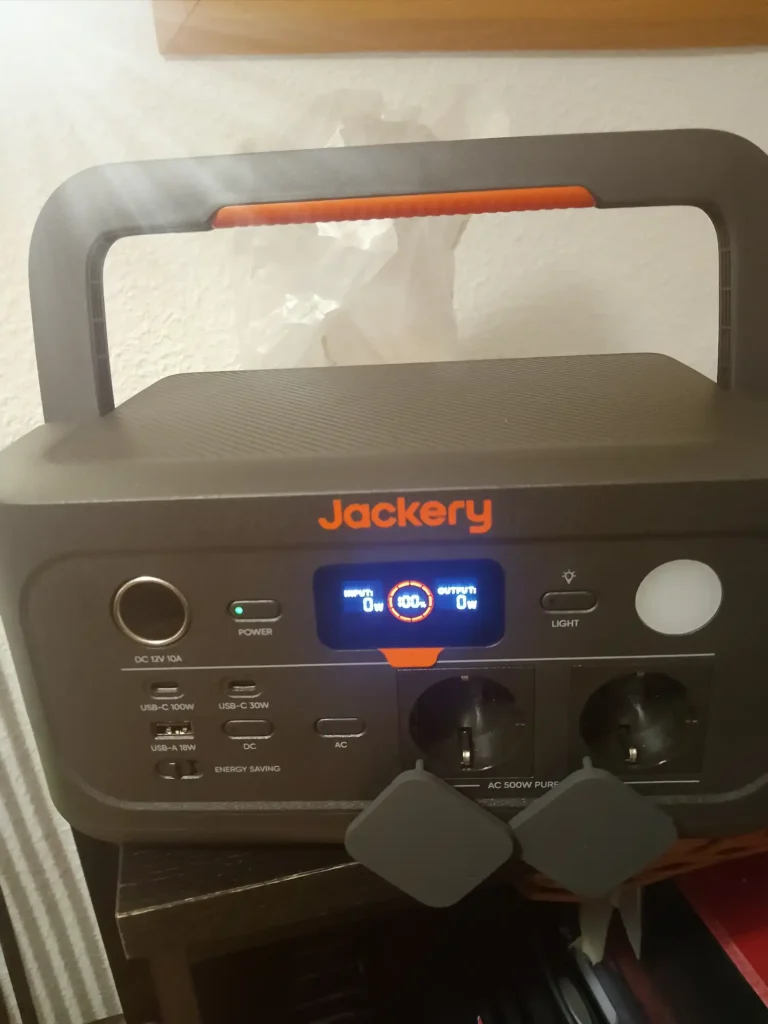
A power station doesn’t deliver its full rated capacity to the socket — the inverter takes a cut, and some capacity is held in reserve. Call it 85 % that actually reaches the appliance, which is conservative for both of these.
Jackery: 518 Wh × 0.85 = 440 Wh available, over 8 hours → 55 W
EcoFlow: 256 Wh × 0.85 = 218 Wh available, over 3.5 hours → 62 W
Two different units, two different battery chemistries, two independent measurements. Both land between 55 and 62 W for a fan the manufacturer labels 46 W.
And my clamp meter, measuring the same fan directly, reads 65 to 85 W depending on speed.
Three methods. None of them agrees with the label. All of them agree with each other about the direction.
If you own a power station, you can do this tonight. Charge it fully, run one appliance until it cuts out, note the hours. Multiply the station’s Wh by 0.85 and divide by those hours. That’s your appliance’s real draw — no meter required.
Error 2: everything through the inverter costs more than it says
If an appliance runs on 230 V, it isn’t drawing from your battery directly. It’s drawing through the inverter, and the inverter takes two cuts.
The first cut is conversion. Turning 12 V DC into 230 V AC is 85 to 90 % efficient on a decent unit, and worse on a cheap one. So a load that genuinely consumes 100 W pulls about 115 W out of the battery. That’s before power factor, which is a separate 20 to 35 % on top for anything with a motor.
The second cut is the one people forget. An inverter that’s switched on but powering nothing still draws current. Between 0.3 and 1.5 A depending on the size of the unit — a big inverter idles harder than a small one.
That sounds trivial. It isn’t, because of how long it runs.
Take 1 A of standby draw. Leave the inverter on for 24 hours and that’s 24 Ah gone. On a 100 Ah AGM you only have about 50 Ah usable, so half your battery has disappeared without powering a single thing.
In my motorhome the lights run on 230 V, which means the inverter has to stay on whenever I want light. I’ve woken up to a flat battery from exactly this — the inverter left on overnight, doing nothing, drawing the whole time.
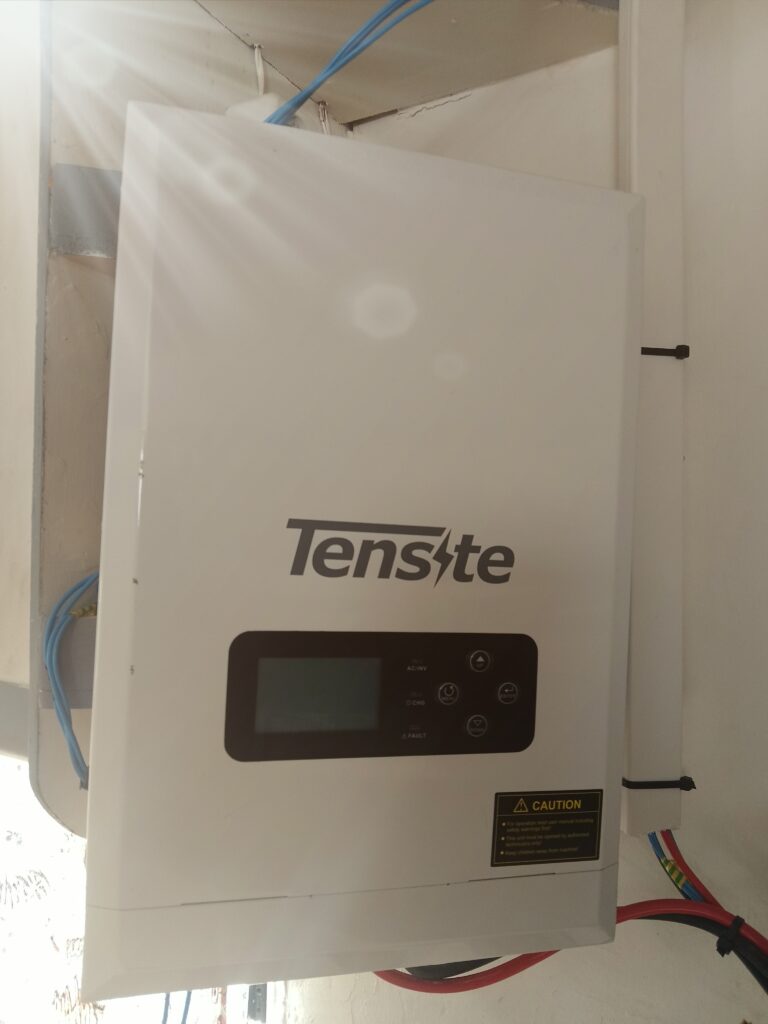
If yours is also cutting out under load rather than just draining, that’s a different fault and it has its own list of causes.
What to do about it. Switch the inverter off when you’re not using it, or fit a remote switch so you don’t have to reach behind the furniture. And when you’re sizing your battery, don’t add standby as a line item on your appliance list — treat it as a fixed daily cost that applies whether you use anything or not.
The rule of thumb: for anything running on 230 V, take the label, add 30 % for power factor if it has a motor, then add 15 % for the inverter. A 46 W fan on a 230 V circuit is realistically 70 W out of the battery.
Error 3: the daily consumption figure was measured in a laboratory
Fridges are the biggest single load in most vans, and they’re the one people calculate most confidently — because the manufacturer gives you a daily figure. “0.8 kWh per day.” Done.
That figure was measured at around 25 °C ambient, with the door shut, with the fridge already cold.
A compressor fridge doesn’t run continuously. It cycles: the compressor kicks in, pulls the temperature down, and shuts off. The percentage of time it spends running is the duty cycle, and it is not a property of the fridge. It’s a property of how hot the van is.
At 25 °C ambient a decent compressor fridge runs perhaps 25 % of the time. Parked in the sun in August, with the interior at 40 °C, the same fridge runs 80 % or more. That’s not a 20 % error. It’s three times the consumption, from the identical appliance, on the same setting.
And it gets worse than that, because the day you most need the fridge working hard is the day your solar panels are hottest and least efficient.
This is why two people with the same fridge report completely different numbers, and why forum answers about fridge consumption are useless without knowing where the van was parked.
Three things that move the duty cycle more than the fridge model does:
- Where you park. Shade versus full sun is the single biggest variable. Bigger than insulation, bigger than the brand
- The colour of your van. A dark van in sun runs far hotter inside than a light one, and the fridge pays for it every hour of the day
- How often you open it. Every opening dumps the cold air out of the bottom and the compressor has to make it again
I measured my own fridge over several days in different conditions — the numbers and the duty cycles are here.
And a warning about the other kind. If your fridge is thermoelectric rather than compressor — a Peltier cooler, the sort sold cheaply for car use — none of this applies, because it never cycles. It runs at close to 100 % duty, permanently, for as long as it’s plugged in. A 45 W Peltier cooler is a genuine 45 W continuous load, 1,080 Wh a day. That will empty a 100 Ah AGM in less than a day and a half. They are not fridges for living in a van.
Error 4: your battery is smaller than the number on it
You have a 100 Ah battery. You do not have 100 Ah.
With lead-acid — AGM, gel or flooded — you have about 50. Going below half discharged shortens the life of the battery dramatically, so the usable half is all you can plan around. With LiFePO4 you get roughly 90 Ah, which is a large part of why lithium is worth what it costs.
That much is fairly well known. The next three parts aren’t.
It shrinks when you draw hard. A lead-acid battery’s rated capacity is measured over a slow 20-hour discharge. Pull the same battery at a high current — an inverter running a kettle, say — and you get noticeably less total energy out of it than the rating promises. Lithium barely suffers from this. Lead-acid suffers a lot.
It shrinks in the cold. At 0 °C a lead-acid battery delivers around 20 % less than it does at 25 °C. The capacity comes back when it warms up, but the winter night it let you down was still a winter night.
And it shrinks permanently as the battery ages — which is the one that caught me out, because it doesn’t announce itself.
My AGM was accepting 330 W of charge when it was new. Months later, in the same sun, at the same time of day, it was accepting 155 W. Less than half. The battery still read a normal resting voltage, still ran the lights, still looked fine on the display.
Charge acceptance drops long before voltage does. If your panels are producing well but the controller reports far less going into the battery than it used to, that’s the battery telling you it’s on the way out — months before anything else shows it.
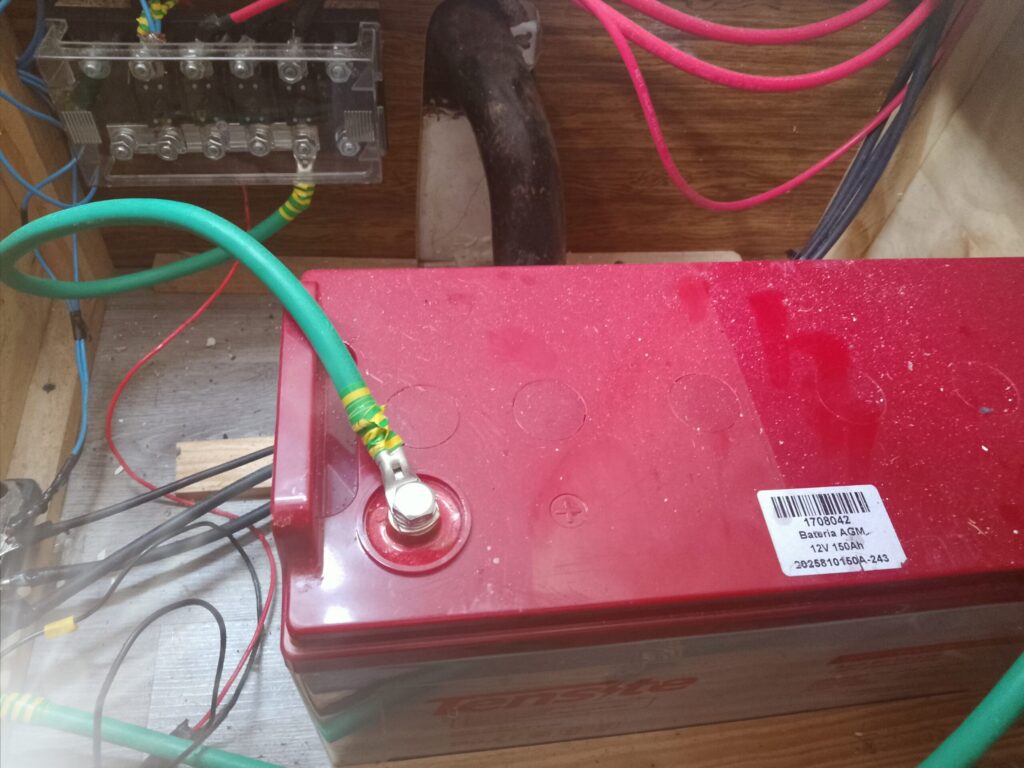
If the panels look healthy but the charge doesn’t arrive, work through these measurements before blaming the battery.
What this means for the calculation. If you worked out that you need 60 Ah a day and bought a 100 Ah AGM, you have not bought comfortable headroom. You’ve bought 50 Ah, minus the cold, minus the discharge rate, minus whatever the battery has already lost. You’re running a deficit and the battery is paying for it.
Error 5: some of it never reaches the appliance
The last one isn’t consumed by anything useful. It’s lost in the cable on the way.
Every metre of wire has resistance, and at 12 V that matters far more than people expect. The same appliance on 230 V draws a twentieth of the current, so the losses are trivial. At 12 V they’re not.
A cable that’s one size too thin doesn’t just waste energy — it makes the appliance draw more. A motor that isn’t getting its full voltage compensates by pulling more current, which drops the voltage further, which makes it pull more still. The load gets hotter, the cable gets hotter, and your calculation is now wrong in both directions at once.
You can watch this happen. My diesel heater dips the system voltage twice during startup — once when the glow plug fires and again when the fan spins up. Those dips are the cable and the battery together failing to hold voltage under load. On a healthy circuit the dip is small and brief. If it’s deep enough to make the lights flicker across the van, the cable is undersized.
Why it dips twice, and what it costs over a winter.
The rule. Keep voltage drop under 3 % for anything sensitive — the fridge, the water pump, the heater, lighting. Up to 10 % is tolerable for things that don’t care, but nothing in a van really doesn’t care.
And the part that catches people out: the run length in the formula is the round trip. Positive out and negative back. A battery three metres from the fridge is a six-metre run, and half the people sizing cable use three.
What I actually do now
I stopped trying to calculate it properly.
Not because the arithmetic is hard, but because every input into it is an estimate with an error bar, and all the error bars point the same way. You can spend an evening being precise about numbers that were wrong before you started.
So here’s what I use instead.
Add up the labels. Multiply by 1.5.
That covers power factor on the motors, the inverter’s conversion loss, its standby draw, and the cable. It doesn’t cover the fridge in a heatwave, and nothing will — if you park in full sun in August, assume the fridge alone doubles.
Then size the battery from that number, not from the labels.
- Lead-acid or AGM: you need double, because you can only use half. 60 Ah of real consumption means a 240 Ah bank if you want two days without sun
- LiFePO4: you need about 20 % more than your daily figure per day of autonomy
The full comparison between the two chemistries is here, including the charge settings that most people get wrong.
A worked example, using my van.
My appliance labels added up to about 60 Ah a day. Multiply by 1.5 and the realistic figure is 90 Ah — which matches what I was actually getting through, near enough.
To run that on AGM with any margin at all I’d need somewhere north of 200 Ah of battery. I had 100. That’s the whole story of why my battery died in under a year — not a fault, not a bad brand, just a bank that was never big enough for the load, being asked to go below half discharge night after night.
The calculation didn’t fail me. The calculation was fine. It just wasn’t calculating what I thought it was.
If you only take one thing from this page: the label on an appliance tells you what the manufacturer measured under laboratory conditions. It does not tell you what leaves your battery. Those are different numbers, and the gap is bigger than most people’s safety margin.
If you’re building the system from scratch, the rest of what I’ve learned is here.
Frequently asked questions
Why does my appliance use more watts than the label says?
Because the label is a rating measured under laboratory conditions, not a measurement of what leaves your battery. Anything with a motor — fridge, fan, pump, air conditioner — has a power factor below 1, typically around 0.65, which means it pulls more current than its useful output suggests. My fan is labelled 46 W and measures between 55 and 85 W depending on how I measure it. Resistive loads like LED lights and heating elements are close to their label and you can trust those.
How do I measure my appliance’s real power draw without a meter?
Use a portable power station. Charge it fully, run the appliance from it until it shuts off, and note the hours. Multiply the station’s rated Wh by 0.85 to account for inverter losses, then divide by the hours. That gives you the real draw. I did this with two different stations and both agreed with each other rather than with the label.
How much power does an inverter waste?
Two ways. Conversion is 85-90 % efficient on a decent unit, so a 100 W load costs about 115 W from the battery. And an inverter that’s switched on but idle still draws 0.3 to 1.5 A depending on size. Left on for 24 hours, 1 A of standby is 24 Ah — half the usable capacity of a 100 Ah AGM, spent on nothing.
Why does my fridge use more power in summer?
Because a compressor fridge cycles, and how often it cycles depends on how hot the van is, not on the fridge. At 25 °C ambient it might run 25 % of the time. Parked in the sun with the interior at 40 °C it can run 80 % or more. That’s three times the consumption from the same appliance on the same setting, which is why manufacturer daily figures and forum answers rarely match what you see.
How much usable capacity does a 100 Ah battery have?
About 50 Ah if it’s AGM, gel or flooded, because discharging lead-acid below half shortens its life sharply. About 90 Ah if it’s LiFePO4. Lead-acid also loses roughly 20 % of that in cold weather, gives you less when you draw hard, and loses capacity permanently as it ages — often long before the voltage reading gives any sign of it.
What safety margin should I add to my power calculation?
Add up the labels and multiply by 1.5. That covers power factor, inverter conversion, inverter standby and cable losses. It does not cover a fridge in a heatwave — if you park in full sun in summer, assume the fridge alone doubles. Then size the battery from that corrected figure: double it again for lead-acid, or add about 20 % for lithium.
[…] ¿Prefieres verlo en inglés? Aquí tienes la guía equivalente sobre cómo calcular correctamente el consumo: Your Power Calculations Are Wrong. Here’s by How Much → […]
[…] Your Power Calculations Are Wrong. Here’s by How Much […]