Filled the tank, turned the tap, and nothing comes out — or the pump runs constantly but no water reaches the faucet? This is one of the most common camper electrical/plumbing problems, and in almost every case it’s not the pump that’s broken. It’s air.
“I killed a perfectly good AGM running a 230 V fan overnight through an inverter.
That’s the kind of mistake this site is built to save you from.”
— Gustavo, why I measure everything
In my actual case, the pump made noise but no water came out even though the tank was full. It had lost its prime after the tank ran empty — once I purged the circuit and checked the filter, it worked again.
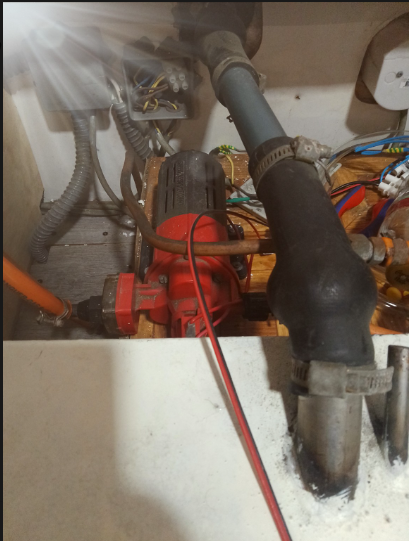
My camper’s 12V water pump, installed under the sink — the same one that lost its prime after the tank ran dry.
Open the tap and listen — does the pump note change?
Pump cycles on/off with tap closed
Leak downstream or faulty check valve
Check every fitting for a slow drip
Pump doesn’t run at all
No power, blown fuse, or dead switch
Multimeter at the pump’s 12V terminals
Weak flow, pump sounds strained
Clogged inlet filter/strainer
Pull and inspect the strainer
Pump runs dry / rattles
Tank empty, or pump mounted above tank level
Check tank level and pump position
Air in the line is the cause I run into most — but it’s not the only one. If you’ve bled the line and it’s still not working, don’t guess: check the fuse, the switch, and the connections before you assume the pump itself is dead.
Does the pump make noise or not?
This is the fork that decides everything else. If the pump is running (you can hear it) but no water comes out, the fault is almost always air or a blockage between the pump and the faucet. If the pump doesn’t run at all, the fault is electrical — power, fuse, switch, or the pump itself — and priming won’t fix it.
Case A — pump runs, no water
Air has replaced water somewhere in the line. This happens after the tank runs fully dry, after transport (vibration loosens fittings), or right after installing a new pump that’s never been primed.
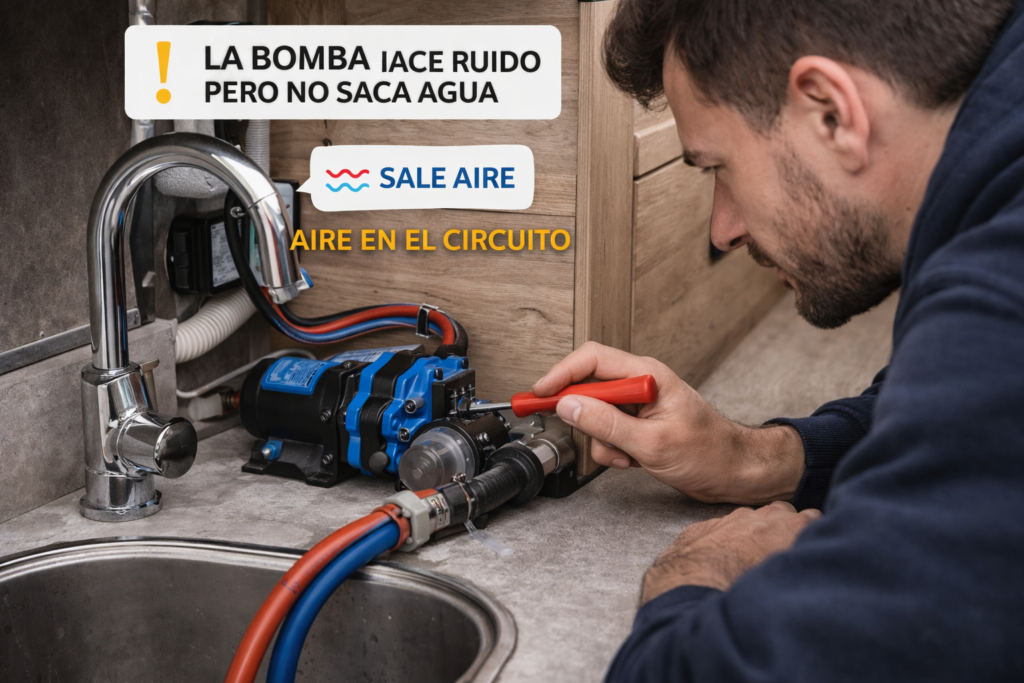
Pump’s running and you can hear it — but air in the circuit means no water actually comes out.
Case B — pump doesn’t run at all
Skip to electrical checks below before touching the plumbing — there’s no point bleeding air out of a pump that has no power.
What the pump looks like — and why it can run fine with zero output
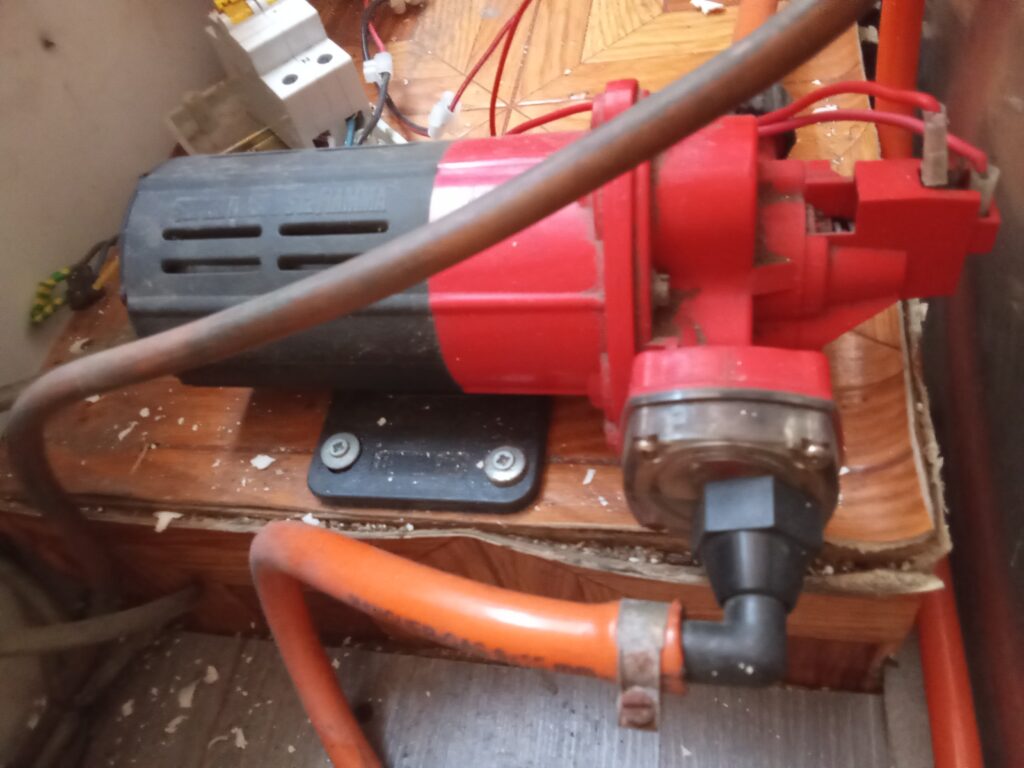
The pump in my Ford Transit conversion — same style covered in this guide.
Most 12V RV pumps are diaphragm pumps: a small motor flexes a diaphragm to push water through one-way check valves. Air is compressible and water isn’t — so if air gets into the chamber, the diaphragm just compresses the air pocket instead of pushing water forward. The pump can run fine, draw normal current, and still deliver nothing.
Typical symptoms
Pump runs continuously without building pressure
Sputtering, then a trickle, then nothing
Pump cycles rapidly even with every tap closed
Loud rattling or grinding noise
One quick manual test: close every tap, then open just one slowly while listening to the pump. If the pump note doesn’t change at all when you open the tap, air is very likely blocking flow rather than the pump being dead.
Most common causes 🔧
Cause
Quick fix
Air trapped in the line (tank ran dry, or after a long drive)
Open a tap, run the pump in short bursts until flow is steady
Pump lost prime
Manually re-prime — see step-by-step below
Air intake at a loose fitting
Soapy water test on suction-side fittings, tighten or reseal
Clogged inlet strainer/filter
Pull, rinse, reinstall
Pump mounted above tank level
Reposition, or use a self-priming model
Step-by-step fix
✔ Confirm the tank actually has water and the intake line is submerged.
✔ Turn off the pump, open the nearest tap fully, and leave it open.
✔ Loosen (don’t fully disconnect) the fitting closest to the pump outlet to let trapped air escape, then re-tighten.
✔ Turn the pump back on with the tap still open — let it run until flow is steady, not just intermittent.
✔ Close the tap slowly and confirm the pump builds pressure and shuts off (doesn’t just run continuously).
✔ Repeat at the next-furthest tap if the first one needed several tries.
If priming doesn’t fix it, move to the filter below, or to electrical checks: verify the fuse at the panel, check for 12V at the pump connector with the switch on, and confirm the pump’s ground connection isn’t corroded — a bad ground reads like a dead pump.
Prevent it from coming back: never let the tank run completely dry with the pump switch on — running dry is what strips the prime and, over time, wears the diaphragm.
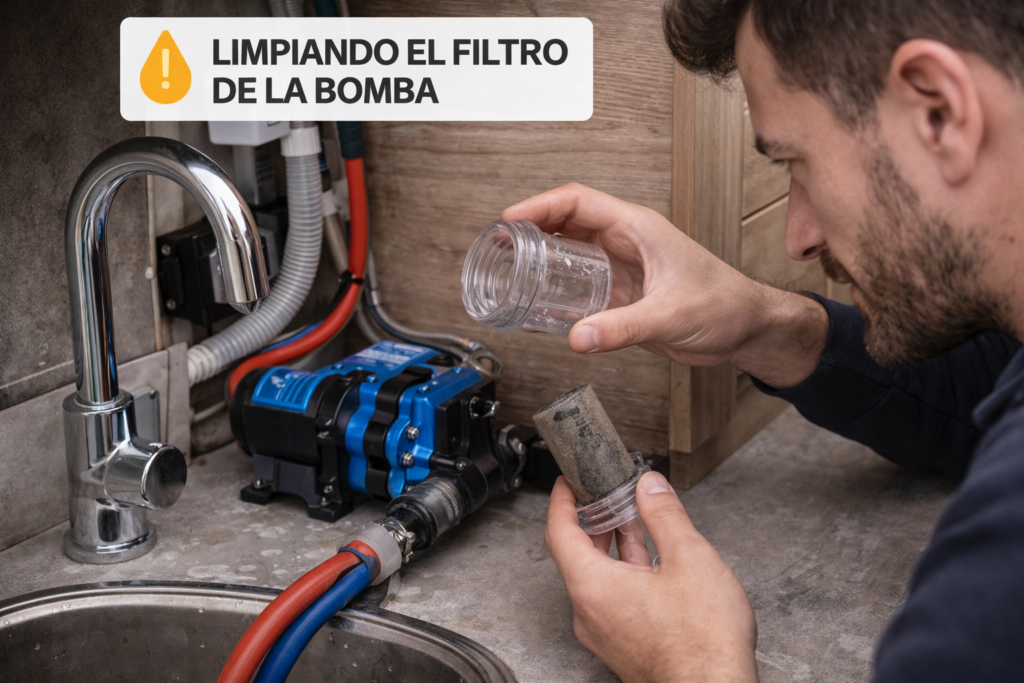
Case 2: the inlet filter
Most pumps have a small inline strainer right before the intake. It’s easy to forget it exists — until sediment from the tank clogs it enough to starve the pump.
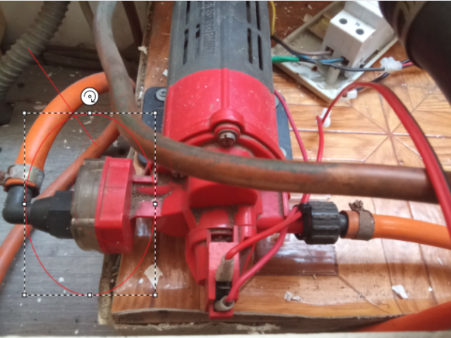
Circled: where the inlet filter sits on the pump — this is the spot to check if flow feels weak.
Symptoms specific to a clogged filter: flow that starts strong and fades within seconds, or a pump that strains audibly under load.
What to check: pull the strainer, rinse it under a tap, and reinstall. If you don’t know where yours is, it’s usually the first fitting after the tank, before the pump housing.
Takes about two minutes: pull the strainer out, rinse it under a tap until the sediment’s gone, and push it back in. If it’s clogged again within a few weeks, the tank itself probably needs cleaning.
Cleaning the pump’s clogged inlet filter — sediment buildup like this is enough to starve the pump of flow.
Related problems that mimic the same symptom
A failing pressure switch can cause identical symptoms to air in the line — the pump cycles or won’t build pressure even with air fully bled. A partially closed tap or a kinked line downstream will also look like a pump fault.
Preventing this long-term
Never run the tank fully dry with the pump on.
Rinse the inlet strainer every few months, more often with well/lake water.
Check hose clamps after long drives — vibration loosens them.
What pump to replace it with, if it’s actually dead
A Seaflo 12V diaphragm pump (1.2 GPM, 35 PSI) covers most single-faucet camper setups without overloading a small battery bank. This is an affiliate link — if you buy through it I earn a small commission, at no extra cost to you.
Conclusion
Nine times out of ten, “the pump isn’t working” is really “there’s air where there should be water.” Bleed it, confirm the fitting isn’t loose, check the filter — and only replace the pump once you’ve ruled those out.
Still stuck?
With submersible pumps and sealed plastic cylinder models — the disposable type with no filter or membrane — the diagnostic margin is short: you can really only check whether they’re getting voltage, and by pulling them out, measure continuity in the coil. Not much else. Still, most of the time the problem isn’t the pump itself but something before it — the fuse, the switch, a connection, or air in the circuit — and that can be figured out remotely. If you’ve tried everything above and you’re still without water, get in touch and I’ll tell you whether it’s something we can solve this way or whether the pump genuinely needs replacing.
Air may have gotten into the pump or the lines, especially if the tank ran completely empty. Check the water level, the connections, the filter, and that no shut-off valve is closed.
Why does the pump make noise but no water comes out?
Usually it’s getting power but can’t draw water. The common causes are air in the circuit, a clogged filter, a misplaced intake, or a small air leak in the suction hose.
What should I check if the pump makes no noise at all?
Check the fuse, the switch, whether voltage is actually reaching the pump, and the connections. If it’s getting the correct voltage and still doesn’t respond, the problem may be the pressure switch or the motor itself.
How do you prime an RV water pump?
Fill the tank properly, open a tap, and run the pump in short bursts until it clears the air. Don’t run it dry for too long — it can overheat or get damaged.
Why does the pump turn on by itself with every tap closed?
This usually points to a pressure loss — a leak, a loose connection, a faulty check valve, or a problem with the pressure switch. Check for dampness around hoses, taps, and connections.
When should you replace the pump?
If it’s getting the correct voltage, the filter is clean, and the circuit has been purged, but it still won’t build pressure, overheats, or makes abnormal noise, it may be worn out. Confirm the fault isn’t the wiring or the pressure switch first.
What type of pump is used in campers?
The most common are diaphragm pressure pumps and submersible pumps. Pressure pumps feed several taps through a pressure switch; submersible units sit inside the tank for a simpler install.
What pressure should a camper water pump run at?
It depends on the taps, water heater, and other components in the system. Don’t install a pump that exceeds what your tubing and fittings are rated for — that’s how you get leaks. Follow the manufacturer’s recommendation for your system.
[…] gets blamed the same way — before you assume the pump is dead, check the wiring first. The water pump troubleshooting guide covers the electrical checks in the “pump doesn’t run at all” […]
[…] → Water pump not working after filling the tank […]
[…] After several months of not being used, my water pump ended up running with a fair amount of air trapped in the line. […]
[…] RV water pump not working? Nine times out of ten it’s air, not the pump. […]

[…] gets blamed the same way — before you assume the pump is dead, check the wiring first. The water pump troubleshooting guide covers the electrical checks in the “pump doesn’t run at all” […]
[…] → Water pump not working after filling the tank […]
[…] After several months of not being used, my water pump ended up running with a fair amount of air trapped in the line. […]
[…] RV water pump not working? Nine times out of ten it’s air, not the pump. […]